LuxSci

New Reporting Features Go Deeper on Email Deliverability Statistics, Trends and Analysis

LuxSci Secure Email Reporting Statistics

We recently rolled out new email reporting features, taking deliverability depth and analysis to new levels. If you’re a current LuxSci customer and haven’t checked them out, now’s the time. If you’re new to LuxSci, learn more below, and don’t hesitate to reach out for more info – or a demo.

LuxSci secure communications solutions have always featured rich reporting on email deliverability, including volumes and percentages for emails:

  • in queue
  • opened
  • clicked
  • failed
  • secured

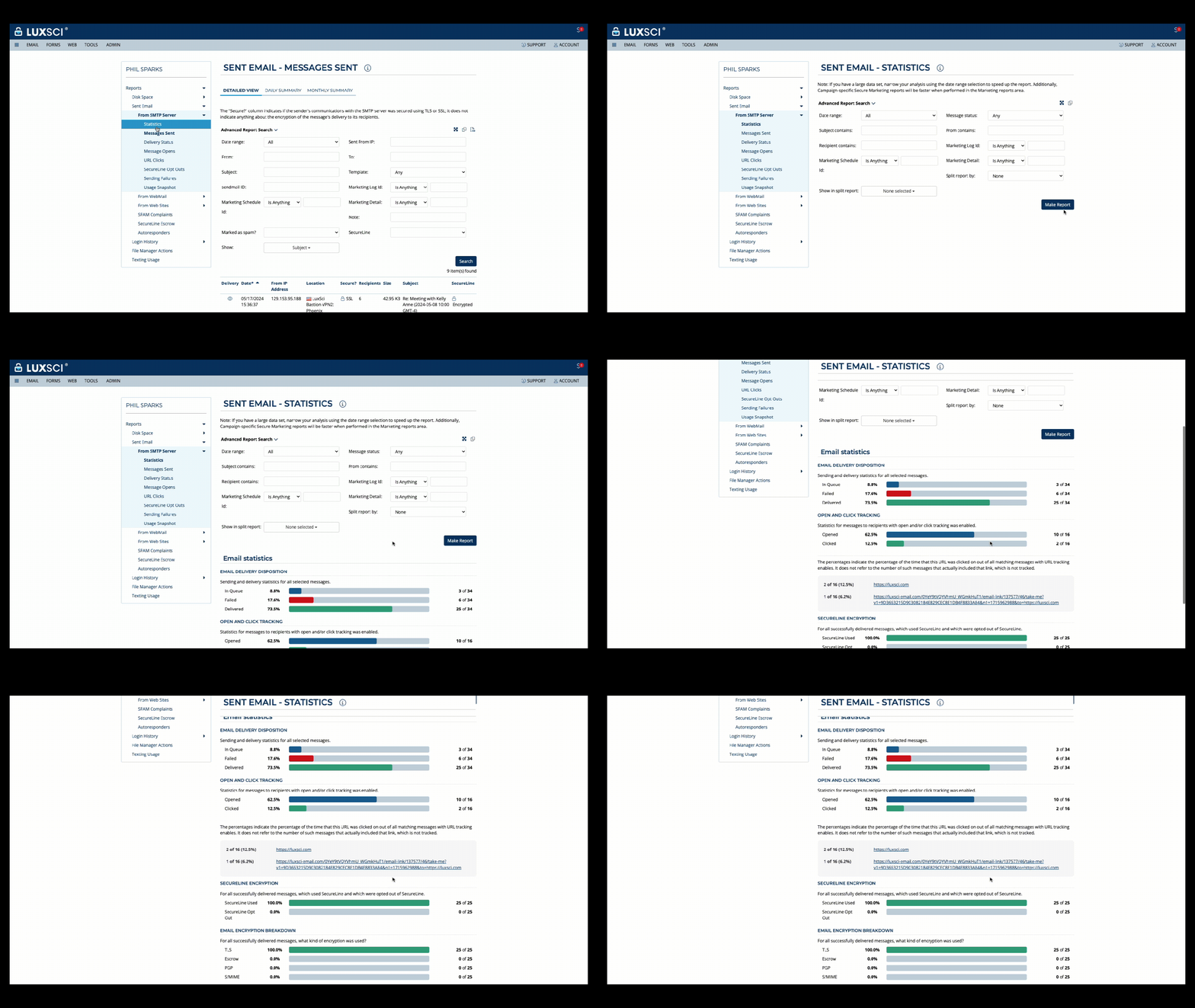
With our latest release, we made these powerful statistics easier to consume and analyze with an improved user interface for more efficiency and greater ease-of-use. Users can simply select the type of report they’d like and customize it using a range of filtering selections. This is great for diving deeper into your email performance to make adjustments on-the-fly, and to spot trends or opportunities for better engagement that you may have missed before.

New UI – Email Deliverability Statistics

LuxSci Secure Email Reporting Statistics

Get more granular, ID trends in real time with Split Reporting

As part of this release, we are pleased to introduce our Split Reporting feature, which empowers users to drill down on email deliverability statistics across a range of parameters, including:

  • subject
  • from address
  • recipient domains
  • marketing ID or campaign
  • custom field

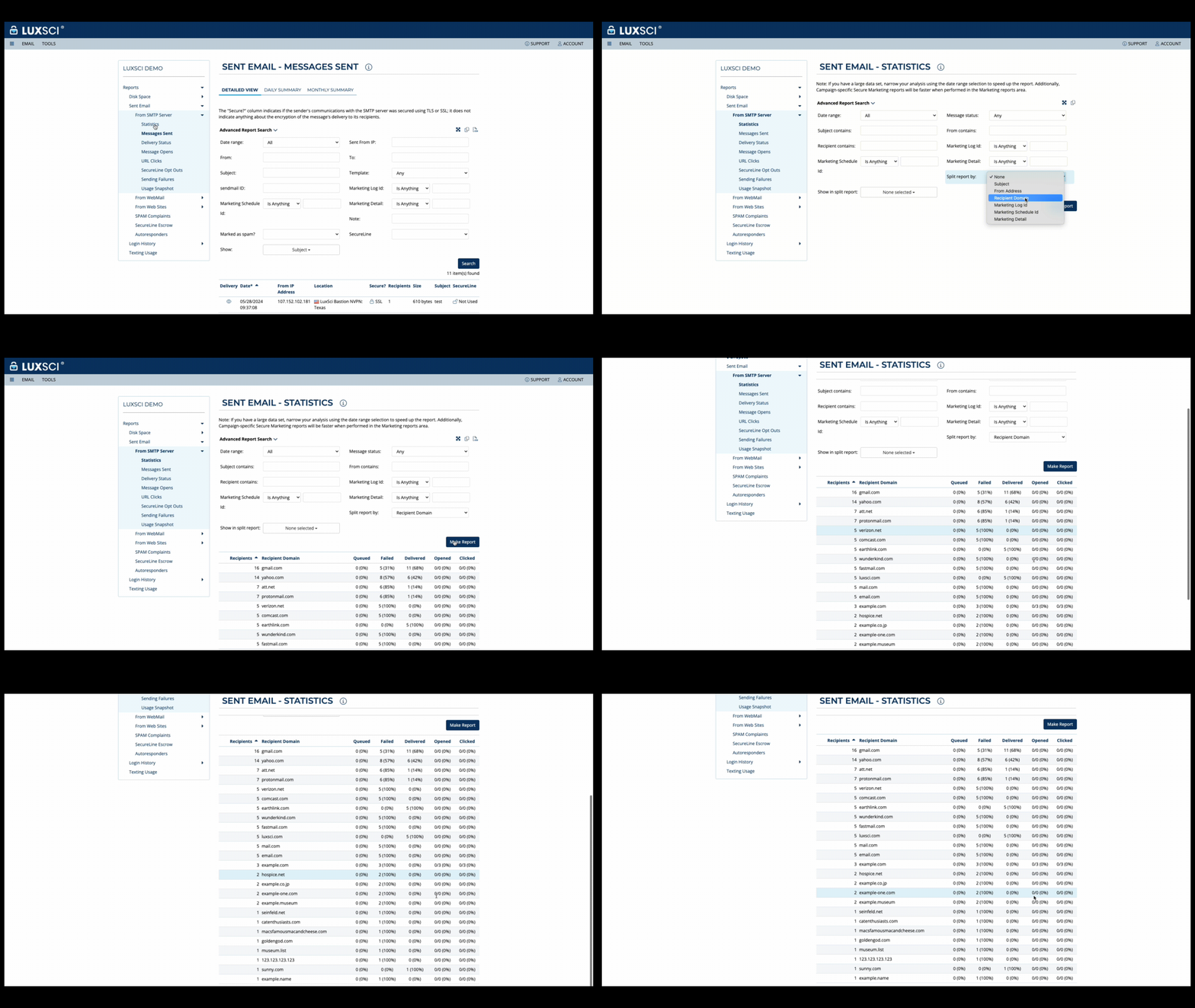
For example, users can analyze email deliverability statistics by subject to determine which ones are performing best, by use case to track results by campaign, or to track performance by recipient email domains. With split reporting, users also can analyze email volumes across queued, delivered, opened, failed and clicked parameters, and determine click-through rates (CTR) to measure effectiveness and ROI of campaigns.

New Feature Example – Split Reporting by Recipient Domain

LuxSci Secure Email Split Reporting

If you’d like to learn more, reach out and connect with us today!


Picture of LuxSci

LuxSci

Get in touch

Find The Best Solution For Your Organization

Talk To An Expert & Get A Quote


A member of our staff will reach out to you

Get Your Free E-Book!

LuxSci High Email Deliverability Best Practices Paper

What you’ll learn:

Related Posts

What Is B2B Marketing in Healthcare?

B2B marketing in healthcare describes the promotion of products and services to healthcare businesses rather than to patients or the public. The audience can include provider groups, payers, laboratories, medical suppliers, health technology firms, and service companies working across the sector. The work calls for a more measured approach than many other business categories because buying decisions tend to involve several stakeholders, internal review, and close attention to data handling, workflow impact, and commercial fit. Good execution depends on clear communication, useful content, and a strong sense of how healthcare organizations evaluate change.

Why healthcare buying requires a different approach

Healthcare companies rarely move through a buying process in a straight line. One person may open the conversation, though several others can influence whether it goes any further. Finance may want a clearer commercial case. Operations may focus on staffing, efficiency, and implementation pressure. IT may look at access, system fit, and data management. Compliance teams may review privacy implications or contractual language. B2B marketing in healthcare works better when the writing reflects those realities early. Buyers are looking for material that helps them assess risk, discuss options internally, and move forward with fewer unanswered questions.

A Difference in stakeholder priorities

A single account can contain several audiences at once. That is part of what makes this area demanding. A hospital operations leader may care about throughput and day to day workflow. A payer executive may be more interested in administrative efficiency or review times. A supplier may focus on coordination, ordering processes, or communication across partner relationships. Content becomes stronger when it takes those different perspectives seriously. The message does not need to become overly technical. It needs enough accuracy and relevance for each reader to feel that the company understands the conditions attached to their role.

Why credibility matters in every channel

Healthcare buyers tend to read promotional material carefully. They notice vague claims, inflated language, and unsupported promises very quickly. That is why credibility has to be built into the writing itself. A clean explanation of a business problem can carry real weight. A grounded case example can help a reader picture how a solution would work in practice. Clear language around implementation, support, privacy, or service structure can also help keep the conversation moving. When protected health information enters the picture, HIPAA may become part of the review as well, especially for companies handling regulated data or supporting covered entities and business associates.

Content to support real decisions

The most useful assets in this space are the ones that help buyers think more clearly. An article can frame a problem in a way that supports internal discussion. An email sequence can keep a company visible while review is taking place. A service page can answer practical questions before a meeting is booked. B2B marketing in healthcare gains traction when content has a clear job and a clear reader. That focus usually produces stronger engagement than broad copy built around generic thought leadership language. Buyers respond well to material that respects their time and gives them something worth passing along.

What strong performance looks like

Success in healthcare is rarely captured by surface numbers alone. Traffic and opens may show that content has reached people, though those signals do not say much on their own about buying intent. Better indicators include repeat visits from the same organization, replies from relevant contacts, deeper engagement with security or implementation pages, and growing activity across several stakeholders in one account. Those patterns can tell commercial teams where interest is becoming more serious. B2B marketing in healthcare proves its value when it helps those teams follow up with better timing, better context, and material that fits the next stage of evaluation.

What Is B2B Medical Marketing?

B2B medical marketing is the promotion of products and services to medical organizations, rather than to patients or general consumers. The audience can include provider groups, laboratories, payers, health technology companies, medical manufacturers, and service firms that sell into the healthcare space. The work involves more scrutiny than many other business sectors because buying decisions are reviewed through operational, financial, legal, and data related lenses. That environment shapes the way messages are written, the way proof is presented, and the pace at which commercial relationships develop.

Where B2B medical marketing fits in healthcare

Medical companies rarely buy on impulse. A new platform, service, or product may affect staff workflows, procurement planning, record handling, contract review, or coordination between teams. For that reason, B2B medical marketing sits close to the practical side of business decision making. Good content helps a buyer assess whether something will work inside an existing organization. It gives shape to the problem, explains the offer in plain terms, and provides enough context for internal discussion. In a medical setting, that matters because a single contact may show interest while several others influence whether the conversation continues.

Why the buying process feels slower

The pace of healthcare purchasing can frustrate vendors that are used to quicker decisions. Interest does not always translate into movement because the next step may depend on approval from finance, operations, IT, procurement, or compliance. Each group reads with a different priority in mind. An operations lead may look for staffing impact. An IT team may focus on access controls, system fit, and data use. Finance may ask whether the commercial case is persuasive enough to justify more review. B2B medical marketing works best when content reflects those realities from the start. Messages that feel rushed or overwritten tend to lose ground early.

Trust and proof carry weight

Medical buyers are used to reading claims with care. They want to know what the service does, how it fits into day to day work, and what kind of burden it may place on the people using it. That is why trust has to be earned through the material itself. Clear examples help. Credible case studies help. Sound explanations of process, security, implementation, or support also help because they answer the questions serious buyers are already asking. When privacy or protected health information enters the picture, references to HIPAA and related data handling expectations may also become part of the evaluation. B2B medical marketing gains traction when the language sounds careful, informed, and accountable on every page.

Content needs a job to do

A medical buyer reading an article, email, or landing page is usually looking for something useful rather than something flashy. The content may need to explain a workflow issue, support an internal conversation, prepare a reader for a product discussion, or clarify how a service would be introduced. That practical role should shape the writing. B2B medical marketing is stronger when each asset has a clear purpose and a clear reader. One article may help an operations contact define a bottleneck. Another may help a compliance stakeholder understand how data is handled. Another may give procurement a cleaner view of scope and process. Content works harder when it can travel inside the account and still make sense to the next person who reads it.

What good measurement looks like

Performance in this area is not captured by one metric. Page views and open rates may show that something has attracted attention, though they do not say much on their own about buying intent. Better signs come from repeat visits from the same account, deeper engagement with implementation or security pages, replies from people with decision making authority, and movement from light interest to active review. B2B medical marketing earns its value when it helps commercial teams see where attention is turning into evaluation. That is where better timing, stronger follow up, and sharper account insight begin to matter.

Zero Trust Email Security in Healthcare

Zero Trust Email Security in Healthcare: A Requirement for Sending PHI?

As healthcare organizations embrace digital patient engagement and AI-assisted care delivery, one reality is becoming impossible to ignore: traditional perimeter-based security is no longer enough. Email, still the backbone of patient and operational communications, has become one of the most exploited attack surfaces.

As a result, Zero Trust email security in healthcare is moving from buzzword to necessity.

At LuxSci, we see this shift firsthand. Healthcare providers, payers, and suppliers are no longer asking if they should modernize their security posture, but how to do it without disrupting care delivery or patient engagement.

Our advice: Start with a Zero Trust-aligned dedicated infrastructure that puts you in total control of email security.

Let’s go deeper!

What Is Zero Trust Email Security in Healthcare?

At its core, Zero Trust email security in healthcare applies the principle of “never trust, always verify” to every email interaction involving protected health information (PHI).

This means:

  • Continuous authentication of users and systems
  • Device and environment validation before granting access
  • Dynamic, policy-based encryption for every message
  • No implicit trust, even within internal networks

Unlike legacy approaches that assume safety inside the network perimeter, Zero Trust treats every email, user, and endpoint as a potential risk.

Why Email Is a Critical Gap in Zero Trust Strategies

While many healthcare organizations have begun adopting Zero Trust frameworks for network access and identity, email often remains overlooked.

This is a major problem.

Email is where:

  • PHI is most frequently shared
  • Human error is most likely to occur
  • Phishing and impersonation attacks are most effective

Without a Zero Trust email security approach, organizations leave a critical gap in their defense strategy, one that attackers can actively exploit.

Healthcare Challenge: Personalized Communication and PHI Risk

Modern healthcare ecosystems are highly distributed:

  • Care teams span multiple locations
  • Third-party vendors access sensitive systems
  • Patients expect digital, personalized communication

This creates a complex web of PHI exchange—much of it through email.

At the same time, compliance requirements like HIPAA demand that PHI email security is addressed at all times.

The result is a growing tension between:

  • Security and compliance
  • Usability, engagement, and better outcomes

From Static Encryption to Intelligent, Adaptive Protection

Traditional email encryption methods often rely on:

  • Manual triggers
  • Static rules
  • User judgment

This introduces risk. A modern zero trust email security in healthcare model replaces this with:

  • Automated encryption policies based on content and context
  • Flexible encryption methods tailored to recipient capabilities – TLS, Portal Fallback, PGP, S/MIME
  • Seamless user experiences that human error – automated email encryption, including content

At LuxSci, our approach to secure healthcare communications is built around this philosophy. By automating encryption and providing each customer with a zero trust-aligned dedicated infrastructure, organizations can protect PHI without relying on end-user decisions or the actions of other vendors on the same cloud, significantly reducing risk while improving performance, including email deliverability.

Aligning Zero Trust with HIPAA and Emerging Frameworks

Zero Trust is not a replacement for compliance, it’s an enabler. A well-implemented Zero Trust approach helps organizations:

  • Meet HIPAA requirements for PHI protection
  • Reduce the likelihood of breaches
  • Strengthen audit readiness and risk management

More importantly, it positions healthcare organizations to align with emerging cybersecurity frameworks that increasingly emphasize identity, data-centric security, and continuous verification.

PHI Protection Starts with Email

Zero Trust is no longer a conceptual framework, it’s becoming the operational standard for healthcare IT, infrastructure, and data security teams.

But success depends on execution. Email remains the most widely used, and vulnerable, communication channels in healthcare. Without addressing it directly, Zero Trust strategies will fall short.

Here are 3 tips to stay on track:

  • Treat every email as a potential risk
  • Automate encryption at scale – secure every email
  • Enable personalized patient engagement with secure PHI in email

At LuxSci, we believe that HIPAA compliant email is the foundation for the future of secure healthcare communications, protecting PHI while enabling better patient engagement and better outcomes.

Reach out today if you want to learn more from our LuxSci experts.

What Sets B2B Marketing In The Healthcare Industry Apart?

B2B marketing in the healthcare industry runs through a buying environment shaped by review, caution, and internal scrutiny. A vendor may catch interest quickly, yet a deal still has to survive procurement, legal input, operational questions, and, in some cases, clinical oversight. That changes the tone and structure of effective outreach. Buyers want clear information, credible framing, and content that holds up when shared across teams. Strong campaigns account for those conditions from the first touch, giving decision makers useful material at the right point in the conversation.

How B2B marketing in the healthcare industry differs from other sectors

Healthcare buying carries a heavier internal burden than many commercial categories. A decision can affect patient related workflows, staff time, data handling, vendor risk, and budget planning all at once. That wider impact shapes how people read. A finance lead may scan for commercial logic and resource use. An operations leader may think immediately about rollout pressure and process disruption. An IT contact may focus on access, integration, and control. Messaging has to stand up to each of those viewpoints. That is why strong healthcare outreach tends to move with more restraint, more clarity, and more attention to proof than campaigns built for faster sales environments.

Trust within B2B marketing in the healthcare industry

Trust grows through judgment on the page. Buyers notice inflated language very quickly, especially when it appears in sectors where risk and accountability are part of everyday work. A polished headline can attract attention, though the body copy still has to carry weight. Clear examples help. Plain explanations help. So does a tone that sounds measured enough for someone to forward internally without hesitation. A payer team may want to see how a service affects review speed or administrative flow. A provider group may care about intake, coordination, or staff workload. A supplier may look for signs that communication across partners will become smoother and easier to manage. Credibility builds when the writing shows a close read of the reader’s world.

Buying committees do not think alike

Most healthcare deals are shaped by several people with different pressures attached to their roles. Procurement may be looking for vendor reliability and a smoother approval process. Compliance may read for privacy exposure and documentation. Operations may focus on practical fit with current workflows. Finance may want a clearer commercial case before the conversation goes any further. Those concerns do not compete with one another so much as stack on top of one another, which is why broad messaging tends to flatten out. Better campaigns anticipate that mix. One sequence can speak to efficiency and team workload. Another can support legal and compliance review. A third can frame the economic rationale in language senior stakeholders will recognise immediately.

Content that helps a deal move

Healthcare content earns its place when it gives buyers something they can use, discuss, and circulate. A short article on referral bottlenecks can help an operations lead frame the problem more clearly. A concise guide to secure communication can help internal teams ask better questions during review. A comparison page on implementation models can help a buyer weigh practical tradeoffs before a call is even booked. Useful content creates momentum because it fits the way decisions are made. It enters the conversation early, gives people sharper language for internal discussion, and keeps the subject alive between meetings. That is where strong work starts to separate itself from content written simply to fill a calendar.

Measuring progress with better signals

Healthcare teams get a clearer picture when they look past surface numbers and pay attention to the signs attached to real interest. Repeat visits from the same account can matter more than a large burst of low value traffic. A reply from an operations contact may tell you more than a high open rate. Visits to implementation, privacy, or procurement pages can indicate that the discussion is moving into a more serious stage.

Patterns like these help commercial teams judge where attention is gathering and where timing is starting to matter. Good B2B marketing in the healthcare industry supports that process by creating sharper entry points for sales, stronger context for follow up, and a more informed path from early curiosity to active evaluation.

You Might Also Like

Google Business Email HIPAA Compliant

Understanding Business Associate Agreements (BAAs) and Shared Responsibility

Modern-day healthcare organizations rely on a growing array of partners and vendors to provide them with the tools they need to effectively serve patients and customers.

However, while new digital solutions and healthcare ecosystems often result in greater productivity and efficiency, they also increase the number of third parties a company must communicate with and share protected health information (PHI), requiring a business associate agreement (BAA). Unfortunately, this increases the risk of PHI being exposed, as it increases a healthcare organization’s supply chain network and the number of external organizations with access to their data, significantly raising the risk of a security breach.

This is where the concept of shared responsibility comes in.

In this article, we explore the shared responsibility model for data security, explaining the concept, the role of a BAA in shared responsibility, and why healthcare companies need to know how it works and where it factors into their HIPAA compliance efforts. 

What Is The Shared Responsibility Model? 

Shared responsibility is a core data security principle that divides the responsibility for protecting data between a company that collects the data and a vendor that supplies the infrastructure or systems used to process said data.

The shared responsibility model grew in prominence as more companies moved to cloud-based environments and applications. In the past, when companies kept their systems and data onsite, they had more control over who could access their data and, subsequently, a better ability to mitigate data security risks.

However, in adopting cloud-based infrastructure and applications, companies have to process and store their data in the cloud – often in shared infrastructure with other vendors using the same cloud – which consequently shifts some of the responsibility of information security to the cloud service provider (CSP) itself. This marked a profound shift in the way data was handled, transmitted, and stored – necessitating an evolved approach to data security.

This fundamental shift in the way companies consume infrastructure and use apps ushered in the shared responsibility model: Where the cloud vendor provides the infrastructure or application, including HIPAA compliant and high secure environments, but it’s still the responsibility of the client to configure and use it securely. 

Business Associate Agreements (BAAs) and Shared Responsibility

By detailing the respective responsibilities of healthcare companies or Covered Entities (CEs) and their vendors or Business Associates (BAs) in securing PHI, a Business Associate Agreement is a prime example of shared responsibility.

For example, the Business Associate shoulders the responsibility of providing the data safeguards required by HIPAA to secure patient data, such as infrastructure, encryption, audit logging, and even physical onsite security.

The Covered Entity, meanwhile, is responsible for conducting risk assessments, defining access control policies and processes, configuring services accordingly, workforce training, and continuous monitoring.

Additionally, both parties have the obligation to report security incidents to each other, as well as being independently accountable to the U.S. Department of Health and Human Services (HHS).

Why Shared Responsibility Is Essential for HIPAA Compliance

For healthcare companies, having a firm grasp of the shared responsibility model for safeguarding and securing PHI, and how they fit within your overall security posture is essential (for two key reasons).  

Security Gaps

Firstly, clearly understanding the shared responsibility decreases the likelihood of security gaps. If CEs are under the impression that the vendor handles all aspects of data security, they won’t be as vigilant. They’ll be less inclined to configure services, educate their staff accordingly, pay appropriate attention to vendor security alerts, etc.

But the same is also true for BAs: If they assume their client does most of the heavy lifting in securing the data disclosed to them, they could be remiss in their duties to protect it. Without shared responsibility, each side simply assumes the other is covering a safeguard, opening the door for security gaps that malicious actors can exploit.

Fortunately, by detailing both parties’ (CEs and BAs) responsibilities and liabilities regarding data protection, a BAA removes this ambiguity and, more importantly, reduces the risk of security gaps. It’s critical to know the details and work with vendors building products for compliance versus implementing a tick-box approach to compliance that places too much burden on the CE.

Covered Entities (CEs) Are Ultimately Accountable

Subsequently, the second reason why it’s essential for CEs to understand the shared responsibility model, and increase their cybersecurity readiness accordingly, is that it’s the CE that’s ultimately held accountable for data breaches.

Mistakenly thinking that a BAA automatically makes them compliant may result in healthcare companies underinvesting in training, monitoring, and incident response. Conversely, understanding that even with a BAA in place, they’re the ones primarily accountable for protecting PHI gives them a greater sense of urgency to properly implement HIPAA compliant security measures. 

The Covered Entity’s Role Within Shared Responsibility

Let’s look at the ways that healthcare companies have to hold up their end in the shared responsibility model. 

Choose Compliance-Conscious Vendors 

First and foremost, companies have to choose the right vendors to supply them with HIPAA compliant services and solutions.

Look for companies that market themselves as HIPAA compliant and display a detailed understanding of HIPAA requirements, particularly the HIPAA Security Rule. Do your due diligence and perform deeper dives on potential vendors, researching their stated security features, reviews from existing clients, whether they have certifications like HITRUST – and if they’ve been involved in any data breaches.

Naturally, a core prerequisite of being a HIPAA compliant vendor is being willing to sign a BAA, so you can immediately rule out any vendors not willing to do so. For instance, some healthcare companies may assume they can use widely adopted solutions such as SendGrid, Mailchimp, but they don’t offer a BAA.

Once you’ve confirmed a vendor offers a BAA, look through it to establish its terms and determine if it covers the services you’re interested in. 

Configuration 

Another core component of shared responsibility is comprehensive configuration management. While the BA’s responsibility is to provide a secure solution that satisfies HIPAA requirements, it’s the CE’s responsibility to configure it securely to fit within their IT ecosystem. 

Features that often require configuration include: 


  • Access control: Role-based access, Zero Trust, Multi-Factor Authentication (MFA).
  • Encryption settings: Enabling encryption, choosing encryption type, enforcing forced TLS, enabling storage encryption.
  • Feature restrictions: Disabling default configurations that enable integration with non-compliant tools. 
  • Audit logging: Enabling audit logging and configuring log formats.
  • Retention settings: How long to retain audit logs and who is permitted to review them.

Finally, establishing a patch management strategy, i.e., when and how your organization applies software updates, is an important element of configuration.  While the vendor must release updates to fix security vulnerabilities discovered in their solutions, it’s up to healthcare companies to deploy the patches. 

Training

Regardless of how many security features a vendor bakes into their solutions, once deployed by a healthcare company, the tool is only as secure as the practices of their least security-conscious employee. Consequently, companies must train their staff on how to properly use a solution to process protected health information and sensitive data. The more an employee is required to handle PHI, the more thorough and frequent their training should be.

Key aspects of comprehensive cybersecurity training include:

  • Common cyber threats: what the most prevalent cyber threats are and how to recognize them.
  • Incident response: how to report a suspected security incident, i.e., who to contact and when. 
  • Specific solution training: how to securely use systems that process PHI
  • Scope awareness: knowing which services within your organization’s IT ecosystem are HIPAA-compliant and which are not

Reporting 

Although both healthcare companies and BAs have notification obligations to the HHS in the event of a data breach involving PHI, it’s the CE that bears most of the investigative burden.

Firstly, while a BA may report a security incident, it’s the CE’s responsibility to conduct a risk assessment to determine the probability of compromise of PHI, assess risk, and determine whether an official notification of a breach to HHS is necessary.

Secondly, BAs must notify the CE without unreasonable delay and no later than 60 days after discovery. Although BAs often wait to complete internal investigations before notifying the CE, the CE’s 60-day clock starts upon the BA’s discovery, not upon the BA’s report. Therefore, BA delays can create compliance risks for the CE.

To prevent this, where possible, you can include stricter contractual reporting timelines in the BAAs. This constantly keeps your company in the loop, ensuring you have sufficient lead time to complete your own investigations and your HIPAA-regulated deadlines.

LuxSci – Secure Healthcare Communications

Developed specifically to fulfil the stringent regulatory and ever-evolving data security needs of the healthcare sector, LuxSci’s secure email, text, marketing and forms solutions help companies protect PHI and personalize communications.

Equally as importantly, instead of leaving you to “figure it out” – pushing additional responsibility back onto your company – LuxSci has a reputation for the best customer support in the business, offering onboarding, detailed documentation, secure default configurations, and ongoing support to help navigate the murky waters of HIPAA compliance, while getting best-in-class performance out of your solution.

Contact LuxSci today to learn more or get a demo.

HIPAA Marketing Compliance

What Are the HIPAA Marketing Compliance Requirements?

HIPAA marketing compliance requires healthcare organizations to obtain written patient authorization before using protected health information for promotional communications, with strict exceptions for treatment communications, appointment reminders, and health-related benefits descriptions. Organizations must distinguish between permissible healthcare operations communications and restricted promotional activities, ensuring that any PHI used for advertising purposes receives explicit patient consent through properly executed authorization forms that detail the intended use, recipients, and patient rights.

Healthcare organizations tend to struggle with the boundary between acceptable patient communications and prohibited promotional activities. Marketing materials that reference patient experiences, treatment outcomes, or demographic information without proper authorization create immediate HIPAA marketing compliance violations.

Authorization Requirements & Marketing Boundaries

Written patient authorization must precede any use of PHI for promotional purposes, including testimonials, case studies, or targeted advertising campaigns. These authorization forms must specify the exact information to be used, identify recipients of the promotional materials, and explain the patient’s right to revoke consent at any time. Healthcare organizations cannot condition treatment or payment on patients providing authorization for promotional activities.

Authorization forms require language elements including expiration dates, patient signature requirements, and clear descriptions of how PHI will be used in promotional contexts. Organizations must maintain signed authorization documents and respect revocation requests immediately upon receipt, stopping all ongoing promotional activities involving that patient’s information.

Treatment Communications Receive Different Standards

Healthcare organizations can communicate directly with patients about treatment alternatives, appointment scheduling, and health-related services without obtaining separate authorization. These communications fall under treatment or healthcare operations rather than promotional activities, allowing providers to send appointment reminders, medication adherence information, and preventive care notifications without additional consent.

Communications that promote third-party products, include financial incentives for referrals, or advertise non-medical services require authorization even when sent to existing patients. Organizations must evaluate each communication to determine whether it serves legitimate healthcare purposes or constitutes promotional activity requiring consent.

Third-Party Vendor Relationships Create Additional Obligations

BAAs with promotional vendors must address PHI handling requirements and specify permitted uses of patient information. Vendors creating promotional materials, managing patient communications, or analyzing treatment data for promotional purposes need appropriate legal frameworks governing their access to protected information.

Healthcare organizations are liable for vendor compliance failures, making careful selection and monitoring of promotional partners essential. Contracts must include breach notification procedures, data destruction requirements, and audit rights to ensure HIPAA marketing compliance with patient information protection standards.

Challenges of Digital Advertising Platforms

Social media advertising, email campaigns, and online promotional activities often involve sharing patient data with technology platforms that may not meet HIPAA requirements. Healthcare organizations must avoid uploading patient contact lists, demographic information, or treatment details to advertising platforms without proper authorization and business associate agreements.

Retargeting campaigns that track patient website visits or online behavior require careful evaluation to ensure no PHI is shared with advertising networks. Organizations should implement protections to prevent accidental transmission of patient information through website analytics, social media pixels, or advertising platform integration.

Patient Testimonials and Case Studies

Using patient stories, photographs, or treatment outcomes in promotional materials requires detailed authorization forms that specify exactly how patient information will be used. These authorizations must address potential future uses, distribution channels, and the duration of consent to prevent compliance violations when promotional materials are repurposed or distributed broadly.

De-identification of patient information offers an alternative to authorization but requires removing all identifying elements according to HIPAA standards. Organizations must ensure that demographic information, treatment dates, and outcome details cannot be combined to identify patients when creating promotional case studies or success stories.

Staff Training & HIPAA Marketing Compliance Violations

Employees involved in promotional activities need training on distinguishing between permissible healthcare communications and restricted promotional activities. Staff must understand authorization requirements, recognize when business associate agreements are necessary, and identify situations requiring legal review before implementing promotional campaigns.

Training updates address new promotional channels, new technology platforms, and changing regulatory interpretations of HIPAA requirements. Organizations should establish clear approval processes for promotional materials and designate compliance personnel to review campaigns before launch.

Common Violations

Recent OCR enforcement cases display the penalties incurred for using patient information in promotional materials without authorization, sharing PHI with advertising vendors without business associate agreements, and failing to honor patient requests to opt out of promotional communications. These violations result in significant financial penalties and corrective action requirements.

Healthcare organizations face scrutiny of their promotional activities, particularly digital advertising campaigns and patient outreach programs. Compliance programs must include audits of promotional materials, vendor relationships, and patient authorization procedures to identify and address potential violations before they result in enforcement actions.

Google Business Email HIPAA Compliant

Is Google Business Email HIPAA Compliant?

Yes, Google business email HIPAA compliant configurations are possible when organizations use Google Workspace with the correct security settings and a signed Business Associate Agreement. Compliance is not automatic, but when these measures are in place, the service can meet the requirements of the HIPAA Privacy and Security Rules. Healthcare organizations must manage configuration, user access, and training carefully to ensure that patient information stays protected at every stage of communication.

What makes google business email HIPAA compliant

HIPAA compliance depends on how technology is managed rather than the software alone. To make Google business email HIPAA compliant, administrators must operate within Google Workspace, not personal Gmail accounts. The business version supports encryption, administrative controls, and account management tools required for compliance. These controls must be configured properly, as Google provides the infrastructure but not the operational responsibility. The healthcare provider remains accountable for applying the necessary privacy and security standards outlined in federal regulations.

The BAA requirement

Before transmitting any Protected Health Information, organizations must obtain a Business Associate Agreement from Google. This document outlines the obligations of both parties for data protection and incident response. Without this signed agreement, google business email HIPAA compliant status cannot be achieved. The agreement extends to core Workspace services such as Gmail, Drive, and Calendar, but not every Google product. Administrators should verify which applications are covered and restrict use of any tools that fall outside the agreement to avoid accidental exposure of patient information.

Security settings that support compliance

Technical safeguards determine whether a system can function securely under HIPAA. Encryption, authentication, and retention policies are essential components of making google business email HIPAA compliant. Messages are protected in transit, while access controls restrict visibility to approved users. Two-step verification strengthens account protection by confirming identity through a secondary method. Administrators should also apply message retention policies that align with the organization’s data handling procedures. These combined measures form a secure framework that meets the confidentiality and integrity standards required for healthcare communication.

Managing user behavior and internal policies

Technology alone does not ensure compliance. Staff must understand how to handle Protected Health Information responsibly within the system. Clear internal policies should explain what qualifies as sensitive data, when encryption is required, and how to report suspected security incidents. Regular training sessions reinforce best practices and reduce the likelihood of human error. With consistent oversight, administrators can confirm that google business email HIPAA compliant configurations continue to operate safely as staff roles or workflows evolve.

Limitations of using google business email

Although Google Workspace supports compliance, it has specific limitations. Some applications included in the Workspace suite are excluded from the Business Associate Agreement. Features such as predictive text or external add-ons may store fragments of data in ways that are not covered by HIPAA. Organizations must review each connected service carefully before treating it as google business email HIPAA compliant. Understanding these restrictions avoids accidental policy violations and prevents data from leaving secure environments.

HIPAA compliance is a continuous process. Administrators should review access logs, message reports, and account activity within the Workspace dashboard. Google’s built-in tools make it possible to track login attempts, device connections, and encryption status. Consistent monitoring ensures that google business email HIPAA compliant systems maintain their protections as new users are added or as policies change. Routine reviews also provide documentation to support compliance audits and inspections.

Evaluating when Google Workspace is appropriate

Google Workspace can suit healthcare organizations that value scalability, cost efficiency, and ease of management. Smaller clinics often appreciate the familiar interface, while larger systems benefit from centralized controls and user management. However, successful implementation depends on how well an organization applies its own privacy framework. Facilities that already have clear compliance policies find it easier to keep google business email HIPAA compliant. Others may need outside expertise to establish proper safeguards before handling Protected Health Information.

Healthcare organizations can also explore dedicated email systems designed specifically for compliance. These services often include automatic encryption and audit-ready logs by default. Google Workspace offers flexibility and broad integration, while specialized platforms provide focused simplicity. Each option can achieve compliance when managed correctly. The choice depends on how much customization an organization is prepared to maintain and the level of internal IT support available to sustain it.

Practical guidance for healthcare administrators

Before using Google Workspace to store or send Protected Health Information, administrators should follow a defined checklist. Obtain the Business Associate Agreement, enable two-step verification, restrict external sharing, and verify encryption in transit. Review covered applications, disable unsupported tools, and train users on secure communication practices. Regular monitoring keeps the system current with security policies. When these steps are followed carefully, google business email HIPAA compliant configurations provide a secure and efficient environment for healthcare communication.

Mailchimp HIPAA compliant

Is Mailchimp HIPAA Compliant?

The question “Is Mailchimp HIPAA-compliant?” has echoed across healthcare companies and organizations countless times. Whenever they explore their options for email automation and marketing software, the popular provider’s name tends to be one of the first to pop up.

Offering an integrated email marketing solution that enables businesses to streamline how they connect with their customers, Mailchimp has long been the go-to option for companies looking to improve their engagement efforts.

With healthcare organizations using the platform to distribute emails, send newsletters, share content on their social channels, track their results and more, it’s only natural that these companies are also wondering whether Mailchimp HIPAA-compliant bulk email is possible.

IS MAILCHIMP HIPAA COMPLIANT?

Unfortunately, the answer will disappoint many in the healthcare sector, as well as other businesses and companies that deal with electronic protected health information (ePHI): Mailchimp is not HIPAA-compliant.

Despite this, however, the platform does have some promising security features and policies that make it seem as though Mailchimp could be a HIPAA-compliant marketing email option, including:

Now, while these security features are certainly encouraging, there is a significant omission that prevents Mailchimp from being a HIPAA-compliant email provider.

MAILCHIMP: NO BUSINESS ASSOCIATE AGREEMENT 

According to the HIPAA Privacy Rule, “A business associate is a person or organization that performs certain functions or activities that involve the use or disclosure of protected health information (PHI) by a covered entity”.

In the context of a HIPAA-compliant email provider, Mailchimp would be the business associate and the healthcare organization would be the covered entity.

Subsequently, a business associate agreement (BAA) is a written contract between a covered entity and a business associate that is essential for HIPAA compliance. It details how two organizations can share data and under what circumstances. A BAA also delineates where the legal responsibilities of each party fall and who will be culpable if there are any problems.

BAAs are a critical part of HIPAA compliance and failure to have one is considered an immediate HIPAA violation. It doesn’t matter if all security best practices are being followed, and the ePHI is shared in a manner that’s compliant in every other way – sharing data without a BAA in place is still a violation.

If a company puts in the extra effort to provide a HIPAA-compliant service, it will generally advertise its compliance to attract more clients from the health sector. In the case of Mailchimp – there is hardly a mention of a BAA on its website.

Additionally, Section 21 of MailChimp’s Terms of Use states, “You’re responsible for determining whether the Service is suitable for you to use in light of your obligations under any regulations like HIPAA, GLBA … If you’re subject to regulations (like HIPAA) and you use the Service, then we won’t be liable if the Service doesn’t meet those requirements.”

In other words, in contrast to a BAA, Mailchimp is transparent and clear on squarely placing the responsibility of non-compliance on the healthcare organization – even mentioning HIPAA by name.

Besides the absence of a BAA, Mailchimp also does not make any provision for encrypting the bulk emails that would be sent out from its platform. This makes it unsuitable for sending HIPPA-compliant emails. On top of this, Mailchimp lacks many other security nuances, which wouldn’t be required unless you have to follow HIPAA or other compliance frameworks.

In conclusion, the only answer to “Is Mailchimp HIPAA-compliant?” is a resounding “No”.

MAILCHIMP HIPAA-COMPLIANT ALTERNATIVES

Fortunately, all is not lost for healthcare companies that need a HIPAA-compliant bulk email or high volume email solution, or other HIPAA-compliant marketing tools. While they may have to rule out popular options like Mailchimp, there are several HIPAA-compliant email services that are specifically designed for organizations that have to comply with the regulations.

As the most experienced HIPAA-compliant email provider, LuxSci specializes in providing secure and HIPAA-compliant services for companies aiming to send hundreds of thousands – or even millions – of emails to patients and customers. In light of this, we place security, regulatory and customer considerations front and center when delivering our solutions.

Our approach combines the most experience in HIPAA-compliant communications with a suite of secure solutions, including HIPAA-compliant high volume email and HIPAA-compliant email marketing. Our flexible encryption and multi-channel approach to secure healthcare communications enables healthcare companies to strike the right balance between security and regulatory concerns, and communicating with patients and customers over the channel of their choice for better outcomes.

Interested in discovering how LuxSci’s secure, HIPAA-compliant email, marketing, text and forms solutions can transform your healthcare engagement efforts?

Contact us to learn more about today!