LuxSci

New Reporting Features Go Deeper on Email Deliverability Statistics, Trends and Analysis

LuxSci Secure Email Reporting Statistics

We recently rolled out new email reporting features, taking deliverability depth and analysis to new levels. If you’re a current LuxSci customer and haven’t checked them out, now’s the time. If you’re new to LuxSci, learn more below, and don’t hesitate to reach out for more info – or a demo.

LuxSci secure communications solutions have always featured rich reporting on email deliverability, including volumes and percentages for emails:

  • in queue
  • opened
  • clicked
  • failed
  • secured

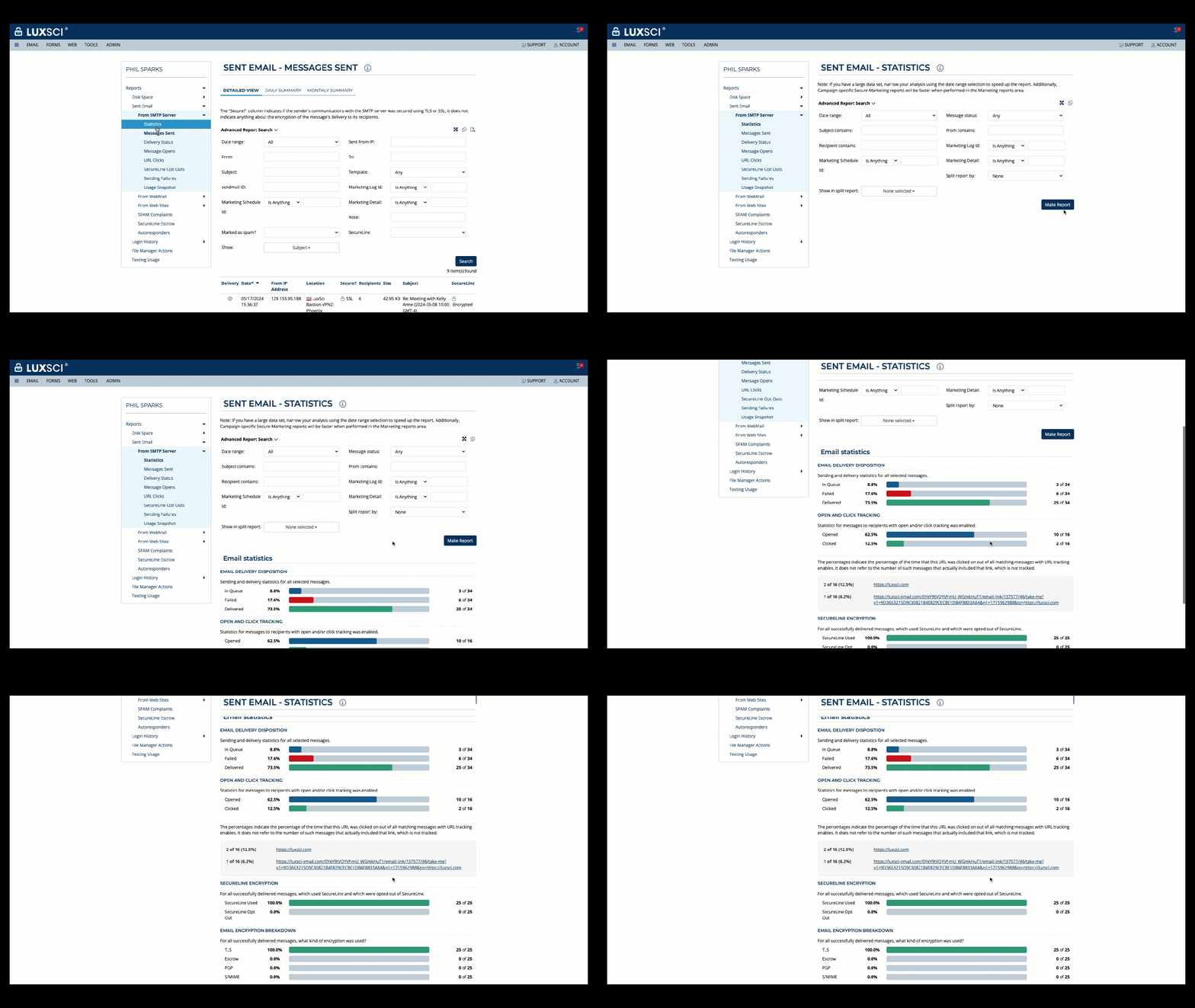
With our latest release, we made these powerful statistics easier to consume and analyze with an improved user interface for more efficiency and greater ease-of-use. Users can simply select the type of report they’d like and customize it using a range of filtering selections. This is great for diving deeper into your email performance to make adjustments on-the-fly, and to spot trends or opportunities for better engagement that you may have missed before.

New UI – Email Deliverability Statistics

LuxSci Secure Email Reporting Statistics

Get more granular, ID trends in real time with Split Reporting

As part of this release, we are pleased to introduce our Split Reporting feature, which empowers users to drill down on email deliverability statistics across a range of parameters, including:

  • subject
  • from address
  • recipient domains
  • marketing ID or campaign
  • custom field

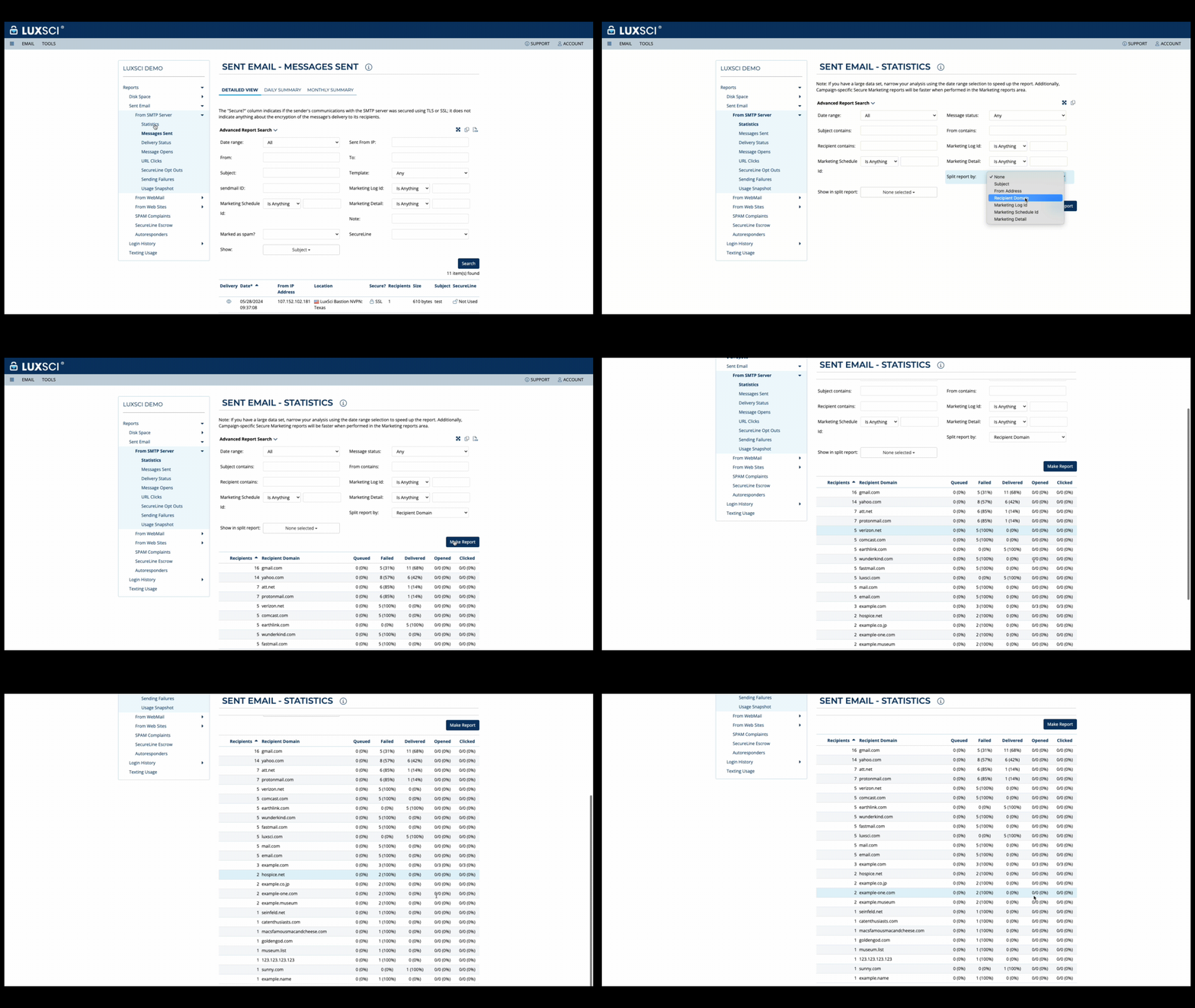
For example, users can analyze email deliverability statistics by subject to determine which ones are performing best, by use case to track results by campaign, or to track performance by recipient email domains. With split reporting, users also can analyze email volumes across queued, delivered, opened, failed and clicked parameters, and determine click-through rates (CTR) to measure effectiveness and ROI of campaigns.

New Feature Example – Split Reporting by Recipient Domain

LuxSci Secure Email Split Reporting

If you’d like to learn more, reach out and connect with us today!


Picture of LuxSci

LuxSci

Get in touch

Find The Best Solution For Your Organization

Talk To An Expert & Get A Quote


A member of our staff will reach out to you

Get Your Free E-Book!

LuxSci High Email Deliverability Best Practices Paper

What you’ll learn:

Related Posts

LuxSci G2 2026

LuxSci Earns 19 G2 Spring 2026 Badges

LuxSci continues its strong performance in the G2 Spring 2026 Reports, earning 19 badges that reflect real customer satisfaction and consistent product excellence across multiple areas, including email encryption, HIPAA compliant messaging, email security and email gateways.

G2: A Highly Reputable Peer Review Platformn

In a crowded software landscape, it’s easy for bold claims to blur together. That’s where G2 stands apart. Its rankings are based entirely on verified user feedback, giving buyers a clearer picture of how solutions actually perform in day-to-day use, not just how they’re marketed.

For Spring 2026, LuxSci earned recognition across multiple categories, including Leader, Best Customer Support, and Best ROI. Together, these awards show that LuxSci delivers leading technology and a best-in-class customer experience.

What the Badges Represent

Each G2 badge reflects direct input from customers using LuxSci in real-world environments. These evaluations cover usability, onboarding, support responsiveness, and long-term value. LuxSci’s Spring 2026 badges span leadership, customer satisfaction, ROI, and ease of implementation, demonstrating consistent strength across the full customer lifecycle.

Leader Badge: Market Leadership Validated

The Leader badge is awarded to companies with high customer satisfaction and strong market presence. LuxSci’s placement reflects reliable performance, strong security, and continued trust from organizations operating in highly regulated environments like healthcare.

Best Customer Support: A Standout Strength

In secure healthcare communications, timely and accurate support is essential. Issues must be resolved quickly to avoid operational or compliance risks. Customers consistently highlight LuxSci’s fast response times, deep expertise, and a hands-on approach, showing that our technology and our people deliver meaningful, real-world solutions.

Best ROI: Proven Business Value

ROI includes reduced compliance risk, improved efficiency, and scalable operations, not just cost. Customers report measurable benefits from LuxSci’s reliability, built-in compliance, and streamlined workflows, leading to strong long-term value and a solution that keeps you ahead of security and compliance risks.

What This Means for LuxSci Customers

These awards show LuxSci’s ability to serve organizations of varying sizes, from mid-market to enterprise. All reviews are from verified users, ensuring authenticity and transparency. Customers consistently mention reliability, security, and responsive support, along with overall peace of mind. The recognitions validate LuxSci’s ability to deliver secure, dependable communication solutions backed by strong support, including HIPAA compliant email, marketing and forms.

LuxSci’s 10 G2 Spring 2026 badges—including Leader, Best Customer Support, and Best ROI—demonstrate consistent excellence across performance, usability, and customer satisfaction. These results reinforce its position as a trusted provider in secure communications.

LuxSci MFA

Traditional MFA No Longer Qualifies as “Reasonable” Security

For years, multi-factor authentication (MFA) was considered one of the most effective ways to protect sensitive systems. By requiring a second verification step, such as a text message code or push notification, organizations could significantly reduce the risk of compromised passwords.

But the threat landscape has changed.

Today, attackers routinely bypass traditional MFA using techniques such as MFA evasion, token replay attacks, and consent phishing. These methods are no longer rare or highly sophisticated. They are widely used, automated, and increasingly effective.

As a result, regulators, auditors, and security frameworks are raising expectations for authentication security. For healthcare organizations in particular, traditional MFA alone may no longer satisfy the HIPAA requirement to implement “reasonable and appropriate safeguards.”

In the near future, email systems that rely only on basic MFA, without conditional access or phishing-resistant authentication, may increasingly be viewed as security gaps during risk assessments.

Why Traditional MFA Is No Longer Enough

Traditional MFA still improves security compared to passwords alone. However, many common MFA methods were designed before today’s phishing techniques and cloud authentication attacks became widespread.

Common MFA methods include:

  • SMS verification codes
  • Email-based authentication codes
  • Push notifications to mobile apps

While these mechanisms add friction for attackers, they can still be intercepted or manipulated during sophisticated phishing attacks. Because modern attackers now target authentication workflows directly, organizations relying solely on traditional MFA may be more vulnerable than they realize.

How Attackers Bypass MFA Today

Cybercriminals increasingly rely on tools that capture credentials and authentication tokens during login sessions. Three attack techniques are now especially common.

  • MFA Evasion and Phishing Proxies – Attackers frequently deploy adversary-in-the-middle phishing kits that sit between the user and the real login service. When users enter their credentials and MFA code on a phishing page, the attacker forwards the information to the legitimate site and captures the authentication session. The user successfully logs in—but the attacker gains access as well. If attackers capture those tokens, they can reuse them to access the account directly.
  • Token Replay Attacks – After successful authentication, systems typically issue session tokens that allow users to remain logged in without repeated MFA prompts. This technique has been widely observed in attacks targeting cloud email platforms such as Microsoft 365, allowing attackers to access email data even when MFA is enabled.
  • Consent Phishing – Consent phishing bypasses MFA entirely. Instead of stealing passwords, attackers trick users into granting permissions to malicious applications that request access to their mailbox or files. If users approve the request, the attacker’s application receives persistent access to the account through APIs—often without triggering security alerts.

Why Email Authentication Matters Most in Healthcare

Email remains one of the most critical systems in healthcare organizations. It supports patient communication, internal collaboration, and the exchange of sensitive information. Unfortunately, it is also the most frequently targeted entry point for cyberattacks.

Once attackers gain access to an email account, they can:

  • Impersonate healthcare staff
  • Launch internal phishing attacks
  • Access sensitive patient communications
  • Extract protected health information (PHI)

Because of this, email authentication controls are becoming a major focus for security teams and compliance auditors alike.

Evolving Regulatory Expectations

HIPAA does not prescribe specific technologies, but it requires organizations to implement safeguards that are “reasonable and appropriate” based on risk. As new attack methods emerge, the definition of reasonable security evolves.

Today, many security frameworks and regulatory bodies are emphasizing stronger identity protections, including:

  • Phishing-resistant authentication
  • Conditional access policies
  • Monitoring for suspicious login behavior
  • Controls for third-party application permissions

Organizations that rely solely on basic MFA may increasingly struggle to demonstrate that their authentication protections are sufficient.

The Shift Toward Phishing-Resistant Authentication

To address the weaknesses of traditional MFA, many organizations are adopting phishing-resistant authentication technologies, which can be enabled with tools like Duo and Okta. These solutions rely on cryptographic authentication tied to trusted devices, which prevents attackers from capturing or replaying login credentials.

Examples include:

  • Hardware security keys
  • Passkeys
  • Certificate-based authentication

Because authentication is tied to both the device and the legitimate website domain, these technologies significantly reduce the success rate of phishing attacks.

Why Conditional Access Is Becoming Essential

Conditional access adds another layer of protection by evaluating context and risk before granting access. Instead of treating every login the same, conditional access policies analyze signals such as:

  • Device security status
  • Geographic location
  • Network reputation
  • User behavior patterns

If something appears unusual, such as a login from a new country, the system can require stronger authentication or block the attempt altogether. This risk-based approach to authentication helps prevent many account compromise scenarios.

The Future of HIPAA Risk Assessments

As authentication threats evolve, healthcare security assessments are increasingly focusing on identity protection maturity. Organizations may begin seeing findings related to:

  • Weak or outdated MFA methods
  • Lack of conditional access policies
  • Insufficient monitoring of login activity
  • Unrestricted third-party application permissions

In particular, email systems without advanced authentication protections may be flagged as high-risk vulnerabilities, especially when PHI is accessible.

LuxSci’s Modern Approach to MFA

Modern threats require more than a simple second login factor. LuxSci approaches authentication security with layered identity protection designed specifically for healthcare environments.

Instead of relying solely on basic MFA methods like SMS codes or email verification, LuxSci supports stronger authentication controls and policies that align with evolving security expectations. These protections can include:

  • Strong multi-factor authentication options
  • Monitoring for unusual login behavior
  • Enhanced identity verification mechanisms

By combining multiple security layers within its HIPAA-compliant secure communications email and marketing solutions, LuxSci helps healthcare organizations protect sensitive email communications while maintaining usability for providers, health plan administrators, payment providers, and patient engagement teams.

Conclusion

Multi-factor authentication remains an important security control—but not all MFA is created equal. Attack techniques such as phishing proxies, token replay, and consent phishing have demonstrated that traditional MFA methods can be bypassed. As a result, regulators and auditors are increasingly expecting stronger identity protections.

For healthcare organizations that rely heavily on email communications, the implications are significant. Weak authentication controls can expose sensitive patient data and may soon appear as high-risk findings during HIPAA risk assessments. The organizations best positioned for the future will be those that modernize authentication strategies now, moving toward phishing-resistant methods, conditional access policies, and layered identity protection.

Reach out to LuxSci today to learn how HIPAA compliant email can support both your organization’s engagement and cybersecurity needs.


FAQs

1. What is traditional MFA?

Traditional MFA refers to authentication methods that require a second verification step, typically SMS codes, email codes, or push notifications.

2. Why can attackers bypass MFA today?

Modern phishing tools can intercept authentication sessions or steal login tokens, allowing attackers to access accounts even when MFA is enabled.

3. What is phishing-resistant authentication?

Phishing-resistant authentication uses cryptographic methods tied to trusted devices, preventing attackers from capturing login credentials.

4. Why is email security especially important for healthcare organizations?

Email systems often contain patient communications and sensitive information, making them a common target for cyberattacks.

5. How can organizations improve authentication security?

Organizations can strengthen identity security by adopting phishing-resistant authentication methods, implementing conditional access policies, and monitoring login activity.

LuxSci Automated Email Encryption

Encryption Optional Email Will Fail Audits in 2026 and Beyond

For years, healthcare organizations have relied on click-to-encrypt email workflows and secure portals as a practical compromise between usability and compliance. Or in some cases, they simply thought most of their emails did not need to be compliant. In regulated industries where data security and privacy are paramount, this approach was still considered “good enough.”

That era is ending.

As we progress into 2026 and beyond, regulators, auditors, and cyber insurers are sending a clear and consistent message: encryption that depends on human choice is no longer acceptable. It’s already happening. Encryption optional email isn’t merely raising concerns, it’s failing audits outright.

An Email Threat Landscape That’s Changing Faster Than Email Habits

Historically, email encryption was treated as a best practice rather than a hard requirement. If an organization could demonstrate that encryption tools existed and that employees had access to them, auditors were often satisfied. The box was checked, everybody moved on.

Today, the questions auditors ask are fundamentally different. Instead of asking whether encryption is available, they are asking whether sensitive data can ever leave the organization unencrypted. If the answer is yes, even in rare cases, or even accidentally, that’s no longer viewed as an acceptable gap. It’s viewed as inadequate control.

Why 2026 Is a Tipping Point for Email Security

Several forces are converging here in 2026 that make optional encryption increasingly untenable. Regulatory scrutiny around PHI and PII exposure continues to intensify. Breach costs and litigation are rising, with email remaining one of the most common vectors for data exposure and breaches. AI is also changing the game for cybercriminals, and attacks will continue to increase and be more sophisticated. As a result, cyber insurers are tightening underwriting requirements and demanding stronger, more predictable controls.

At the same time, email user behavior is unpredictable and inconsistent, which is a non-starter for data security in today’s world.

Taken together, these trends and behaviors point to a single requirement: email security controls must be automated. They must be enforced by systems, not dependent on employee memory, judgment, or good intentions.

The Reality of “Encryption Optional” in Practice

On paper, optional encryption can sound reasonable. In practice, it creates gaps large enough to open you up to a breach.

Secure portals are a good example. They require recipients to click a link, authenticate, and access content in a controlled environment. While this protects data in transit, and is a better approach than no security at all, it also introduces friction. And people don’t like friction. Senders forget to use the portal. Recipients ask for “just a quick email instead.” Shortcuts are taken to save time. And every shortcut becomes a risk.

Click-to-encrypt systems suffer from a similar problem. They rely on users to correctly identify sensitive data and remember to take action. But people often misclassify information, forget to click the button, or assume someone else has already secured the message. From an auditor’s perspective, this isn’t a training failure. It’s a set-up and control failure.

Email Security Defaults Are the New Normal

The latest message from regulators, auditors, and insurers is clear. If encryption is optional, data vulnerabilities become inevitable.

What can you do?

Below is a quick email security checklist to help you get started. Cyber insurers may require or recommend the following safeguards during the underwriting process, such as:

  • Multi-factor authentication (MFA)
  • Endpoint protection
  • Encrypted backups
  • Incident response planning
  • Encryption protocols for sensitive data in transit and at rest, including PHI in emails

In 2026 and beyond, healthcare organizations and regulated industries will be judged not by what they allow, but by what they prevent. Automated, encrypted email is the new. normal.

Want to learn more about LuxSci HIPAA compliant email? Reach out today.

LuxSci Oiva Health

LuxSci and Oiva Health Combine to Form Transatlantic Healthcare Communications Group

Boston & Helsinki, February 12, 2026 – LuxSci, a provider of secure healthcare communications solutions in the United States, and Oiva Health, a Nordic provider of Digital Care solutions in social and healthcare services, today announced that the companies are joining forces. Backed by Main Capital Partners (“Main”), the combination brings together two complementary platforms and teams, forming a strong transatlantic software group focused on secure healthcare communications.

Founded in 1999, LuxSci is a U.S. provider of HIPAA‑compliant, secure email, marketing, and forms solutions. Its application and infrastructure software enable organizations to securely deliver personalized, sensitive data at scale to support a broad range of healthcare communications and workflows including care coordination, benefits and payments, marketing, wellness communications, after care and ongoing care. Certified by HITRUST for the highest levels of data security, LuxSci serves dozens of healthcare enterprises and hundreds of mid‑market organizations.

Founded in 2010, Oiva Health is a provider of digital care and communications solutions in the Nordics. Headquartered in Finland, with additional offices in Denmark, Norway, and Sweden, Oiva Health offers digital care and digital clinic solutions – including digital visits, secure messaging, online scheduling and appointments, and caregiver communications – serving the long-term care, especially elderly care, and occupational healthcare verticals. The company employs approximately 60 people and has recently expanded across the Nordic region, with a growing presence in Norway and Sweden.

The combination of LuxSci and Oiva Health creates a larger, cross Atlantic group with complementary solutions, serving the U.S. and European markets. Together, the companies offer healthcare providers, payers, and suppliers a comprehensive suite of tools to communicate securely and compliantly, spanning communications, workflows, and virtual care delivery.

Daan Visscher, Partner and Co-Head North America at Main, commented: “We are pleased to announce this cross Atlantic transaction, creating an internationally active secure communications player within the healthcare and home care space. The combined product suite enables healthcare organizations to drive much needed efficiency gains in healthcare provision addressing a global trend of rising costs, aging population, and increasing pressure on resources needed to provide high-quality care.”

Mark Leonard, CEO of LuxSci, said, “We are thrilled to join forces with Oiva Health and believe that together we can truly make a difference in healthcare coordination, access, and delivery. We see an exciting path forward with our customers benefiting from an end-to-end, secure and compliant approach to optimizing both healthcare communications and today’s frontline workers, which we need now more than ever.”

Juhana Ojala, CEO at Oiva Health, concluded, “We look forward to this new chapter together with LuxSci. We are very excited about the strong alignment between our solutions, which especially strongly positions us to expand our flagship Digital Care offering to the high-potential U.S. care market – from care coordination to care delivery to in-home and institutional care.”

Nothing contained in this Press Release is intended to project, predict, guarantee, or forecast the future performance of any investment. This Press Release is for information purposes only and is not investment advice or an offer to buy or sell any securities or to invest in any funds or other investment vehicles managed by Main Capital Partners or any other person.

[END OF MESSAGE]

About LuxSci

LuxSci is a U.S.-based provider of secure healthcare communications solutions for the healthcare industry. The company offers secure email, marketing, forms and hosting, delivering HIPAA‑compliant communication solutions that enable organizations to safely manage and transmit sensitive data. Founded in 1999, LuxSci serves more than 1,900 customers across healthcare verticals, including providers, payers, suppliers, and healthcare retail, home care providers, and healthcare systems, as well as organizations operating in other highly regulated industries. LuxSci is HITRUST‑certified with example clients being Athenahealth, 1800 Contacts, Lucerna Health, Eurofins, and Rotech Healthcare, among others.

About Oiva Health

Oiva Health is a Digital Care provider in the Nordics, offering a comprehensive Digital Platform for integrated health and care services to digitalize primary healthcare, social care, hospital healthcare and long-term care services. The company was founded in 2010 and currently employs approximately 60 people in Finland, Denmark, Norway, and Sweden serving domestic municipalities, customers and partners, such as City of Helsinki, Keski-Suomi Welfare Region, Länsi-Uusimaa Welfare Region in Finland, and Viborg municipality in Denmark with its Digital Care platform. Annually over 5 million customer contacts are handled digitally through Oiva Health’s Digital Care and Digital Clinic platforms.  

About Main Capital Partners

Main Capital Partners is a software investor managing private equity funds active in the Benelux, DACH, the Nordics, France, and the United States with approximately EUR 7 billion in assets under management. Main has over 20 years of experience in strengthening software companies and works closely with the management teams across its portfolio as a strategic partner to achieve profitable growth and create larger outstanding software groups. Main has approximately 95 employees operating out of its offices in The Hague, Düsseldorf, Stockholm, Antwerp, Paris, and an affiliate office in Boston. Main maintains an active portfolio of over 50 software companies. The underlying portfolio employs approximately 15,000 employees. Through its Main Social Institute, Main supports students with grants and scholarships to study IT and Computer Science at Technical Universities and Universities of Applied Sciences.

The sender of this press release is Main Capital Partners.

For more information, please contact:

Main Capital Partners
Sophia Hengelbrok (PR & Communications Specialist)

sophia.hengelbrok@main.nl

+ 31 6 53 70 76 86

You Might Also Like

improve reputation ip address

How do I fix the reputation of my IP address?

It happens — you’re sending email messages without issue, and then suddenly emails are not being delivered, or they’re being flagged as spam. A little digging reveals that the problem is that your “IP reputation” is poor, and you need to fix it somehow.

improve reputation ip address (more…)

email deliverability

What is Email Deliverability?

Email deliverability refers to the ability of emails to reach recipients’ inboxes successfully without being filtered into spam folders or blocked entirely by email service providers. This metric involves the entire journey an email takes from sender to recipient, including authentication protocols, sender reputation, content quality, and recipient engagement patterns. For healthcare organizations managing patient communications, provider networks, and supplier relationships, understanding email deliverability is highly important given the sensitive nature of healthcare data and the need for reliable communication channels.

How Email Service Providers Filter Messages

Email service providers use sophisticated algorithms to evaluate incoming messages and determine their appropriate destination. These systems analyze multiple factors simultaneously, including sender authentication records, message content, sending patterns, and recipient behavior. The filtering process occurs in real-time, with providers like Gmail, Outlook, and Yahoo applying machine learning models trained on billions of email interactions to identify potential spam or malicious content. Authentication plays a large role in this filtering process. Providers verify sender identity through SPF (Sender Policy Framework), DKIM (DomainKeys Identified Mail), and DMARC (Domain-based Message Authentication, Reporting, and Conformance) records. Healthcare organizations without properly configured authentication often find their appointment reminders, lab results, or billing communications relegated to spam folders, disrupting patient care workflows and administrative processes.

Sender Reputation and Its Impact on Healthcare Communications

Sender reputation functions as a digital credit score for email domains and IP addresses, influencing whether healthcare organizations can reliably reach patients, providers, and business partners. Email service providers maintain reputation databases that track sending behavior, bounce rates, spam complaints, and recipient engagement over time. A single domain or IP address with poor reputation can affect email deliverability across an entire healthcare network. Healthcare entities take on reputation challenges due to the nature of their communications. Patient appointment reminders sent to outdated email addresses generate high bounce rates, while automated billing notifications may receive spam complaints from recipients who forgot they subscribed to such communications. These factors can gradually erode sender reputation, making it increasingly difficult to reach patients with time-sensitive medical information.

Protocols for Healthcare Email Deliverability Security

Modern email deliverability depends heavily on proper implementation of authentication protocols that verify sender identity and prevent email spoofing. SPF records specify which mail servers are authorized to send emails on behalf of a domain, while DKIM adds cryptographic signatures to verify message integrity. DMARC ties these protocols together by instructing receiving servers how to handle emails that fail authentication checks. Healthcare organizations must configure these protocols carefully to avoid authentication failures that could block legitimate patient communications. A misconfigured SPF record might prevent appointment confirmation emails from reaching patients, while improper DKIM setup could cause lab result notifications to be filtered as spam. These authentication failures can have serious implications for patient care, particularly when dealing with urgent medical communications or time-sensitive treatment instructions.

Content Quality and Compliance Considerations

Email content quality directly affects email deliverability, with providers using advanced algorithms to evaluate message structure, language patterns, and formatting for spam indicators. Healthcare organizations must balance informative content with deliverability requirements, ensuring that medical communications reach their intended recipients without triggering spam filters. This balance becomes particularly challenging when dealing with complex medical terminology, prescription information, or insurance-related content that may resemble spam to automated filtering systems. HIPAA compliance adds another element of complexity to healthcare email content, as organizations must protect patient information while maintaining effective communication channels. Emails containing protected health information require extra security measures and careful content formatting to avoid both compliance violations and deliverability issues. The challenge is in creating compliant, informative communications that also pass through increasingly sophisticated spam filters.

Email Deliverability Performance

Tracking email deliverability metrics provides healthcare organizations with the data needed to identify and address communication issues before they impact patient care or administrative operations. Key metrics include delivery rates, bounce rates, spam complaint rates, and inbox placement percentages across different email providers. These metrics help organizations understand how their communications perform across various platforms and identify potential problems with specific communication types or recipient segments.

Healthcare organizations should establish monitoring systems that track deliverability performance across different communication channels, including patient portal notifications, appointment reminders, billing communications, and provider-to-provider messages. This approach helps identify patterns that might indicate authentication issues, content problems, or reputation concerns that could affect the organization’s ability to communicate effectively with patients and business partners.

HIPAA compliant email

LuxSci Welcomes Angel Mazariegos as Head of Finance

LuxSci, a leader in secure healthcare communications and HIPAA compliant email, is pleased to announce the appointment of Angel Marie Mazariegos as the company’s new Head of Finance. With over 25 years of experience in financial management, accounting, and human resources, Angel will play a central role in advancing LuxSci’s operational excellence and supporting the company’s rapid growth in 2026 and beyond.

Angel brings a wealth of expertise to LuxSci, having held senior leadership positions at organizations focused on financial services, language and access services for healthcare, and human resources. In these roles, Angel has led multi-department Finance and HR teams, spearheading critical initiatives, including ERP implementations, streamlined employee onboarding, and financial process optimization.

In her role at LuxSci, Angel will oversee all aspects of the company’s finance operations, including budgeting, forecasting and reporting. Additionally, Angel will manage the company’s HR function, ensuring that LuxSci continues to foster a strong, people-driven culture based on its Secure, Trust, Responsible and Smart company values.

“Angel’s blend of financial and HR leadership makes her an invaluable addition to the LuxSci executive team and a real asset for our people,” said Mark Leonard, CEO of LuxSci. “We look forward to working with Angel to build the high-performing teams that will be critical to our future growth and serving the evolving needs of our customers.”

Angel holds dual MBA degrees in Accounting and Human Resource Management from Cappella University, as well as dual BS degrees in Business Administration (Accounting and CIS Business Systems) from California State University, Los Angeles.

“I am honored to join the LuxSci team at such an exciting time for the company,” said Mazariegos. “I look forward to working with the team and helping build on LuxSci’s reputation for excellence and reliability in secure healthcare communications.”

HIPAA Compliant

Is Wix HIPAA Compliant?

Wix is not HIPAA compliant for healthcare websites that collect, store, or process protected health information. Wix does not offer Business Associate Agreements and lacks the necessary security features required for handling patient data under HIPAA regulations. While Wix provides user-friendly website building tools and basic security measures like SSL certificates, these features do not satisfy the requirements for healthcare data protection. Healthcare organizations need specialized platforms if they plan to handle protected health information on their websites.

Wix Platform Limitations for Healthcare

Wix website building tools focus on ease of use rather than healthcare compliance requirements. The platform uses shared hosting infrastructure that may lack the data isolation needed for sensitive health information. User authentication systems in Wix do not provide the access controls required by HIPAA regulations. Form data collected through Wix stores information in ways that don’t align with healthcare privacy requirements. The platform may lack adequate audit logging capabilities to track who accesses patient information and when. Data backup systems do not include the encryption guarantees needed for protected health information. These structural limitations prevent Wix from serving as a platform for healthcare websites with patient data.

Business Associate Agreement Status

Healthcare organizations require Business Associate Agreements (BAAs) from any service provider handling protected health information. Wix does not offer BAAs for its website building platform or hosting services, making it legally impossible to use Wix for websites collecting or displaying patient information, regardless of added security measures. Wix does not offer HIPAA assurances or a BAA for its website platform; Wix advises customers not to use Wix in a way that causes Wix to handle PHI. Healthcare providers may assume website builders automatically support healthcare regulatory requirements without checking BAA availability.

Form Collection and Data Storage

Many healthcare websites collect patient information through online forms. Wix form builders store submitted information in ways that don’t meet HIPAA requirements. Form data typically resides in the Wix database without the encryption needed for protected health information. The platform lacks documentation about data storage locations and security measures applied to form submissions. Integration options for connecting form data to HIPAA compliant systems remain limited. Access to stored form data doesn’t include the detailed permission controls needed for healthcare information. These form handling limitations are challenging for healthcare websites that may need to collect patient information securely.

Acceptable Uses for Healthcare Organizations

Despite HIPAA limitations, Wix remains suitable for certain healthcare-related websites that don’t involve protected health information. Healthcare providers can use Wix for informational websites displaying services, provider details, location information, and general health resources. Marketing materials and educational content without patient-specific information work well on the platform. Healthcare organizations sometimes maintain separate websites, keeping public information on Wix while placing patient portals on HIPAA compliant platforms. This separation allows organizations to benefit from Wix’s user-friendly design tools for public-facing content while maintaining compliance for protected information.

Secure Alternatives for Healthcare Websites

Healthcare organizations have several alternatives for creating HIPAA compliant websites. Specialized healthcare website platforms include appropriate security measures and offer BAAs as standard practice. Content management systems like WordPress can be configured for HIPAA compliance with proper hosting and security implementations. Custom web development on compliant hosting environments provides maximum flexibility while meeting security requirements. Patient portal systems designed specifically for healthcare use include built-in compliance features. These alternatives typically require more technical knowledge or higher investment than Wix but provide the necessary security infrastructure for protected health information.

Website Compliance Assessment

Healthcare organizations should assess their website needs before selecting a platform. This process starts with determining exactly what information the website will collect and process. Organizations need policies defining what constitutes protected health information in their context. Security requirements should align with the sensitivity of information handled on the website. Budget considerations need to balance platform costs against compliance requirements and potential penalty risks. Technical resources available for website maintenance affect platform choices. This assessment helps organizations select appropriate website platforms and implement necessary security measures based on their needs