LuxSci

New Reporting Features Go Deeper on Email Deliverability Statistics, Trends and Analysis

LuxSci Secure Email Reporting Statistics

We recently rolled out new email reporting features, taking deliverability depth and analysis to new levels. If you’re a current LuxSci customer and haven’t checked them out, now’s the time. If you’re new to LuxSci, learn more below, and don’t hesitate to reach out for more info – or a demo.

LuxSci secure communications solutions have always featured rich reporting on email deliverability, including volumes and percentages for emails:

  • in queue
  • opened
  • clicked
  • failed
  • secured

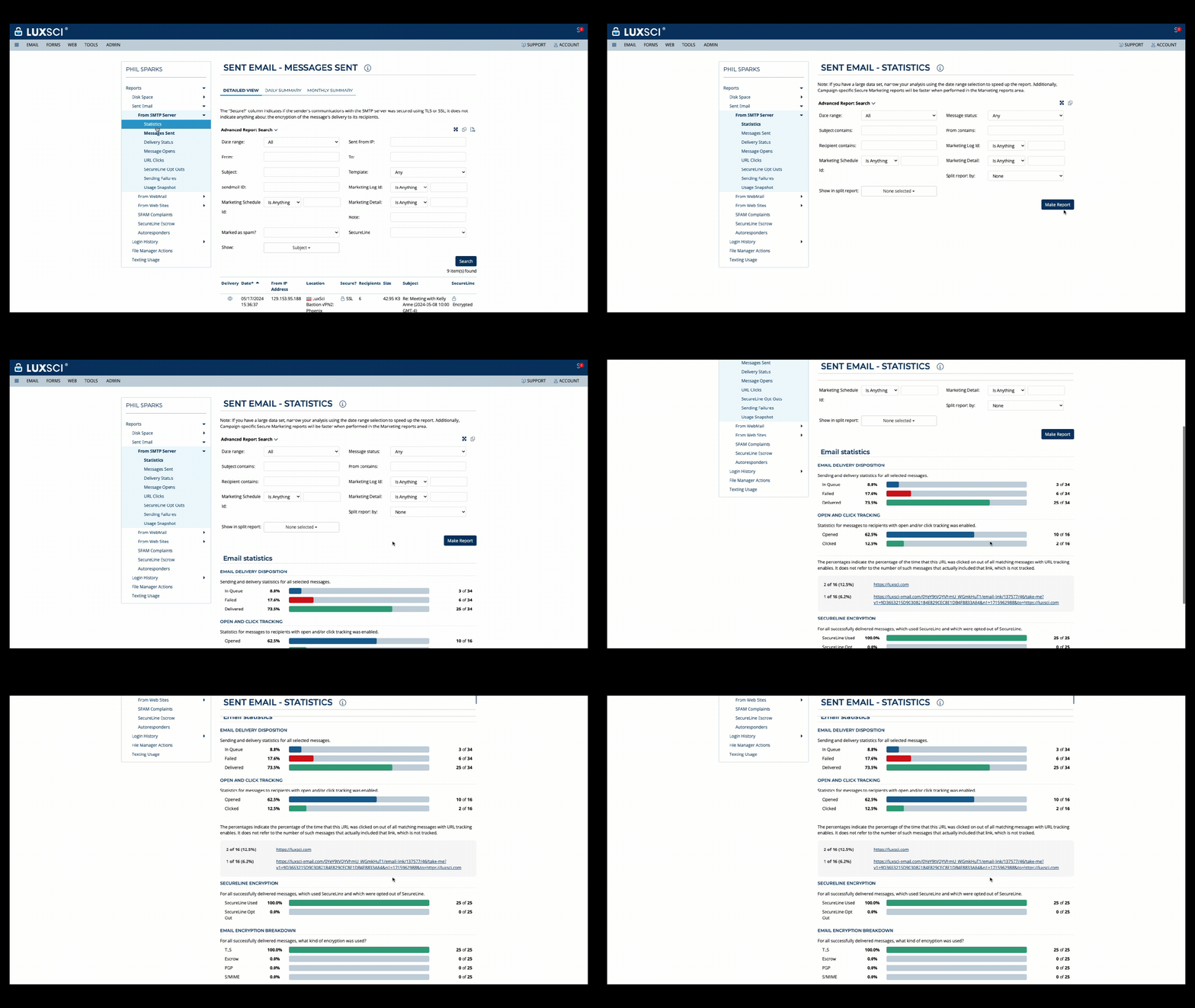
With our latest release, we made these powerful statistics easier to consume and analyze with an improved user interface for more efficiency and greater ease-of-use. Users can simply select the type of report they’d like and customize it using a range of filtering selections. This is great for diving deeper into your email performance to make adjustments on-the-fly, and to spot trends or opportunities for better engagement that you may have missed before.

New UI – Email Deliverability Statistics

LuxSci Secure Email Reporting Statistics

Get more granular, ID trends in real time with Split Reporting

As part of this release, we are pleased to introduce our Split Reporting feature, which empowers users to drill down on email deliverability statistics across a range of parameters, including:

  • subject
  • from address
  • recipient domains
  • marketing ID or campaign
  • custom field

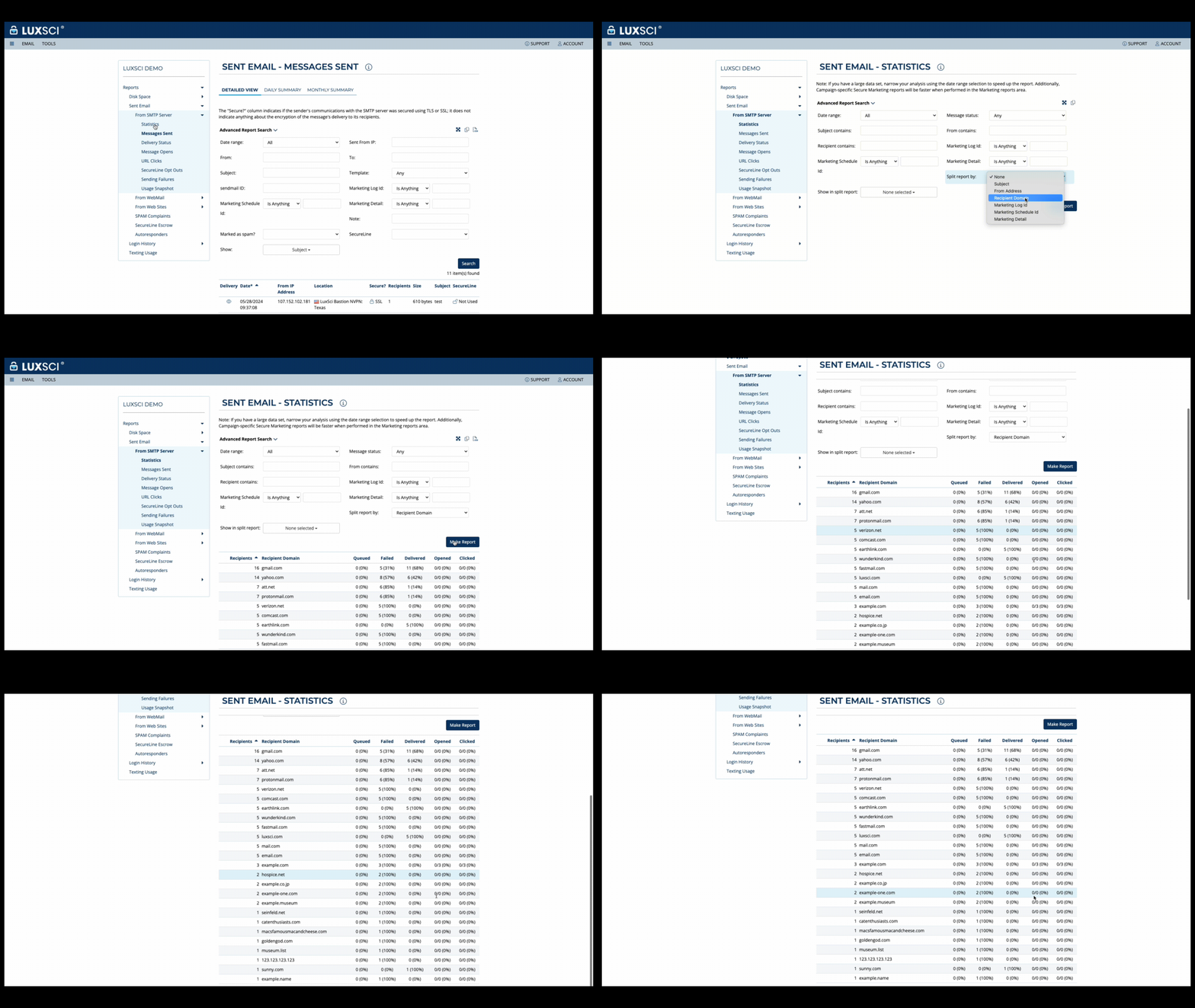
For example, users can analyze email deliverability statistics by subject to determine which ones are performing best, by use case to track results by campaign, or to track performance by recipient email domains. With split reporting, users also can analyze email volumes across queued, delivered, opened, failed and clicked parameters, and determine click-through rates (CTR) to measure effectiveness and ROI of campaigns.

New Feature Example – Split Reporting by Recipient Domain

LuxSci Secure Email Split Reporting

If you’d like to learn more, reach out and connect with us today!


Picture of LuxSci

LuxSci

Get in touch

Find The Best Solution For Your Organization

Talk To An Expert & Get A Quote


A member of our staff will reach out to you

Get Your Free E-Book!

LuxSci High Email Deliverability Best Practices Paper

What you’ll learn:

Related Posts

Email Encryption

Is OCR Already Enforcing Email Encryption Under the New HIPAA Security Rule?

Healthcare organizations waiting for the final HIPAA Security Rule updates before improving email encryption and security may already be behind.

While the proposed changes to the HIPAA Security Rule are expected to be finalized in May, the direction from the U.S. Department of Health and Human Services Office for Civil Rights (OCR) is becoming increasingly clear. Across investigations, settlements, and enforcement actions, OCR continues emphasizing stronger technical safeguards, encryption, documented security programs, multi-factor authentication (MFA), risk analysis, and proactive cybersecurity operations.

For healthcare organizations, one area stands directly in the middle of all of these priorities: email.

Email remains a primary communication channel in healthcare — and one of the industry’s largest security vulnerabilities. From unauthorized PHI exposure to phishing attacks and ransomware delivery to account compromise, email continues to be at the center of healthcare cybersecurity incidents.

So, are the proposed HIPAA Security Rule changes hypothetical future guidance or a preview of OCR’s future enforcement expectations?

For healthcare email security, the implications are significant.

Email = Healthcare Cybersecurity Risk

Healthcare organizations rely on email for critical communications and healthcare workflows, including:

  • Patient communications
  • Care coordination
  • Claims and billing notifications
  • Marketing and engagement
  • Internal collaboration
  • Third-party vendor communications
  • Delivery of sensitive PHI

At the same time, attackers continue targeting email systems because they remain one of the easiest entry points into healthcare environments.

Insecure email workflows create unnecessary exposure of protected health information. Phishing campaigns are becoming more sophisticated. Credential theft attacks are bypassing traditional MFA methods. And business email compromise (BEC) attacks continue rising.

Recent OCR enforcement actions increasingly reflect these realities.

Organizations are being evaluated not simply on whether a breach occurred, but whether they implemented reasonable safeguards beforehand, including encryption, authentication controls, monitoring, access management, and documented risk mitigation processes.

For email systems specifically, that means healthcare organizations should expect increased scrutiny around:

  • Email encryption enforcement
  • MFA deployment
  • Audit logging and retention
  • Conditional access policies
  • Vendor security controls
  • Secure email delivery best practices
  • Segmentation and infrastructure isolation
  • Ongoing patch and vulnerability management

In many ways, email infrastructure is becoming a visible test of an organization’s overall cybersecurity posture.

Email Encryption Is Moving From Addressable to Required

Historically, healthcare organizations often interpreted HIPAA email encryption requirements with flexibility because encryption was technically categorized as an “addressable” safeguard under the Security Rule. But, OCR enforcement and broader cybersecurity realities are changing that interpretation rapidly.

Today, failing to encrypt sensitive healthcare communications increasingly creates both security and regulatory risk. The proposed Security Rule updates place even greater emphasis on encryption and technical safeguards. At the same time, OCR investigations continue examining whether organizations properly protected PHI in transit and at rest.

For healthcare email specifically, this creates several growing expectations:

  • Email encryption should be automated wherever possible
  • Human error should not determine whether PHI is protected
  • Organizations should maintain documented encryption policies
  • Secure delivery methods should adapt dynamically to recipient capabilities
  • Audit trails should demonstrate how messages were secured

At LuxSci, we have long believed that encryption should operate as a strategic layer of healthcare communications infrastructure, not as a manual user decision.

Our SecureLine email encryption technology automatically applies appropriate encryption methods based on organizational policies and delivery requirements, helping reduce the risks associated with human error while maintaining usability, deliverability and compliance. As enforcement expectations rise, this type of automated security enforcement is becoming increasingly important.

Traditional MFA May No Longer Be Enough

Another major shift emerging from both OCR enforcement trends and the proposed rule updates is the growing importance of stronger authentication models.

Healthcare organizations have historically viewed MFA deployment as sufficient protection. But attackers have adapted quickly.

MFA bypass attacks, token theft, session hijacking, and consent phishing campaigns are increasingly targeting healthcare users. As a result, regulators and cybersecurity experts are placing greater emphasis on phishing-resistant authentication approaches and contextual access controls.

For email environments, organizations should increasingly evaluate:

  • Whether MFA methods are resistant to phishing attacks
  • Conditional access policies based on device, location, and behavior
  • Account monitoring and anomaly detection
  • Administrative access protections
  • Session management controls
  • Logging and authentication auditing

The broader message is clear: healthcare organizations need authentication strategies designed for today’s threat landscape, not yesterday’s compliance checklist.

OCR Wants Proof, Not Just Policies

One of the clearest trends emerging from recent OCR activity is the increasing importance of documentation and operational evidence. Healthcare organizations must increasingly demonstrate not only that safeguards exist, but that they are consistently enforced, monitored, tested, and maintained over time.

For email systems, organizations should be prepared to demonstrate:

  • Email encryption policies
  • MFA enforcement records
  • Audit logs and message tracking
  • Vendor security documentation
  • Risk assessments involving email infrastructure
  • Patch management procedures
  • Employee security awareness training
  • Incident response procedures for email-based threats

This represents a broader shift in healthcare cybersecurity expectations.

The question is no longer: “Do you have email security controls?”

The question is increasingly: “Can you prove they are operationally effective?”

Healthcare Organizations Need a New Email Security Strategy

The healthcare industry is entering a new phase of cybersecurity enforcement.

OCR’s direction is becoming increasingly clear: organizations are expected to proactively secure systems handling PHI using modern, documented, and continuously maintained safeguards. For email security specifically, that means organizations should stop treating encryption, MFA, and secure communications as optional compliance requirements. Instead, they should view secure email infrastructure as a strategic component of enterprise cybersecurity and patient trust.

At LuxSci, we help healthcare organizations modernize secure communications with HIPAA compliant email infrastructure designed specifically for healthcare environments, including flexible encryption, secure delivery, auditability, high deliverability, access controls, and dedicated infrastructure options.

The proposed HIPAA Security Rule updates may not yet be final. But, OCR is already signaling where healthcare cybersecurity enforcement is headed next. For organizations relying on email to communicate with patients, members, customers, and partners, the time to examine your secure email infrastructure is now.

Connect with our experts to learn more using the form at the top of this page!

LuxSci HIPAA Compliant Email for Mid-Sized Healthcare Organizations

LuxSci Launches Enterprise-Grade HIPAA Compliant Email Security for Mid-Sized Healthcare Organizations

New right-sized offering brings advanced encryption, easy API integration, and HITRUST-certified compliance to the most underserved segment in healthcare email — with pricing starting at $99/month

CAMBRIDGE, MA — May 5, 2026 — LuxSci, a leading provider of HIPAA compliant secure healthcare communications, today announced the launch of LuxSci Secure High Volume Email for mid-sized healthcare organizations, the industry’s trusted HIPPA-compliant email solution now packaged and priced for mid-size healthcare organizations. Regional health systems, health plans, specialty group practices, urgent care networks, and multi-site regional providers can now access LuxSci’s enterprise-grade email security and encryption infrastructure at published, volume-based pricing — with no custom quote required.

LuxSci Secure High Volume Email for mid-sized healthcare organizations delivers the same HITRUST CSF r2-certified email security and flexible encryption capabilities that power communications for some of the largest healthcare organizations in the industry, including Athenahealth, 1-800 Contacts, Hinge Health and Eurofins. The new LuxSci mid-sized offer is tiered and priced for organizations with email sending volumes of between 300 and 99,000 emails per month.

LuxSci Secure High Volume Email is built on the company’s proprietary SecureLine™ encryption technology, which automatically selects the optimal email encryption method — TLS, secure portal fallback, PGP, or S/MIME — on a per-recipient basis at the time of delivery, with no action required from senders or recipients. This intelligent, adaptive encryption method goes significantly beyond TLS-only or portal fallback models offered by basic platforms, giving mid-market healthcare organizations the flexibility and cybersecurity depth they need as HIPAA regulations tighten and email threats continue to get more sophisticated.

Key capabilities include:

  • Automatic email encryption via SecureLine™ — encrypt every email and its content, including Protected Health Information (PHI), with per-recipient adaptive encryption across TLS, portal fallback, PGP, and S/MIME.
  • Advanced REST API with webhooks for dataflows into your systems — supports unlimited messages/hour with failover, queuing, plus webhooks can push email engagement data back to EHRs, CRMs, RCM and customer data platforms.
  • Comprehensive audit logging and reporting — message-level tracking, delivery status, engagement reporting, and downloadable reports for compliance officers.
  • HITRUST CSF r2 certification, BAA, GDPR-compliant, and US-EU Privacy Framework agreement all included.
  • Microsoft 365 and Google Workspace overlay — use LuxSci’s Secure Email Gateway add-on to integrate directly with existing M365 or Google Workspace environments, adding HIPAA-compliant encryption without migration or user retraining.
  • HIPAA-compliant patient engagement — secure outbound email campaigns with PHI-powered hyper-segmentation, automated workflows, and personalized emails for marketing campaigns, proactive patient communications, appointment reminders, care gap outreach, new plan enrollments, healthcare education, and more — with LuxSci Secure Marketing add-on.

New Published LuxSci Pricing

LuxSci Secure High Volume Emai for mid-sized healthcare organizations features published pricing based on monthly sending volume:

Monthly Send VolumeMonthly Price
300 to 9,999 emails/month $99/month
10,000 – 29,999 emails/month $199/month
30,000 – 49,999 emails/month $299/month
50,000 – 99,999 emails/month $399/month
100,000+ emails/month Custom

“Mid-size healthcare organizations have been underserved for too long, forced to choose between inadequate email security tools that weren’t built for healthcare and HIPAA compliance and enterprise level solutions that felt too big or too complex,” said Mark Leanord, CEO of LuxSci. “Our new secure email packaging for mid-sized organizations changes that. We’re making the same encryption depth, ease of integration into EHRs, CRMs and other systems, and compliance rigor that powers our largest customers accessible for mid-sized organizations to easily evaluate and buy.”

Timing and Market Context

The launch comes at a critical moment for mid-size healthcare organizations. The HHS HIPAA Security Rule overhaul, expected to finalize in mid-2026, is anticipated to mandate email encryption as a required safeguard, elevating email security from addressable best practice to a regulatory requirement for thousands of organizations that have not yet upgraded their email security and compliance posture. LuxSci secure email is designed to meet these requirements, backed by HITRUST CSF r2 certification and the company’s 20-year track record in secure healthcare communications.

Availability

LuxSci Secure Email for mid-sized healthcare organizations is available immediately. Pricing and product details are published here.

Users can contact LuxSci to set up a call or DEMO.

About LuxSci

LuxSci is a leading provider of secure healthcare communications solutions for the healthcare industry. The company offers secure email, marketing, forms and hosting, delivering HIPAA‑compliant communication solutions that enable organizations to safely manage and transmit sensitive data, including protected health information (PHI). Founded in 1999 and recently merged with digital care and telehealth provider Ovia Health, LuxSci serves more than 2,000 customers across healthcare verticals, including providers, payers, suppliers, and healthcare retail, home care providers, and healthcare systems, as well as organizations operating in other highly regulated industries. LuxSci is HITRUST‑certified with current customers including Athenahealth, 1800 Contacts, Lucerna Health, Eurofins, and Rotech Healthcare, among others.

###

Media Contact:
Pete Wermter, CMO

pwermter@luxsci.com

Patient Engagement ROI

Patient Engagement ROI: The Business Case for Secure Email in Healthcare

Every IT investment in healthcare today is being evaluated through a sharper lens.

Budgets are tighter. Expectations are higher. AI is the shiny object. Across healthcare organizations, leadership is asking the same question: how does this investment drive measurable results?

That’s where Patient Engagement ROI comes in, and where many traditional approaches fall short.

The Hidden Cost of Ineffective Communication

Patient engagement isn’t just a healthcare priority. It’s a financial one.

Missed appointments, gaps in care, and low response rates all translate directly into increased costs, operational inefficiencies, and a poor patient experience. Yet many organizations still rely on fragmented, manual, or non-personalized communication strategies.

Why?

For many, it’s because of uncertainty around HIPAA compliance, and what’s allowed and not allowed. Too often, healthcare IT and marketing teams avoid using valuable patient data to avoid security and compliance risks, especially over the email channel. The result is often generic outreach that fails to connect, and fails to deliver meaningful results, such as better health outcomes, fewer missed appointments, and increased sales.

How Secure Email Delivers ROI in Healthcare

Among all healthcare IT investments, secure email stands out for one reason: it directly impacts both patient engagement and staff and process efficiency.

With the right HIPAA-compliant marketing automation platform, secure email enables organizations to:

  • Deliver personalized, relevant messages using PHI data in their emails
  • Automate outreach at scale with triggered, engagement-driven campaigns
  • Improve patient response rates and adherence for better outcomes
  • Reduce manual workload across teams for greater productivity

This is where patient engagement ROI becomes tangible.

Instead of one-size-fits-all messaging, organizations can connect with patients based on unique needs and health conditions, such as appointments, care plans, preventative care reminders, new product needs, and more. And because it’s automated, these improvements scale without adding to workloads.

Turning Compliance into Better Outcomes and Growth

HIPAA is often viewed as a constraint. In reality, it’s an opportunity. If you have the right tools.

At LuxSci, we focus exclusively on secure healthcare communications, helping organizations safely unlock the value of their data and communications. Our solutions are designed to remove the friction between compliance and communication, so you don’t have to choose between security and growth.

With capabilities like flexible encryption, advanced segmentation, and high-volume delivery, secure email marketing becomes more than a safeguard, it becomes a growth driver.

And with industry-leading security performance and recognition, organizations can trust that their communications are protected at every level with LuxSci.

Scaling Patient Engagement ROI with Automation

The real power of secure email comes when it’s combined with automated healthcare workflows.

HIPAA compliant marketing automation allows you to build multi-step, data-driven patient journeys that run continuously in the background, taking adaptive steps based on each individual’s email engagement activity. This can include:

  • Appointment reminders that reduce no-shows
  • Follow-up communications that improve outcomes
  • Preventative care outreach for check-ups, annual test and care reminders
  • New product offers, upgrades and promotions
  • Educational email campaigns that drive long-term engagement and better health

Each interaction is an opportunity to improve both patient experience and your financial performance. Over time, these incremental gains compound, resulting in significantly higher patient engagement that delivers real value to your business.

Why Act Now?

Healthcare organizations can no longer afford IT investments that don’t deliver clear, measurable value. Secure email, powered by HIPAA compliant marketing automation, offers one of the most direct paths to improving engagement, efficiency, and outcomes, all while maintaining the highest standards of security.

Ready to see how LuxSci secure email can transform your patient engagement into real ROI?

Connect with us today or book a demo to explore how HITRUST-certified, HIPAA-compliant marketing automation can work for your organization.

What Is B2B Marketing in Healthcare?

B2B marketing in healthcare describes the promotion of products and services to healthcare businesses rather than to patients or the public. The audience can include provider groups, payers, laboratories, medical suppliers, health technology firms, and service companies working across the sector. The work calls for a more measured approach than many other business categories because buying decisions tend to involve several stakeholders, internal review, and close attention to data handling, workflow impact, and commercial fit. Good execution depends on clear communication, useful content, and a strong sense of how healthcare organizations evaluate change.

Why healthcare buying requires a different approach

Healthcare companies rarely move through a buying process in a straight line. One person may open the conversation, though several others can influence whether it goes any further. Finance may want a clearer commercial case. Operations may focus on staffing, efficiency, and implementation pressure. IT may look at access, system fit, and data management. Compliance teams may review privacy implications or contractual language. B2B marketing in healthcare works better when the writing reflects those realities early. Buyers are looking for material that helps them assess risk, discuss options internally, and move forward with fewer unanswered questions.

A Difference in stakeholder priorities

A single account can contain several audiences at once. That is part of what makes this area demanding. A hospital operations leader may care about throughput and day to day workflow. A payer executive may be more interested in administrative efficiency or review times. A supplier may focus on coordination, ordering processes, or communication across partner relationships. Content becomes stronger when it takes those different perspectives seriously. The message does not need to become overly technical. It needs enough accuracy and relevance for each reader to feel that the company understands the conditions attached to their role.

Why credibility matters in every channel

Healthcare buyers tend to read promotional material carefully. They notice vague claims, inflated language, and unsupported promises very quickly. That is why credibility has to be built into the writing itself. A clean explanation of a business problem can carry real weight. A grounded case example can help a reader picture how a solution would work in practice. Clear language around implementation, support, privacy, or service structure can also help keep the conversation moving. When protected health information enters the picture, HIPAA may become part of the review as well, especially for companies handling regulated data or supporting covered entities and business associates.

Content to support real decisions

The most useful assets in this space are the ones that help buyers think more clearly. An article can frame a problem in a way that supports internal discussion. An email sequence can keep a company visible while review is taking place. A service page can answer practical questions before a meeting is booked. B2B marketing in healthcare gains traction when content has a clear job and a clear reader. That focus usually produces stronger engagement than broad copy built around generic thought leadership language. Buyers respond well to material that respects their time and gives them something worth passing along.

What strong performance looks like

Success in healthcare is rarely captured by surface numbers alone. Traffic and opens may show that content has reached people, though those signals do not say much on their own about buying intent. Better indicators include repeat visits from the same organization, replies from relevant contacts, deeper engagement with security or implementation pages, and growing activity across several stakeholders in one account. Those patterns can tell commercial teams where interest is becoming more serious. B2B marketing in healthcare proves its value when it helps those teams follow up with better timing, better context, and material that fits the next stage of evaluation.

You Might Also Like

LuxSci HITRUST Certified

LuxSci Achieves HITRUST Certification for Third Consecutive Term

We’re thrilled to announce our latest data security achievements here at LuxSci! Once again, LuxSci has achieved HITRUST CSF® certification, following a multi-step process that includes a deep assessment, validation, and quality assurance analysis for a company and its products. Our 2024-26 certification marks the third consecutive time that LuxSci has received the 2-year HITRUST certification, meeting the rigorous standards set by the HITRUST CSF framework.

In related news, LuxSci, which is GDPR compliant, has also renewed its US-EU Data Privacy Framework (DPF) certification for the next 12 months. According to the certification, U.S. companies that participate in the DPF provide adequate levels of security for personal data transfers received from the EU within the scope of the EU General Data Protection Regulation (GDPR). This renewal enables us to support customers in Europe, while ensuring we meet the highest data protection standards for cross-border data transfers. For customers that do business in the EU and UK, LuxSci ensures data privacy is upheld in compliance with regulations.

Our latest security certifications are a testament to our continuous and unrelenting commitment to delivering the highest levels of data protection for healthcare communications. This includes securing email, marketing, text, forms and hosting—while also improving patient engagement and outcomes with the use of protected health information (PHI) in communications.

Why HITRUST Certification Matters in Healthcare

In the healthcare industry, protecting sensitive patient data is not just a legal requirement—it’s an ethical responsibility and an imperative for any company or organization in existence today. While HIPAA compliance establishes a strong baseline for safeguarding patient information, HITRUST certification takes data protection a step further. The HITRUST Common Security Framework (CSF) integrates multiple regulatory standards, including HIPAA, to provide a comprehensive approach to information security, privacy, and risk management.

For healthcare organizations—and larger companies and enterprises, in particular—partnering with a HITRUST-certified provider like LuxSci provides peace of mind. You can trust that our security controls not only meet HIPAA standards but also go beyond them to address the latest industry challenges and emerging threats—we do this constantly, year after year.

How HITRUST Enhances Data Security Beyond HIPAA

HIPAA establishes the essential requirements for securing protected health information (PHI), putting a solid, but basic foundation in place. HITRUST certification is recognized for going beyond the basics. Here’s how:

  • Comprehensive Approach to Risk Management: HITRUST CSF combines various security, privacy, and regulatory standards such as NIST, ISO, and PCI-DSS, providing a more robust framework for managing risks in healthcare.
  • Continuous Monitoring and Improvement: HITRUST requires organizations to continuously monitor and improve their security measures, ensuring that their defenses evolve alongside new threats and new technologies.
  • Tailored Security Controls: HITRUST’s framework scales based on the size, complexity, and nature of the organization, offering flexibility while maintaining a high standard of security.
  • Third-Party Validation: Achieving HITRUST certification involves rigorous third-party audits, which demonstrate that an organization’s security practices are not only in place but have been thoroughly validated.

The Benefits of HITRUST Certification for Healthcare

For healthcare providers, payers, and suppliers, the advantages of partnering with a HITRUST-certified organization like LuxSci are clear:

  • Streamlined Compliance: HITRUST certification simplifies compliance with multiple regulatory frameworks, reducing the burden of managing multiple audits and certifications.
  • Enhanced Patient and Customer Trust: By choosing a HITRUST-certified partner, you show patients, partners, and regulators that your organization prioritizes the highest levels of security.
  • Future-Proofing: HITRUST ensures that you’re not just up to date with today’s standards but prepared for future regulatory requirements and security challenges as they arise.

At LuxSci, we remain committed to delivering secure, scalable, and flexible HIPAA-compliant healthcare communications solutions that our clients can depend on for the highest levels of data protection.

If you’d like to learn more about LuxSci’s secure healthcare communications solutions—and how we elevate your healthcare data protection to the next level—contact us today!

Healthcare Marketing Compliance

What Are HIPAA Rules For Healthcare Insurance Companies?

HIPAA rules for healthcare insurance companies include privacy protections, security requirements, breach notification obligations, and administrative safeguards that govern how health plans handle protected health information. These regulations apply to all health insurance entities that transmit health information electronically, including traditional insurers, health maintenance organizations, and third-party administrators. Healthcare insurance companies must implement HIPAA rules across their operations, from claims processing and member communications to provider networks and business associate relationships. Understanding HIPAA rules for healthcare insurance companies helps organizations maintain compliance while delivering efficient services to members and healthcare providers.

Privacy Rule Requirements for Health Insurance Operations

The Privacy Rule establishes how healthcare insurance companies can use and disclose protected health information in their daily operations. HIPAA rules permit health plans to use member information for treatment, payment, and healthcare operations without obtaining individual authorization from patients. Claims processing, care coordination, and quality improvement activities fall under these permitted uses, allowing insurers to conduct business while protecting patient privacy. Health insurance companies must provide privacy notices to members explaining how their information may be used and disclosed. These notices outline member rights, including the ability to request access to their records, seek amendments to incorrect information, and file complaints about privacy practices. The Privacy Rule also requires insurers to honor reasonable requests for restrictions on information use, though plans are not obligated to agree to all requested limitations.

Security Rule Standards for Electronic Health Information

HIPAA rules for healthcare insurance companies require organizations to implement administrative, physical, and technical safeguards to protect electronic protected health information. Administrative safeguards include appointing security officers, conducting workforce training, and establishing procedures for granting and revoking system access. Physical safeguards protect computer systems, equipment, and facilities housing electronic health information from unauthorized access. Technical safeguards focus on access controls, audit logs, data integrity measures, and transmission security protocols. Healthcare insurance companies must encrypt sensitive data during transmission and storage, implement user authentication systems, and maintain detailed logs of who accesses member information. Security assessments help identify vulnerabilities and ensure that protection measures remain effective against evolving cyber threats.

Breach Notification Procedures for Insurance Companies

When healthcare insurance companies experience security incidents involving member information, HIPAA rules require specific notification procedures within defined timeframes. Insurers must notify affected members within 60 days of discovering a breach, providing details about what information was involved and steps being taken to address the incident. The notification must include recommendations for members to protect themselves from potential harm. Insurance companies must also report breaches to the Department of Health and Human Services within 60 days, with larger breaches requiring immediate notification to federal authorities. Media notification becomes necessary when breaches affect more than 500 individuals in a single state or jurisdiction. Documentation of all breach response activities helps demonstrate compliance with notification requirements during regulatory reviews.

Business Associate Agreement Management

HIPAA rules for healthcare insurance companies extend to relationships with vendors, contractors, and other third parties that handle member information on behalf of the health plan. Business associate agreements must specify how these partners will protect member data, limit its use to authorized purposes, and report security incidents or unauthorized disclosures. Insurance companies remain liable for ensuring their business associates comply with applicable HIPAA requirements. Common business associates for insurance companies include claims processing vendors, customer service providers, data analytics firms, and technology companies managing member portals or mobile applications. Each relationship requires careful evaluation of privacy and security risks, along with ongoing monitoring to verify continued compliance. Contract provisions should address data return or destruction when business relationships end.

Member Rights and Access Procedures

Healthcare insurance companies must establish procedures for members to exercise their rights under HIPAA rules, including requests for access to their health information, amendments to records, and accounting of disclosures. Members can request copies of their claims history, coverage decisions, and other records maintained by their health plan. Insurance companies have 30 days to respond to access requests, with one possible 30-day extension if additional time is needed. Amendment requests require insurers to review the accuracy of information in member records and either approve corrections or provide written explanations for denials. Members can request accounting of disclosures for purposes other than treatment, payment, or healthcare operations. These procedures help ensure transparency in how insurance companies handle member information while respecting individual privacy preferences.

Compliance Monitoring and Risk Management

Healthcare insurance companies need systematic approaches to monitor HIPAA compliance across all business operations and identify areas requiring improvement. Regular risk assessments evaluate privacy and security practices, workforce training effectiveness, and business associate oversight programs. Internal audits help identify potential compliance gaps before they result in violations or security incidents. Training programs keep staff updated on HIPAA rules and company policies for handling member information appropriately. Incident response procedures address potential privacy violations or security breaches, including investigation protocols and corrective action plans. Maintaining detailed documentation of compliance activities, training records, and risk assessments creates an audit trail that demonstrates ongoing commitment to protecting member privacy and meeting regulatory obligations.

HIPAA Email API

What is a HIPAA Email API?

A HIPAA email API is a programming interface that allows healthcare applications to send secure emails containing protected health information while maintaining compliance with HIPAA regulations. These APIs provide developers with tools to integrate encrypted email functionality into healthcare software systems while automatically handling security requirements, audit logging, and PHI protection measures. Healthcare software development increasingly requires email capabilities for patient notifications, care coordination, and administrative communications. Standard email APIs lack the security controls and compliance features necessary for healthcare applications that handle sensitive patient data.

Technical Architecture and Security Framework

REST and SOAP protocols provide the foundation for most HIPAA email APIs, enabling healthcare applications to integrate email functionality through standard web service interfaces. These protocols support secure authentication and encrypted data transmission while maintaining compatibility with diverse healthcare technology environments. Message queuing systems help manage email delivery during high-volume periods while maintaining security controls throughout the transmission process. Healthcare applications can submit emails to secure queues where they receive encryption and compliance validation before delivery to recipients. Error handling mechanisms ensure that failed email transmissions do not compromise PHI security or leave sensitive data exposed in log files. HIPAA email APIs must provide detailed error information to developers while protecting patient information from unauthorized disclosure.

Authentication and Authorization Protocols

API key management provides secure access control for healthcare applications using email services. These keys must include appropriate permissions and expiration policies that prevent unauthorized access while enabling legitimate healthcare communications, allowing healthcare applications to authenticate users and obtain appropriate permissions for sending emails on their behalf. These protocols help ensure that only authorized personnel can trigger email communications containing PHI.

LuxSci supports three industry-standard authentication methods—alongside its proprietary LuxSci Secure option. These include:

  1. OAuth 2.0 – The modern standard. Secure, flexible, and ideal for enterprise-scale integrations.
  2. API Key – Simple and efficient. Ideal for server-to-server use when convenience matters most.
  3. Basic Authentication – Straightforward, widely supported. Good for internal systems and quick testing.

For those who want the tightest possible control over API sessions—including HMAC signatures and session revocation—LuxSci Secure authentication remains the best option for customers.

Message Formatting, Template Management, and Security

MIME and S/MIME encoding support enables healthcare applications to send rich-text emails with attachments while maintaining encryption and security controls. These capabilities allow inclusion of medical images, test results, and formatted reports within compliant email communications. Template engines help healthcare developers create standardized email formats that include dynamic patient data while preventing inappropriate PHI disclosure. These systems can validate content against organizational policies before message transmission. Attachment handling procedures ensure that medical documents and images receive appropriate encryption and access controls when included in email communications. HIPAA email APIs must provide secure upload and transmission capabilities for healthcare file attachments.

Delivery Tracking and Status Reporting

Real-time delivery status updates help healthcare applications track email transmission progress and identify potential delivery issues. These status reports must provide actionable information without exposing PHI to unauthorized systems or personnel. Read receipt capabilities enable healthcare applications to confirm that recipients have accessed important medical communications. These features help care coordination while maintaining appropriate privacy protections for patient email interactions. Bounce management systems handle failed email deliveries appropriately while protecting PHI from exposure through error messages or automated responses. Healthcare applications need visibility into delivery problems without compromising patient privacy.

Compliance Logging and Audit Features

Automated audit trails capture detailed information about all email activities initiated through HIPAA email APIs. These logs must include sender identification, recipient information, transmission timestamps, and delivery status while protecting actual message content from unauthorized access. Compliance reporting features help healthcare organizations track their email usage patterns and identify potential policy violations. These reports can highlight unusual sending volumes, unauthorized recipient addresses, or messages that might violate PHI handling policies. Data retention controls ensure that API logs and message metadata comply with healthcare record-keeping requirements while managing storage costs and system performance. Healthcare organizations can configure retention periods based on their regulatory and operational needs.

Integration Patterns for Healthcare Applications

Electronic health record system (EHR), customer data platform (CDP), and Revenue Capture Management (RCM) platform integrations can enable automatic email messages and notifications to be sent based on clinical events like lab result availability or appointment scheduling changes. These integrations must respect minimum necessary standards while providing timely patient communications. Workflow automation allows healthcare applications to trigger email sequences based on patient care milestones or administrative requirements, tailoring communications based on user actions taken with each email. For example, healthcare organizations might send automated email reminders about upcoming appointments or medication refills. Batch processing capabilities enable healthcare organizations to send large volumes of patient communications efficiently while maintaining security controls and HIPAA compliance. These features support activities like appointment reminders, wellness newsletters, or billing notifications that affect many patients simultaneously.

Performance Optimization and Scalability

Rate limiting controls help healthcare organizations manage email volumes while preventing abuse or accidental bulk sending that might violate patient communication policies and damage your IP reputation. These controls can be customized based on organizational needs and user roles. Caching mechanisms improve API performance by storing frequently used templates and configuration data while maintaining appropriate security controls. These optimizations help reduce response times for healthcare applications without compromising PHI protection. Load balancing systems ensure reliable email delivery during peak usage periods when healthcare organizations send high volumes of patient communications. These systems must maintain security controls while distributing processing loads across multiple servers.

Testing and Development Support

Sandbox environments enable healthcare developers to test email functionality without exposing real patient data or sending communications to actual patients. These testing systems provide realistic API responses while using protected data that supports thorough integration testing. Documentation and code samples help healthcare development teams implement HIPAA email API functionality correctly while understanding security requirements and compliance obligations. These resources should include examples for common healthcare use cases and integration scenarios.

Finally, support services provide healthcare developers with technical assistance and compliance guidance during implementation and ongoing operations. API providers should offer expertise in both technical integration and healthcare regulatory requirements to ensure successful deployments.

Luxsci API

LuxSci Enhances API Authentication for Easier, More Flexible Integrations with EHRs, CDPs and RCM Platforms

Today, we’re pleased to announce that LuxSci just made it even easier to leverage its powerful high volume email API with the healthcare platforms you rely on most. Whether you’re connecting with an EHR system, Customer Data Platform (CDP), Revenue Capital Management (RCM) platform—or even your contact center or unified communications suite—the new LuxSci API authentication options unlock the flexibility you need to scale and move fast.

In healthcare, connected patient journeys anchored in secure, personalized communications are driving increased engagement and better outcomes for patients and companies—all at a lower cost. From sending secure high-volume transactional emails to targeted marketing and educational communications, your systems and platforms need to talk to each other without friction to achieve the best results. LuxSci’s new API updates make that possible, securely.

What’s New in This Update

  • Support for OAuth 2.0, API Key, and Basic authentication methods.
  • Published API YAML specs and SwaggerHub integration for instant testing.
  • Enhanced multi-factor authentication (MFA) protection with one-time-use codes.

Overview of the LuxSci API

The LuxSci API is built with healthcare IT, security and developer teams in mind. It’s RESTful, secure, and designed for high volume email workflows.

Using industry standards like HTTPS, JSON, and TLS 1.2+, LuxSci’s API delivers fast and reliable integration and communication. Whether you’re sending appointment reminders, test results, preventative care communications, explanation of benefits (EoBs), or new product offers, your messages go out quickly and securely, with best-in-class email deliverability rates of 98% or more.

Designed for Compliance and Performance

LuxSci is HIPAA-compliant and HITRUST Certified, ensuring your healthcare communications stay within the bounds of regulatory compliance, keeping patient and company data secure—even as your email sending volume scales into the millions.

Authentication Gets a Major Upgrade

With the latest API release, LuxSci now supports three industry-standard authentication methods—alongside its proprietary LuxSci Secure option.

Let’s break them down:

  1. OAuth 2.0 – The modern standard. Secure, flexible, and ideal for enterprise-scale integrations.
  2. API Key – Simple and efficient. Ideal for server-to-server use when convenience matters most.
  3. Basic Authentication – Straightforward and widely supported. Great for internal systems and quick testing.

Still Available and Highly Recommended: LuxSci Secure Authentication

For those who want the tightest possible control over API sessions—including HMAC signatures and session revocation—LuxSci Secure authentication remains the best option for customers.

Now, let’s take a closer look at how each of the new authentication methods work:

OAuth 2.0: A Standards-Based Approach

OAuth 2.0 gives you a robust framework to handle both account-level and user-level integrations.

Account-Level Authentication (Client Credentials Flow)

Perfect for system-level access—including EHR, CDP or RCM platform integrations where user context isn’t needed.

User-Level Authentication (Resource Owner Password Credentials Flow)

This method allows API access on behalf of individual users—great for patient portals or provider tools.

Security, Flexibility, and Simplicity Combined

Tokens expire after a default of 15 minutes, ensuring sessions aren’t left open indefinitely. Bonus: No message body signing is required, making integration quick and painless.

API Key: Simple and Straightforward

API Key authentication is as easy as including your credentials in a custom header. No session to manage, no extra handshake steps.

How It Works:

You send the HTTP header

X-API-Key: client_id:client_secret

With each request. That’s it.

Ideal Use Cases

  • Server-to-server automation
  • Internal dashboards
  • Data exports from analytics platforms

Basic Authentication: Familiar and Easy

Basic Auth is a time-tested option. Just Base64 encode your API credentials, include them in an HTTP header, and go.

While not as bulletproof as OAuth or LuxSci Secure, API Key and Basic Auth work fine for less sensitive data or development environments.

Easy Access to YAML Specs and SwaggerHub for API Testing

LuxSci has also published detailed YAML API specifications, making it easier for developers and IT teams to access testing interfaces.

You can find more information on our LuxSci API page.

Improved MFA and Easier Access to Testing Tools

As part of today’s announcement, LuxSci also rolled out new, smarter Multi-Factor Authentication (MFA) for enhanced web interface login protection.

LuxSci now ensures that each MFA code can be used only once. So, even if a hacker captures your password and MFA code, they are useless for conducting new login sessions. This update helps protect against automated phishing, spoofing, and fake login pages.

Why Healthcare Leaders Trust LuxSci

Best-In-Class Email Deliverability Rates of 98%

We don’t just send your emails—we get them delivered. Our 98%+ deliverability rate is among the highest in the industry, especially for sensitive healthcare data and communications.

HIPAA Compliance and HITRUST Certification

LuxSci checks every box when it comes to data privacy and protection. Trust your messages are safe, every step of the way.

Secure Communication at Scale

From a few thousand appointment reminders to millions of outbound secure emails—LuxSci scales with your business. Today, we work with some of the largest players in the healthcare industry, including Athenahealth, 1800 Contacts, US Healthconnect, Lucerna Health and Eurofins.

Contact us today with any questions.

FAQs

Q1: What’s the most secure authentication method to use with LuxSci?

A: LuxSci Secure authentication offers the highest security with message signing and session revocation. For more information, visit our API Mechanics page.

Q2: Can I use OAuth 2.0 with user-level access?

A: Yes! Use the Resource Owner Password Credentials Flow (ROPC) to authenticate individual users.

Q3: Where can I find the SwaggerHub API testing tools?

A: LuxSci has published YAML specifications for SwaggerHub. Visit the LuxSci API page for more information.

Q4: How does LuxSci ensure HIPAA compliance in its API?

A: Through encryption, access controls, auditing, and industry certifications like HITRUST.