LuxSci

New Reporting Features Go Deeper on Email Deliverability Statistics, Trends and Analysis

LuxSci Secure Email Reporting Statistics

We recently rolled out new email reporting features, taking deliverability depth and analysis to new levels. If you’re a current LuxSci customer and haven’t checked them out, now’s the time. If you’re new to LuxSci, learn more below, and don’t hesitate to reach out for more info – or a demo.

LuxSci secure communications solutions have always featured rich reporting on email deliverability, including volumes and percentages for emails:

  • in queue
  • opened
  • clicked
  • failed
  • secured

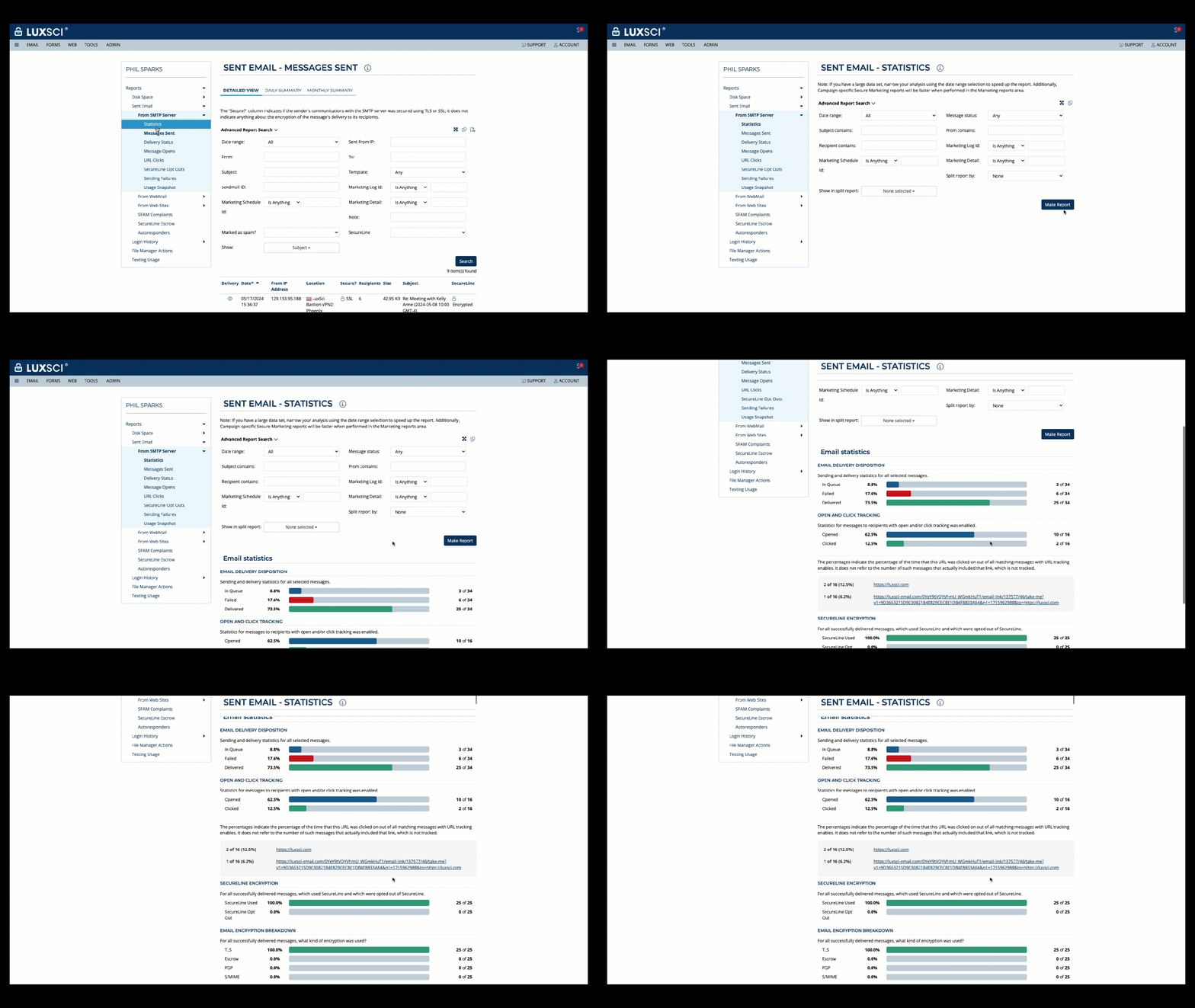
With our latest release, we made these powerful statistics easier to consume and analyze with an improved user interface for more efficiency and greater ease-of-use. Users can simply select the type of report they’d like and customize it using a range of filtering selections. This is great for diving deeper into your email performance to make adjustments on-the-fly, and to spot trends or opportunities for better engagement that you may have missed before.

New UI – Email Deliverability Statistics

LuxSci Secure Email Reporting Statistics

Get more granular, ID trends in real time with Split Reporting

As part of this release, we are pleased to introduce our Split Reporting feature, which empowers users to drill down on email deliverability statistics across a range of parameters, including:

  • subject
  • from address
  • recipient domains
  • marketing ID or campaign
  • custom field

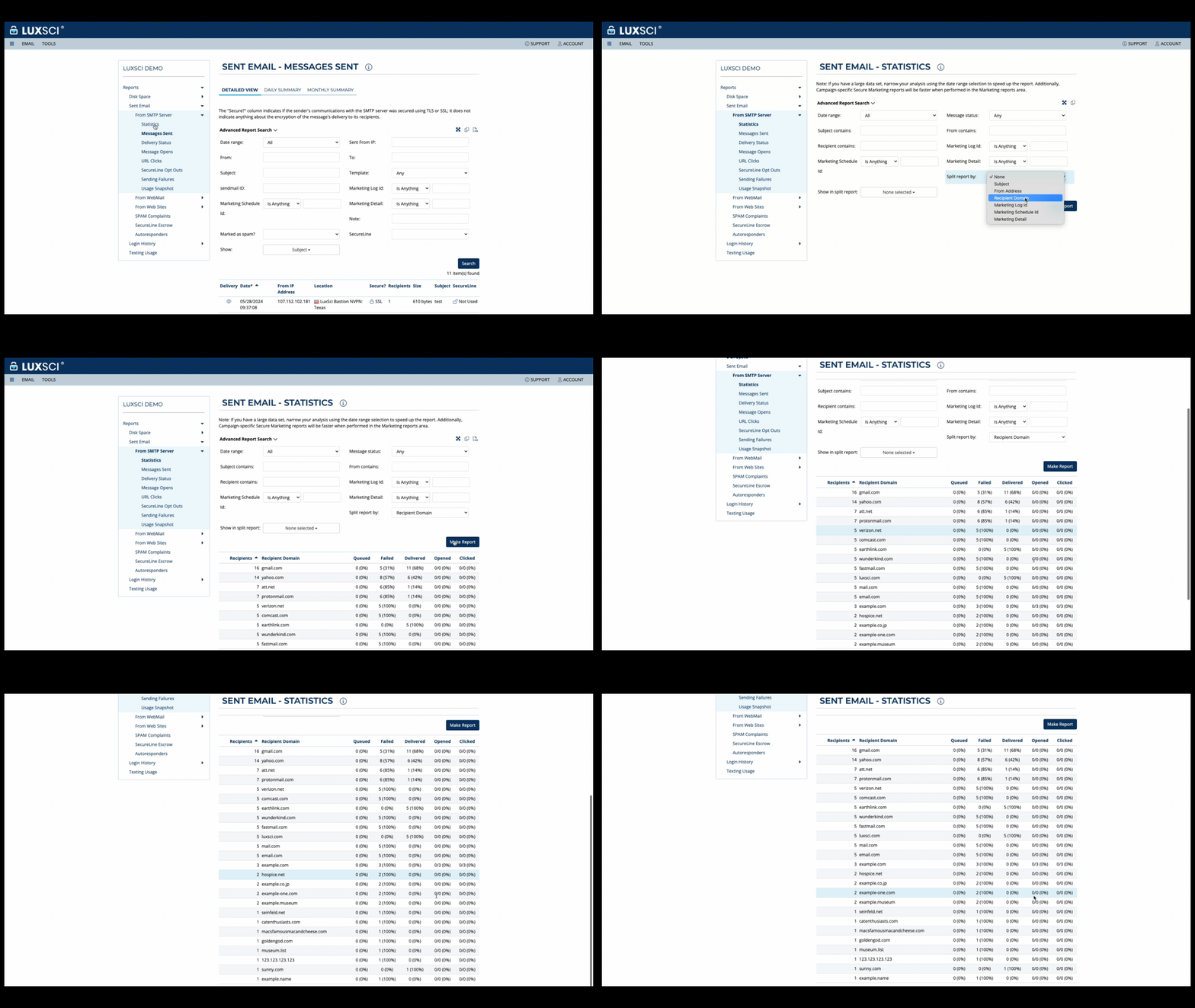
For example, users can analyze email deliverability statistics by subject to determine which ones are performing best, by use case to track results by campaign, or to track performance by recipient email domains. With split reporting, users also can analyze email volumes across queued, delivered, opened, failed and clicked parameters, and determine click-through rates (CTR) to measure effectiveness and ROI of campaigns.

New Feature Example – Split Reporting by Recipient Domain

LuxSci Secure Email Split Reporting

If you’d like to learn more, reach out and connect with us today!


Picture of LuxSci

LuxSci

Get in touch

Find The Best Solution For Your Organization

Talk To An Expert & Get A Quote


A member of our staff will reach out to you

Get Your Free E-Book!

LuxSci High Email Deliverability Best Practices Paper

What you’ll learn:

Related Posts

Patient Engagement ROI

Patient Engagement ROI: The Business Case for Secure Email in Healthcare

Every IT investment in healthcare today is being evaluated through a sharper lens.

Budgets are tighter. Expectations are higher. AI is the shiny object. Across healthcare organizations, leadership is asking the same question: how does this investment drive measurable results?

That’s where Patient Engagement ROI comes in, and where many traditional approaches fall short.

The Hidden Cost of Ineffective Communication

Patient engagement isn’t just a healthcare priority. It’s a financial one.

Missed appointments, gaps in care, and low response rates all translate directly into increased costs, operational inefficiencies, and a poor patient experience. Yet many organizations still rely on fragmented, manual, or non-personalized communication strategies.

Why?

For many, it’s because of uncertainty around HIPAA compliance, and what’s allowed and not allowed. Too often, healthcare IT and marketing teams avoid using valuable patient data to avoid security and compliance risks, especially over the email channel. The result is often generic outreach that fails to connect, and fails to deliver meaningful results, such as better health outcomes, fewer missed appointments, and increased sales.

How Secure Email Delivers ROI in Healthcare

Among all healthcare IT investments, secure email stands out for one reason: it directly impacts both patient engagement and staff and process efficiency.

With the right HIPAA-compliant marketing automation platform, secure email enables organizations to:

  • Deliver personalized, relevant messages using PHI data in their emails
  • Automate outreach at scale with triggered, engagement-driven campaigns
  • Improve patient response rates and adherence for better outcomes
  • Reduce manual workload across teams for greater productivity

This is where patient engagement ROI becomes tangible.

Instead of one-size-fits-all messaging, organizations can connect with patients based on unique needs and health conditions, such as appointments, care plans, preventative care reminders, new product needs, and more. And because it’s automated, these improvements scale without adding to workloads.

Turning Compliance into Better Outcomes and Growth

HIPAA is often viewed as a constraint. In reality, it’s an opportunity. If you have the right tools.

At LuxSci, we focus exclusively on secure healthcare communications, helping organizations safely unlock the value of their data and communications. Our solutions are designed to remove the friction between compliance and communication, so you don’t have to choose between security and growth.

With capabilities like flexible encryption, advanced segmentation, and high-volume delivery, secure email marketing becomes more than a safeguard, it becomes a growth driver.

And with industry-leading security performance and recognition, organizations can trust that their communications are protected at every level with LuxSci.

Scaling Patient Engagement ROI with Automation

The real power of secure email comes when it’s combined with automated healthcare workflows.

HIPAA compliant marketing automation allows you to build multi-step, data-driven patient journeys that run continuously in the background, taking adaptive steps based on each individual’s email engagement activity. This can include:

  • Appointment reminders that reduce no-shows
  • Follow-up communications that improve outcomes
  • Preventative care outreach for check-ups, annual test and care reminders
  • New product offers, upgrades and promotions
  • Educational email campaigns that drive long-term engagement and better health

Each interaction is an opportunity to improve both patient experience and your financial performance. Over time, these incremental gains compound, resulting in significantly higher patient engagement that delivers real value to your business.

Why Act Now?

Healthcare organizations can no longer afford IT investments that don’t deliver clear, measurable value. Secure email, powered by HIPAA compliant marketing automation, offers one of the most direct paths to improving engagement, efficiency, and outcomes, all while maintaining the highest standards of security.

Ready to see how LuxSci secure email can transform your patient engagement into real ROI?

Connect with us today or book a demo to explore how HITRUST-certified, HIPAA-compliant marketing automation can work for your organization.

What Is B2B Marketing in Healthcare?

B2B marketing in healthcare describes the promotion of products and services to healthcare businesses rather than to patients or the public. The audience can include provider groups, payers, laboratories, medical suppliers, health technology firms, and service companies working across the sector. The work calls for a more measured approach than many other business categories because buying decisions tend to involve several stakeholders, internal review, and close attention to data handling, workflow impact, and commercial fit. Good execution depends on clear communication, useful content, and a strong sense of how healthcare organizations evaluate change.

Why healthcare buying requires a different approach

Healthcare companies rarely move through a buying process in a straight line. One person may open the conversation, though several others can influence whether it goes any further. Finance may want a clearer commercial case. Operations may focus on staffing, efficiency, and implementation pressure. IT may look at access, system fit, and data management. Compliance teams may review privacy implications or contractual language. B2B marketing in healthcare works better when the writing reflects those realities early. Buyers are looking for material that helps them assess risk, discuss options internally, and move forward with fewer unanswered questions.

A Difference in stakeholder priorities

A single account can contain several audiences at once. That is part of what makes this area demanding. A hospital operations leader may care about throughput and day to day workflow. A payer executive may be more interested in administrative efficiency or review times. A supplier may focus on coordination, ordering processes, or communication across partner relationships. Content becomes stronger when it takes those different perspectives seriously. The message does not need to become overly technical. It needs enough accuracy and relevance for each reader to feel that the company understands the conditions attached to their role.

Why credibility matters in every channel

Healthcare buyers tend to read promotional material carefully. They notice vague claims, inflated language, and unsupported promises very quickly. That is why credibility has to be built into the writing itself. A clean explanation of a business problem can carry real weight. A grounded case example can help a reader picture how a solution would work in practice. Clear language around implementation, support, privacy, or service structure can also help keep the conversation moving. When protected health information enters the picture, HIPAA may become part of the review as well, especially for companies handling regulated data or supporting covered entities and business associates.

Content to support real decisions

The most useful assets in this space are the ones that help buyers think more clearly. An article can frame a problem in a way that supports internal discussion. An email sequence can keep a company visible while review is taking place. A service page can answer practical questions before a meeting is booked. B2B marketing in healthcare gains traction when content has a clear job and a clear reader. That focus usually produces stronger engagement than broad copy built around generic thought leadership language. Buyers respond well to material that respects their time and gives them something worth passing along.

What strong performance looks like

Success in healthcare is rarely captured by surface numbers alone. Traffic and opens may show that content has reached people, though those signals do not say much on their own about buying intent. Better indicators include repeat visits from the same organization, replies from relevant contacts, deeper engagement with security or implementation pages, and growing activity across several stakeholders in one account. Those patterns can tell commercial teams where interest is becoming more serious. B2B marketing in healthcare proves its value when it helps those teams follow up with better timing, better context, and material that fits the next stage of evaluation.

What Is B2B Medical Marketing?

B2B medical marketing is the promotion of products and services to medical organizations, rather than to patients or general consumers. The audience can include provider groups, laboratories, payers, health technology companies, medical manufacturers, and service firms that sell into the healthcare space. The work involves more scrutiny than many other business sectors because buying decisions are reviewed through operational, financial, legal, and data related lenses. That environment shapes the way messages are written, the way proof is presented, and the pace at which commercial relationships develop.

Where B2B medical marketing fits in healthcare

Medical companies rarely buy on impulse. A new platform, service, or product may affect staff workflows, procurement planning, record handling, contract review, or coordination between teams. For that reason, B2B medical marketing sits close to the practical side of business decision making. Good content helps a buyer assess whether something will work inside an existing organization. It gives shape to the problem, explains the offer in plain terms, and provides enough context for internal discussion. In a medical setting, that matters because a single contact may show interest while several others influence whether the conversation continues.

Why the buying process feels slower

The pace of healthcare purchasing can frustrate vendors that are used to quicker decisions. Interest does not always translate into movement because the next step may depend on approval from finance, operations, IT, procurement, or compliance. Each group reads with a different priority in mind. An operations lead may look for staffing impact. An IT team may focus on access controls, system fit, and data use. Finance may ask whether the commercial case is persuasive enough to justify more review. B2B medical marketing works best when content reflects those realities from the start. Messages that feel rushed or overwritten tend to lose ground early.

Trust and proof carry weight

Medical buyers are used to reading claims with care. They want to know what the service does, how it fits into day to day work, and what kind of burden it may place on the people using it. That is why trust has to be earned through the material itself. Clear examples help. Credible case studies help. Sound explanations of process, security, implementation, or support also help because they answer the questions serious buyers are already asking. When privacy or protected health information enters the picture, references to HIPAA and related data handling expectations may also become part of the evaluation. B2B medical marketing gains traction when the language sounds careful, informed, and accountable on every page.

Content needs a job to do

A medical buyer reading an article, email, or landing page is usually looking for something useful rather than something flashy. The content may need to explain a workflow issue, support an internal conversation, prepare a reader for a product discussion, or clarify how a service would be introduced. That practical role should shape the writing. B2B medical marketing is stronger when each asset has a clear purpose and a clear reader. One article may help an operations contact define a bottleneck. Another may help a compliance stakeholder understand how data is handled. Another may give procurement a cleaner view of scope and process. Content works harder when it can travel inside the account and still make sense to the next person who reads it.

What good measurement looks like

Performance in this area is not captured by one metric. Page views and open rates may show that something has attracted attention, though they do not say much on their own about buying intent. Better signs come from repeat visits from the same account, deeper engagement with implementation or security pages, replies from people with decision making authority, and movement from light interest to active review. B2B medical marketing earns its value when it helps commercial teams see where attention is turning into evaluation. That is where better timing, stronger follow up, and sharper account insight begin to matter.

Zero Trust Email Security in Healthcare

Zero Trust Email Security in Healthcare: A Requirement for Sending PHI?

As healthcare organizations embrace digital patient engagement and AI-assisted care delivery, one reality is becoming impossible to ignore: traditional perimeter-based security is no longer enough. Email, still the backbone of patient and operational communications, has become one of the most exploited attack surfaces.

As a result, Zero Trust email security in healthcare is moving from buzzword to necessity.

At LuxSci, we see this shift firsthand. Healthcare providers, payers, and suppliers are no longer asking if they should modernize their security posture, but how to do it without disrupting care delivery or patient engagement.

Our advice: Start with a Zero Trust-aligned dedicated infrastructure that puts you in total control of email security.

Let’s go deeper!

What Is Zero Trust Email Security in Healthcare?

At its core, Zero Trust email security in healthcare applies the principle of “never trust, always verify” to every email interaction involving protected health information (PHI).

This means:

  • Continuous authentication of users and systems
  • Device and environment validation before granting access
  • Dynamic, policy-based encryption for every message
  • No implicit trust, even within internal networks

Unlike legacy approaches that assume safety inside the network perimeter, Zero Trust treats every email, user, and endpoint as a potential risk.

Why Email Is a Critical Gap in Zero Trust Strategies

While many healthcare organizations have begun adopting Zero Trust frameworks for network access and identity, email often remains overlooked.

This is a major problem.

Email is where:

  • PHI is most frequently shared
  • Human error is most likely to occur
  • Phishing and impersonation attacks are most effective

Without a Zero Trust email security approach, organizations leave a critical gap in their defense strategy, one that attackers can actively exploit.

Healthcare Challenge: Personalized Communication and PHI Risk

Modern healthcare ecosystems are highly distributed:

  • Care teams span multiple locations
  • Third-party vendors access sensitive systems
  • Patients expect digital, personalized communication

This creates a complex web of PHI exchange—much of it through email.

At the same time, compliance requirements like HIPAA demand that PHI email security is addressed at all times.

The result is a growing tension between:

  • Security and compliance
  • Usability, engagement, and better outcomes

From Static Encryption to Intelligent, Adaptive Protection

Traditional email encryption methods often rely on:

  • Manual triggers
  • Static rules
  • User judgment

This introduces risk. A modern zero trust email security in healthcare model replaces this with:

  • Automated encryption policies based on content and context
  • Flexible encryption methods tailored to recipient capabilities – TLS, Portal Fallback, PGP, S/MIME
  • Seamless user experiences that human error – automated email encryption, including content

At LuxSci, our approach to secure healthcare communications is built around this philosophy. By automating encryption and providing each customer with a zero trust-aligned dedicated infrastructure, organizations can protect PHI without relying on end-user decisions or the actions of other vendors on the same cloud, significantly reducing risk while improving performance, including email deliverability.

Aligning Zero Trust with HIPAA and Emerging Frameworks

Zero Trust is not a replacement for compliance, it’s an enabler. A well-implemented Zero Trust approach helps organizations:

  • Meet HIPAA requirements for PHI protection
  • Reduce the likelihood of breaches
  • Strengthen audit readiness and risk management

More importantly, it positions healthcare organizations to align with emerging cybersecurity frameworks that increasingly emphasize identity, data-centric security, and continuous verification.

PHI Protection Starts with Email

Zero Trust is no longer a conceptual framework, it’s becoming the operational standard for healthcare IT, infrastructure, and data security teams.

But success depends on execution. Email remains the most widely used, and vulnerable, communication channels in healthcare. Without addressing it directly, Zero Trust strategies will fall short.

Here are 3 tips to stay on track:

  • Treat every email as a potential risk
  • Automate encryption at scale – secure every email
  • Enable personalized patient engagement with secure PHI in email

At LuxSci, we believe that HIPAA compliant email is the foundation for the future of secure healthcare communications, protecting PHI while enabling better patient engagement and better outcomes.

Reach out today if you want to learn more from our LuxSci experts.

You Might Also Like

replying to an email

Are Replies to Encrypted Emails also Secure?

Sending HIPAA-compliant emails is easy when you use an encryption solution like LuxSci. But what happens when someone replies to an encrypted message? Are the replies also secure? This is primarily a concern when using SMTP TLS as a secure means of email delivery. 

This article will explain how messages are sent securely, how replies behave, and whether they are secure and compliant. At the end, we provide some recommendations for how to balance security and usability. 

(more…)

HIPAA compliant email

Is There a HIPAA Compliant Email?

Yes, HIPAA compliant email is available through specialized platforms and services designed specifically for healthcare organizations that need to transmit protected health information securely. HIPAA compliant email solutions include encryption, access controls, audit logging, and other security features required to meet regulatory standards for protecting patient information during electronic communication. Healthcare providers, payers, and suppliers can choose from various HIPAA compliant email options that range from standalone secure messaging platforms to integrated solutions that work with existing healthcare systems. Understanding available HIPAA compliant email solutions helps organizations select appropriate tools for their communication needs while maintaining regulatory compliance and protecting patient privacy.

Types of HIPAA Compliant Email Solutions

Several categories of HIPAA compliant email solutions serve different organizational needs and technical requirements. Cloud-based secure email platforms provide hosted solutions that require minimal technical infrastructure while offering enterprise-grade security features. These platforms handle encryption, server maintenance, and security updates, allowing healthcare organizations to focus on patient care rather than email system management. On-premises HIPAA compliant email systems give organizations direct control over their email infrastructure and data storage locations. Hybrid solutions combine cloud convenience with on-premises control, allowing organizations to customize their email security approach based on specific requirements. Email encryption gateways work with existing email systems to add HIPAA compliance features without requiring complete system replacement.

Security Features in HIPAA Compliant Email Platforms

HIPAA compliant email platforms include end-to-end encryption that protects messages and attachments from unauthorized access during transmission and storage. Transport Layer Security protocols secure connections between email servers, while message-level encryption ensures that only intended recipients can read email content. Digital signatures verify sender authenticity and message integrity, preventing tampering or impersonation. Multi-factor authentication requires users to provide additional verification beyond passwords before accessing email accounts. Access controls limit which users can send emails to external recipients and which types of information can be included in different message categories. Automatic data loss prevention features scan outgoing emails for protected health information and apply appropriate security measures or block transmission of potentially sensitive content.

Business Associate Agreements and Vendor Requirements

Healthcare organizations using HIPAA compliant email services need business associate agreements with their email providers to ensure regulatory compliance. These agreements specify how email vendors will protect patient information, limit data use to authorized purposes, and report security incidents or unauthorized disclosures. Email providers operating as business associates must implement appropriate safeguards and allow healthcare organizations to audit their security practices. Vendor selection criteria should include security certifications, compliance track records, and technical capabilities that meet organizational requirements. Service level agreements define uptime expectations, support response times, and data recovery procedures. Due diligence processes help verify that email providers have appropriate security controls and compliance programs before entering into business relationships.

Implementation Challenges and Solutions

Healthcare organizations implementing HIPAA compliant email often encounter workflow disruptions as staff adapt to new security procedures and software interfaces. Training programs help users understand proper email security practices and organizational policies for handling protected health information. Change management strategies address resistance to new procedures and ensure that staff members understand the importance of email security compliance. Technical integration challenges arise when connecting HIPAA compliant email systems with existing healthcare applications and databases. Application programming interfaces enable custom integrations that streamline workflows while maintaining security standards. Migration planning addresses data transfer from legacy email systems and ensures that historical communications remain accessible when needed.

Cost Considerations for HIPAA Compliant Email

HIPAA compliant email solutions involve various cost components including software licensing, implementation services, ongoing support, and staff training expenses. Per-user subscription models allow organizations to scale email security based on their actual usage patterns. Enterprise licensing agreements may provide cost advantages for larger healthcare organizations with many email users. Hidden costs can include system integration expenses, data migration fees, and productivity losses during implementation periods. Return on investment calculations should consider potential savings from avoiding HIPAA violation penalties, reduced risk of data breaches, and improved operational efficiency from streamlined secure communication processes. Long-term cost analysis helps organizations budget appropriately for ongoing email security requirements.

Selecting the Right HIPAA Compliant Email Solution

Healthcare organizations should evaluate HIPAA compliant email options based on their specific communication patterns, technical infrastructure, and regulatory requirements. Feature comparisons help identify which platforms offer the security capabilities and integration options needed for particular use cases. Pilot testing allows organizations to evaluate user experience and system performance before making long-term commitments. Vendor demonstrations provide opportunities to assess ease of use, administrative features, and customer support quality. Reference checks with similar healthcare organizations offer insights into real-world performance and implementation experiences. Decision frameworks that consider security requirements, usability needs, and budget constraints help organizations select HIPAA compliant email solutions that will serve their long-term communication and compliance objectives effectively.

HIPAA Compliant Email

On-Demand Webinar: HIPAA Compliant Email – 20 Tips in 20 Minutes

Healthcare providers, payers, and suppliers: are you confident your email practices are fully HIPAA compliant—especially with major HIPAA Security Rule updates on the horizon?

HIPAA compliance is complex, and email remains one of the biggest areas of risk when it comes to protecting electronic Protected Health Information (ePHI). To help keep you up to date and on top of the latest threats, we’re pleased to share a quick on-demand webinar – HIPAA Compliant Email: 20 Tips in 20 Minutes – designed to give you the latest practical information and insider tips on HIPAA compliant email.

Why You Should Watch

Whether you’re a seasoned security, infrastructure or compliance pro or just beginning your journey into HIPAA compliant email communications, this webinar provides an easy-to-consume way to get up to speed on what matters most—without a massive time commitment.

LuxSci’s expert team breaks down 20 tips across the technical, legal and operational aspects of HIPAA compliant email to help healthcare organizations of all sizes get it right, and avoid the consequences of non-compliance. The webinar is packed with immediately useful guidance to help you tackle compliance with confidence, even as new HIPAA Security Rule updates loom in 2025.

What You’ll Learn

Here’s a sneak peek at just a few of the topics covered:

How to build a HIPAA compliant email infrastructure
From cyber risk assessments to data encryption in transit and at rest to secure portals, LuxSci walks you through the essentials of securing ePHI in your infrastructure.

The must-have email settings and policies
Understand why SPF, DKIM, DMARC, email archiving, retention rules, and secure gateways aren’t optional—they’re critical.

Empowering your staff as the first line of defense
Staff training, social engineering awareness, and multi-factor authentication go a long way toward compliance and peace of mind.

Upcoming changes to the HIPAA Security Rule
Get a preview of what’s coming later in 2025 and how you can prepare now to avoid scrambling later.

Why non-compliance is non-negotiable
Learn the real-world consequences of HIPAA violations—from steep fines and data breaches to loss of patient trust.

Why LuxSci?

LuxSci has more than 20 years of experience securing healthcare communications. With 20+ billion emails sent, 98% deliverability rates, and nearly 2,000 customers served, LuxSci is trusted by leading healthcare providers, payers, and suppliers for high performance, scalable, and flexible HIPAA compliant marketing solutions. Customers include Athenahealth, 1800 Contacts, Delta Dental, Lucerna Health, Rotech Medical Equipment, and Eurofins.

Click here to watch the free on-demand webinar now.

Why Does B2B Healthcare Email Marketing Matter To Healthcare Buyers?

B2B healthcare email marketing is the practice of using email to reach healthcare business audiences with timely, relevant communication that supports trust, evaluation, and purchase decisions. In healthcare, that means more than sending promotional copy. Buyers want proof that a vendor understands procurement realities, privacy expectations, clinical workflows, and the pace of internal review. When the message is well judged, email helps move a conversation forward without forcing it. It can introduce a problem, frame the business case, and give decision makers something useful to circulate inside the company while they weigh next steps.

What makes B2B healthcare email marketing work in real buying cycles?

The difference between ignored email and useful email is context. Healthcare deals rarely move on impulse, and very few readers want a sales pitch in their inbox after one click or one download. Good B2B healthcare email marketing takes its cues from where the buyer is in the process. A first touch might define a problem in plain terms. A later message may explain implementation questions, privacy considerations, or internal adoption issues. That sequencing matters because healthcare buyers read with caution. They are not just asking whether a product looks good. They are asking whether it can survive legal review, procurement review, and scrutiny from the teams who will live with it day after day.

How does compliance shape B2B healthcare email marketing?

Healthcare email lives under closer scrutiny than email in many other industries. If a campaign touches protected health information, HIPAA enters the conversation immediately, especially the Privacy Rule and Security Rule. Even when outreach is aimed at business contacts, teams still need a disciplined view of what data is stored, who can access it, and how consent, opt out, and message content are handled.

The CAN SPAM Act also matters because sender identity, subject line accuracy, and unsubscribe function are not small details. Strong B2B healthcare email marketing treats compliance as part of message design from the start. That leads to cleaner copy, better internal approval, and fewer edits after legal teams step in.

Which audiences respond best to B2B healthcare email marketing?

Healthcare buying groups are rarely made up of one decision maker. A payer executive may care about administrative efficiency and audit readiness. A provider operations leader may be focused on referral flow, patient intake, or staff time. A supplier may look at partner communication, order handling, or data movement between systems. B2B healthcare email marketing works better when each audience receives language that matches its concerns instead of one generic message sent to everyone. That does not require jargon. It requires precision in the everyday sense of the word. Readers need to feel that the sender understands the pressures attached to their role, not just the industry label attached to their company.

What kind of content earns trust instead of quick deletion?

Healthcare buyers respond well to emails that help them think clearly. A short note that explains why referral leakage happens will land better than a vague message about transformation. A concise example showing how a health plan cut review delays can do more than a page of inflated claims. This is where B2B healthcare email marketing becomes persuasive without sounding pushy. The best messages teach, but they also move. They give the reader one useful idea, one practical example, and one reason to keep the conversation alive. That balance matters because healthcare readers are trained to be skeptical, and skepticism is not a barrier when the content respects it.

How can teams judge whether the program is doing its job?

Open rate alone does not say much in a long healthcare sales cycle. A better read comes from the quality of replies, the number of relevant page visits after a send, the movement of target accounts through the pipeline, and the way contacts share content internally.

B2B healthcare email marketing earns its place when it helps sales teams enter conversations with better timing and better context. If email is drawing the right people back to security pages, implementation pages, or procurement material, that is a useful signal. The real win is steady progress with buyers who need time, evidence, and confidence before they move.