LuxSci

New Reporting Features Go Deeper on Email Deliverability Statistics, Trends and Analysis

LuxSci Secure Email Reporting Statistics

We recently rolled out new email reporting features, taking deliverability depth and analysis to new levels. If you’re a current LuxSci customer and haven’t checked them out, now’s the time. If you’re new to LuxSci, learn more below, and don’t hesitate to reach out for more info – or a demo.

LuxSci secure communications solutions have always featured rich reporting on email deliverability, including volumes and percentages for emails:

  • in queue
  • opened
  • clicked
  • failed
  • secured

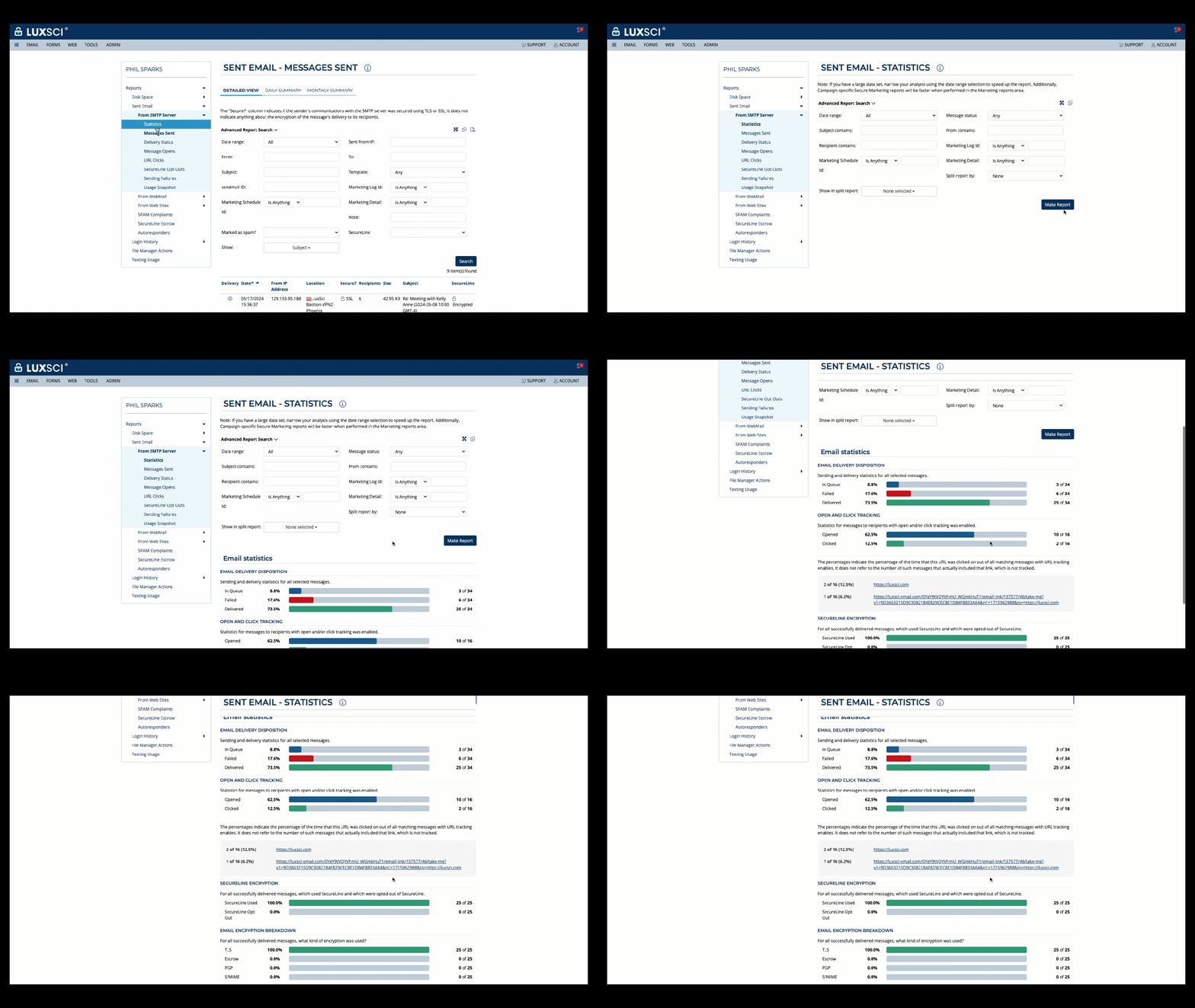
With our latest release, we made these powerful statistics easier to consume and analyze with an improved user interface for more efficiency and greater ease-of-use. Users can simply select the type of report they’d like and customize it using a range of filtering selections. This is great for diving deeper into your email performance to make adjustments on-the-fly, and to spot trends or opportunities for better engagement that you may have missed before.

New UI – Email Deliverability Statistics

LuxSci Secure Email Reporting Statistics

Get more granular, ID trends in real time with Split Reporting

As part of this release, we are pleased to introduce our Split Reporting feature, which empowers users to drill down on email deliverability statistics across a range of parameters, including:

  • subject
  • from address
  • recipient domains
  • marketing ID or campaign
  • custom field

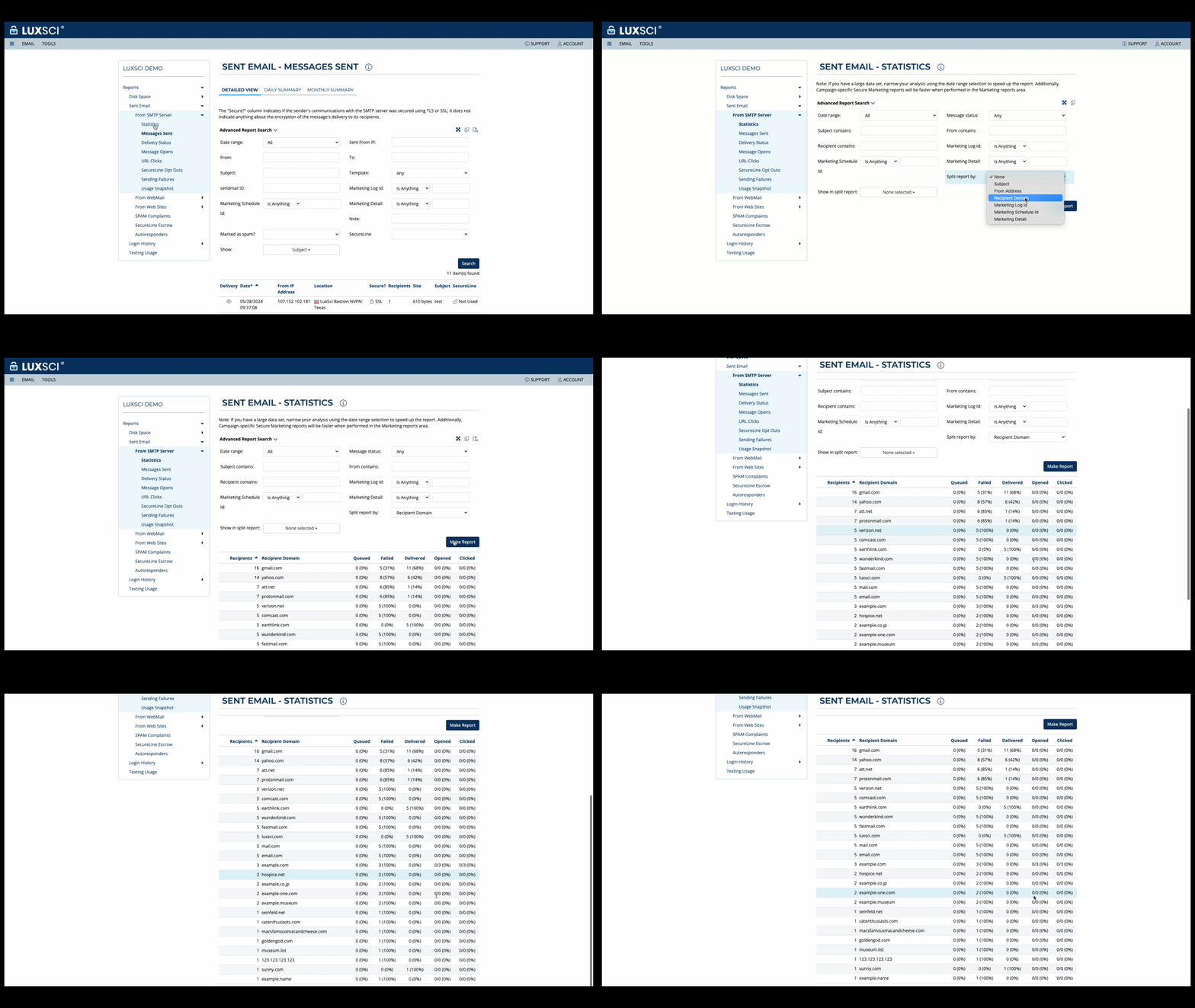
For example, users can analyze email deliverability statistics by subject to determine which ones are performing best, by use case to track results by campaign, or to track performance by recipient email domains. With split reporting, users also can analyze email volumes across queued, delivered, opened, failed and clicked parameters, and determine click-through rates (CTR) to measure effectiveness and ROI of campaigns.

New Feature Example – Split Reporting by Recipient Domain

LuxSci Secure Email Split Reporting

If you’d like to learn more, reach out and connect with us today!


Picture of LuxSci

LuxSci

Get in touch

Find The Best Solution For Your Organization

Talk To An Expert & Get A Quote


A member of our staff will reach out to you

Get Your Free E-Book!

LuxSci High Email Deliverability Best Practices Paper

What you’ll learn:

Related Posts

Zero Trust Email Security in Healthcare

Zero Trust Email Security in Healthcare: A Requirement for Sending PHI?

As healthcare organizations embrace digital patient engagement and AI-assisted care delivery, one reality is becoming impossible to ignore: traditional perimeter-based security is no longer enough. Email, still the backbone of patient and operational communications, has become one of the most exploited attack surfaces.

As a result, Zero Trust email security in healthcare is moving from buzzword to necessity.

At LuxSci, we see this shift firsthand. Healthcare providers, payers, and suppliers are no longer asking if they should modernize their security posture, but how to do it without disrupting care delivery or patient engagement.

Our advice: Start with a Zero Trust-aligned dedicated infrastructure that puts you in total control of email security.

Let’s go deeper!

What Is Zero Trust Email Security in Healthcare?

At its core, Zero Trust email security in healthcare applies the principle of “never trust, always verify” to every email interaction involving protected health information (PHI).

This means:

  • Continuous authentication of users and systems
  • Device and environment validation before granting access
  • Dynamic, policy-based encryption for every message
  • No implicit trust, even within internal networks

Unlike legacy approaches that assume safety inside the network perimeter, Zero Trust treats every email, user, and endpoint as a potential risk.

Why Email Is a Critical Gap in Zero Trust Strategies

While many healthcare organizations have begun adopting Zero Trust frameworks for network access and identity, email often remains overlooked.

This is a major problem.

Email is where:

  • PHI is most frequently shared
  • Human error is most likely to occur
  • Phishing and impersonation attacks are most effective

Without a Zero Trust email security approach, organizations leave a critical gap in their defense strategy, one that attackers can actively exploit.

Healthcare Challenge: Personalized Communication and PHI Risk

Modern healthcare ecosystems are highly distributed:

  • Care teams span multiple locations
  • Third-party vendors access sensitive systems
  • Patients expect digital, personalized communication

This creates a complex web of PHI exchange—much of it through email.

At the same time, compliance requirements like HIPAA demand that PHI email security is addressed at all times.

The result is a growing tension between:

  • Security and compliance
  • Usability, engagement, and better outcomes

From Static Encryption to Intelligent, Adaptive Protection

Traditional email encryption methods often rely on:

  • Manual triggers
  • Static rules
  • User judgment

This introduces risk. A modern zero trust email security in healthcare model replaces this with:

  • Automated encryption policies based on content and context
  • Flexible encryption methods tailored to recipient capabilities – TLS, Portal Fallback, PGP, S/MIME
  • Seamless user experiences that human error – automated email encryption, including content

At LuxSci, our approach to secure healthcare communications is built around this philosophy. By automating encryption and providing each customer with a zero trust-aligned dedicated infrastructure, organizations can protect PHI without relying on end-user decisions or the actions of other vendors on the same cloud, significantly reducing risk while improving performance, including email deliverability.

Aligning Zero Trust with HIPAA and Emerging Frameworks

Zero Trust is not a replacement for compliance, it’s an enabler. A well-implemented Zero Trust approach helps organizations:

  • Meet HIPAA requirements for PHI protection
  • Reduce the likelihood of breaches
  • Strengthen audit readiness and risk management

More importantly, it positions healthcare organizations to align with emerging cybersecurity frameworks that increasingly emphasize identity, data-centric security, and continuous verification.

PHI Protection Starts with Email

Zero Trust is no longer a conceptual framework, it’s becoming the operational standard for healthcare IT, infrastructure, and data security teams.

But success depends on execution. Email remains the most widely used, and vulnerable, communication channels in healthcare. Without addressing it directly, Zero Trust strategies will fall short.

Here are 3 tips to stay on track:

  • Treat every email as a potential risk
  • Automate encryption at scale – secure every email
  • Enable personalized patient engagement with secure PHI in email

At LuxSci, we believe that HIPAA compliant email is the foundation for the future of secure healthcare communications, protecting PHI while enabling better patient engagement and better outcomes.

Reach out today if you want to learn more from our LuxSci experts.

What Sets B2B Marketing In The Healthcare Industry Apart?

B2B marketing in the healthcare industry runs through a buying environment shaped by review, caution, and internal scrutiny. A vendor may catch interest quickly, yet a deal still has to survive procurement, legal input, operational questions, and, in some cases, clinical oversight. That changes the tone and structure of effective outreach. Buyers want clear information, credible framing, and content that holds up when shared across teams. Strong campaigns account for those conditions from the first touch, giving decision makers useful material at the right point in the conversation.

How B2B marketing in the healthcare industry differs from other sectors

Healthcare buying carries a heavier internal burden than many commercial categories. A decision can affect patient related workflows, staff time, data handling, vendor risk, and budget planning all at once. That wider impact shapes how people read. A finance lead may scan for commercial logic and resource use. An operations leader may think immediately about rollout pressure and process disruption. An IT contact may focus on access, integration, and control. Messaging has to stand up to each of those viewpoints. That is why strong healthcare outreach tends to move with more restraint, more clarity, and more attention to proof than campaigns built for faster sales environments.

Trust within B2B marketing in the healthcare industry

Trust grows through judgment on the page. Buyers notice inflated language very quickly, especially when it appears in sectors where risk and accountability are part of everyday work. A polished headline can attract attention, though the body copy still has to carry weight. Clear examples help. Plain explanations help. So does a tone that sounds measured enough for someone to forward internally without hesitation. A payer team may want to see how a service affects review speed or administrative flow. A provider group may care about intake, coordination, or staff workload. A supplier may look for signs that communication across partners will become smoother and easier to manage. Credibility builds when the writing shows a close read of the reader’s world.

Buying committees do not think alike

Most healthcare deals are shaped by several people with different pressures attached to their roles. Procurement may be looking for vendor reliability and a smoother approval process. Compliance may read for privacy exposure and documentation. Operations may focus on practical fit with current workflows. Finance may want a clearer commercial case before the conversation goes any further. Those concerns do not compete with one another so much as stack on top of one another, which is why broad messaging tends to flatten out. Better campaigns anticipate that mix. One sequence can speak to efficiency and team workload. Another can support legal and compliance review. A third can frame the economic rationale in language senior stakeholders will recognise immediately.

Content that helps a deal move

Healthcare content earns its place when it gives buyers something they can use, discuss, and circulate. A short article on referral bottlenecks can help an operations lead frame the problem more clearly. A concise guide to secure communication can help internal teams ask better questions during review. A comparison page on implementation models can help a buyer weigh practical tradeoffs before a call is even booked. Useful content creates momentum because it fits the way decisions are made. It enters the conversation early, gives people sharper language for internal discussion, and keeps the subject alive between meetings. That is where strong work starts to separate itself from content written simply to fill a calendar.

Measuring progress with better signals

Healthcare teams get a clearer picture when they look past surface numbers and pay attention to the signs attached to real interest. Repeat visits from the same account can matter more than a large burst of low value traffic. A reply from an operations contact may tell you more than a high open rate. Visits to implementation, privacy, or procurement pages can indicate that the discussion is moving into a more serious stage.

Patterns like these help commercial teams judge where attention is gathering and where timing is starting to matter. Good B2B marketing in the healthcare industry supports that process by creating sharper entry points for sales, stronger context for follow up, and a more informed path from early curiosity to active evaluation.

Why Does B2B Healthcare Email Marketing Matter To Healthcare Buyers?

B2B healthcare email marketing is the practice of using email to reach healthcare business audiences with timely, relevant communication that supports trust, evaluation, and purchase decisions. In healthcare, that means more than sending promotional copy. Buyers want proof that a vendor understands procurement realities, privacy expectations, clinical workflows, and the pace of internal review. When the message is well judged, email helps move a conversation forward without forcing it. It can introduce a problem, frame the business case, and give decision makers something useful to circulate inside the company while they weigh next steps.

What makes B2B healthcare email marketing work in real buying cycles?

The difference between ignored email and useful email is context. Healthcare deals rarely move on impulse, and very few readers want a sales pitch in their inbox after one click or one download. Good B2B healthcare email marketing takes its cues from where the buyer is in the process. A first touch might define a problem in plain terms. A later message may explain implementation questions, privacy considerations, or internal adoption issues. That sequencing matters because healthcare buyers read with caution. They are not just asking whether a product looks good. They are asking whether it can survive legal review, procurement review, and scrutiny from the teams who will live with it day after day.

How does compliance shape B2B healthcare email marketing?

Healthcare email lives under closer scrutiny than email in many other industries. If a campaign touches protected health information, HIPAA enters the conversation immediately, especially the Privacy Rule and Security Rule. Even when outreach is aimed at business contacts, teams still need a disciplined view of what data is stored, who can access it, and how consent, opt out, and message content are handled.

The CAN SPAM Act also matters because sender identity, subject line accuracy, and unsubscribe function are not small details. Strong B2B healthcare email marketing treats compliance as part of message design from the start. That leads to cleaner copy, better internal approval, and fewer edits after legal teams step in.

Which audiences respond best to B2B healthcare email marketing?

Healthcare buying groups are rarely made up of one decision maker. A payer executive may care about administrative efficiency and audit readiness. A provider operations leader may be focused on referral flow, patient intake, or staff time. A supplier may look at partner communication, order handling, or data movement between systems. B2B healthcare email marketing works better when each audience receives language that matches its concerns instead of one generic message sent to everyone. That does not require jargon. It requires precision in the everyday sense of the word. Readers need to feel that the sender understands the pressures attached to their role, not just the industry label attached to their company.

What kind of content earns trust instead of quick deletion?

Healthcare buyers respond well to emails that help them think clearly. A short note that explains why referral leakage happens will land better than a vague message about transformation. A concise example showing how a health plan cut review delays can do more than a page of inflated claims. This is where B2B healthcare email marketing becomes persuasive without sounding pushy. The best messages teach, but they also move. They give the reader one useful idea, one practical example, and one reason to keep the conversation alive. That balance matters because healthcare readers are trained to be skeptical, and skepticism is not a barrier when the content respects it.

How can teams judge whether the program is doing its job?

Open rate alone does not say much in a long healthcare sales cycle. A better read comes from the quality of replies, the number of relevant page visits after a send, the movement of target accounts through the pipeline, and the way contacts share content internally.

B2B healthcare email marketing earns its place when it helps sales teams enter conversations with better timing and better context. If email is drawing the right people back to security pages, implementation pages, or procurement material, that is a useful signal. The real win is steady progress with buyers who need time, evidence, and confidence before they move.

HIPAA Compliant Email

New HIPAA Security Rule Makes Email Encryption Mandatory—Act Now!

The 2026 Deadline Is Closer Than You Think

The upcoming HIPAA Security Rule overhaul is expected to finalize by mid-2026, and it’s shaping up to be one of the most significant updates in years. Healthcare organizations that fail to prepare, especially when it comes to email security, will face immediate compliance gaps the moment enforcement begins.

Mid-2026 may sound distant, but for healthcare IT and compliance leaders, it’s right around the corner. Regulatory change at this scale doesn’t happen overnight, it requires planning, vendor evaluation, implementation, and internal alignment.

This isn’t a gradual shift. It’s a hard requirement.

Encryption Is About to Become Mandatory

For years, HIPAA has treated encryption as “addressable,” giving organizations flexibility in how they protect sensitive data. That flexibility is disappearing.

Under the updated rule, encryption, particularly for email containing protected health information (PHI), is expected to become a required safeguard.

That means:

  • Encryption must be automatic and standard for email, not optional
  • Policies must be enforced consistently
  • Email security can’t depend on human behavior

If your current system relies on users to manually trigger encryption, it’s already out of step with where compliance is heading. If you’re not encrypting your emails at all, then now is the time to re-evaluate and rest your technology and policies.

Email Is the Weakest Link in Healthcare Security

Email remains the most widely used communication tool in healthcare—and the most common source of data exposure. Every day, sensitive information flows through inboxes, including patient records, lab results, billing details, plan renewals and appointment reminders. Yet many organizations still depend on:

  • Basic TLS encryption that only works under certain conditions
  • Manual processes that leave room for human error
  • Limited visibility into email activity and risk

It only takes one mistake, such as a missed encryption trigger or a misaddressed email, to create a reportable breach. Regulators are well aware of this. That’s why email is a primary focus of the upcoming HIPAA Security Rule changes.

The Cost of Waiting Is Higher Than You Think

Delaying action may feel easier in the short term, but it significantly increases risk. Once the new rule is finalized, organizations without compliant systems may face:

  • Immediate audit failures
  • Regulatory penalties
  • Expensive, rushed remediation efforts
  • Or worst of all, an email security breach

Beyond financial consequences, there’s also reputational harm. Patients expect their data to be protected. A single incident can immediately erode trust and damage your brand beyond repair.

Waiting until the end of 2026 also means that you’ll be competing with every other organization trying to fix the same problem at the same time, driving up costs and limiting vendor availability.

Most Email Solutions Won’t Meet the New Standard

Here’s the uncomfortable reality: many existing email platforms won’t be enough, especially those that are not HIPAA compliant. Common gaps include:

  • Encryption that isn’t automatic or policy-driven
  • Lack of Data Loss Prevention (DLP)
  • Insufficient audit logging for compliance reporting
  • Lack of Zero Trust security principles

On top of that, vendors without alignment to HITRUST certification and Zero-Trust architectures may struggle to demonstrate the level of assurance regulators will expect moving forward.

If your current solution wasn’t designed specifically for healthcare and HIPAA compliance, it’s likely not ready for what’s coming.

LuxSci Secure Email: Built for What’s Next

This is where a purpose-built solution makes all the difference. LuxSci HIPAA compliant email is designed specifically for healthcare organizations navigating the latest compliance requirements, not just today, but in the future regulatory landscape.

LuxSci delivers:

  • Automatic, policy-based encryption that removes user guesswork
  • Advanced DLP controls to prevent PHI exposure before it happens
  • Comprehensive audit logs to support audits and investigations
  • Zero Trust architecture that verifies every user and action

Additionally, LuxSci is HITRUST-certified, helping organizations demonstrate a mature and defensible security posture as regulations tighten. Email data protection isn’t about patching gaps, it’s about eliminating them.

Act Now or Pay Later

If there’s one takeaway, it’s this: the time to act is now. Start by asking a few direct questions:

  • Is our email encryption automatic and enforced?
  • Do we have full visibility into email activity and risk?
  • Is our vendor equipped for evolving HIPAA requirements?

If the answer to any of these is unclear, now’s the time to take action. Organizations that move early will have time to implement the right solution, train their teams, and validate compliance. Those that wait will be forced into reactive decisions under pressure.

Conclusion: The Time to Act is Now!

The HIPAA Security Rule overhaul is coming fast, and it’s raising expectations across the board. Encryption will no longer be addressable, but rather mandatory. As a result, email security can no longer be overlooked, and compliance will no longer tolerate gaps.

LuxSci HIPAA compliant email provides a clear, future-ready path for your organization, combining automated encryption, DLP, auditability, and Zero Trust security in one solution.

The real question isn’t whether change is coming. It’s whether your organization will be ready when it does.

Reach out today. We can look at your existing set up, help you identify the gaps, and show you how LuxSci can help!

FAQs

1. When will the updated HIPAA Security Rule take effect?
The changes to the HIPAA Security Rule are expected to be finalized and announced around mid-2026, with enforcement likely soon after, by the end of the year.

2. Will email encryption truly be mandatory?
Yes, current direction strongly indicates encryption will become a required safeguard, which could start later this year or in early 2027.

3. Is TLS encryption enough for compliance?
No. TLS alone does not provide sufficient, guaranteed protection for PHI.

4. Why is HITRUST important in this context?
HITRUST certification demonstrates a vendor’s strong alignment with healthcare security standards and will likely carry more weight with regulators.

5. How does LuxSci help organizations prepare?
HITRUST-certified LuxSci offers secure email with automated encryption, DLP, audit logs, and Zero Trust architecture, helping organizations meet evolving compliance demands.

You Might Also Like

HIPAA secure email

What Are the HIPAA Emailing Rules Healthcare Organizations Must Follow?

HIPAA emailing rules require healthcare organizations to protect patient information through encryption, access controls, and business associate agreements when transmitting protected health information electronically. The HIPAA Security Rule mandates that covered entities implement administrative, physical, and operational safeguards to ensure the confidentiality, integrity, and availability of electronic protected health information during email transmission. These regulations apply to all healthcare providers, health plans, and healthcare clearinghouses that use email to communicate about patients, making compliance with HIPAA emailing rules essential for avoiding regulatory penalties and protecting patient privacy.

Encryption Requirements and Data Protection Standards

Protected health information transmitted via email must be encrypted using current industry standards that render the information unreadable to unauthorized recipients. The Department of Health and Human Services does not specify particular encryption algorithms, but most healthcare organizations implement Advanced Encryption Standard (AES) 256-bit encryption to meet regulatory expectations. Transport Layer Security (TLS) protocols create secure connections between email servers during message transmission, preventing interception of patient data while communications travel across public internet networks. Message-level encryption protects email content even if transport security fails or messages are stored on intermediate servers during transmission delays. End-to-end encryption ensures that only intended recipients can decrypt and read patient communications, maintaining privacy protection throughout the entire communication process.

Digital signatures provide additional security by verifying sender authenticity and detecting any unauthorized modifications to email content during transmission. These authentication measures help recipients confirm that patient communications originated from legitimate healthcare sources and have not been tampered with by malicious actors. Certificate-based authentication systems ensure that only verified healthcare providers and authorized recipients can access encrypted patient information sent through email channels. Key management protocols protect the encryption keys that safeguard patient information while ensuring that legitimate healthcare providers can access necessary communications without delays that might interfere with patient care. Secure key storage systems prevent unauthorized access to encryption keys while maintaining backup procedures that prevent data loss if primary key storage systems experience failures. Healthcare organizations following HIPAA emailing rules must maintain documented procedures for key management that balance security requirements with operational necessity.

Access Control Implementation and User Authentication

Multi-factor authentication serves as the primary defense against unauthorized access to healthcare email systems containing patient information. Users must provide multiple forms of verification before accessing their email accounts, typically combining passwords with mobile device verification codes, hardware tokens, or biometric identification. Role-based permissions ensure that healthcare staff can only access patient communications relevant to their job responsibilities and patient care relationships. Physicians need different access levels compared to billing specialists or administrative staff, with granular controls preventing unauthorized viewing of patient information outside legitimate care activities. Access permissions should automatically adjust when staff members change positions within healthcare organizations or when their patient care responsibilities shift to different departments or specialties.

Session management controls protect against unauthorized access from unattended workstations by automatically logging users out of email systems after predetermined periods of inactivity. Session timeout configurations must balance security requirements with operational efficiency, allowing sufficient time for healthcare providers to compose thoughtful patient communications without creating security vulnerabilities. Login monitoring systems detect unusual access patterns and trigger security responses when potential account compromises occur. Password policies must enforce strong authentication credentials without creating excessive burden that encourages staff to write down passwords or reuse credentials across multiple healthcare systems. Healthcare organizations implementing HIPAA emailing rules benefit from password managers that help staff maintain unique, complex passwords while integrating with single sign-on systems that reduce authentication friction during busy clinical workflows.

BAA Requirements for HIPAA Emailing Rules

Business associate agreements establish the legal framework governing relationships between healthcare organizations and their email service providers. These contracts must specify exactly how providers will protect patient information, what security measures they will maintain, and detailed procedures for reporting security incidents to healthcare organizations. Agreement terms should cover data retention requirements, geographic restrictions on information storage, and procedures for returning or destroying patient data when business relationships terminate. Vendor security assessments verify that email service providers maintain appropriate technical safeguards and compliance programs before healthcare organizations entrust them with patient information. Due diligence evaluations should include reviewing provider security certifications, examining their data center facilities, and verifying their experience with healthcare compliance requirements. Insurance verification ensures that email providers maintain adequate cyber liability coverage to protect healthcare organizations from financial exposure during security incidents.

Audit rights enable healthcare organizations to verify that their email providers comply with business associate agreement terms and maintain appropriate security controls. These contractual rights should include access to security audit reports, penetration testing results, and compliance documentation relevant to patient data protection. Liability allocation clauses protect healthcare organizations from financial responsibility when email security incidents result from provider negligence or system failures. Contract terms should clearly define each party’s responsibilities for maintaining security controls and specify how costs will be allocated when security breaches require patient notification, credit monitoring, or regulatory penalties. Those mastering HIPAA emailing rules recognize that business associate agreements are the foundation for compliant email communication with third-party service providers.

Workflow Integration for HIPAA Emailing Rules

Staff training programs must educate healthcare workers about appropriate use of email for patient communications and help them understand when alternative communication methods are more appropriate than electronic messaging. Training should cover recipient verification procedures, encryption activation requirements, and any other HIPAA Emailing Rules for determining what health information is suitable for email transmission versus what requires telephone calls or secure patient portals. Healthcare staff need decision-making frameworks that help them evaluate the appropriateness of email communication for different types of patient information and clinical situations. Incident response procedures prepare healthcare organizations to handle security breaches involving patient information transmitted through email systems. Response protocols should include immediate containment measures, assessment of potential patient impact, and notification procedures for affected individuals and regulatory authorities. Documentation requirements ensure that incident response activities demonstrate compliance with breach notification requirements and provide evidence of appropriate remediation efforts.

Backup and disaster recovery procedures protect patient communications from data loss while maintaining the same encryption and access control standards as primary email systems. Recovery procedures should be tested regularly to verify that patient information can be restored quickly without compromising security protections. Archive systems must preserve encrypted email communications for required retention periods while maintaining searchability for clinical and legal purposes. Quality assurance monitoring verifies that email security measures function correctly and staff follow established procedures for protecting patient information. Audit procedures should review email usage patterns, verify encryption activation, and assess compliance with access control requirements. Entities implementing HIPAA emailing rules receive help from automated monitoring systems that detect potential security issues and generate alerts when unusual email activities occur that might indicate security incidents or policy violations.

Consent Procedures for HIPAA Emailing Rules

Patient consent requirements vary depending on the type of health information being transmitted and the communication preferences expressed by individual patients. While healthcare providers can generally communicate with patients about treatment, payment, and healthcare operations without specific authorization, organizations should obtain written consent before sending detailed medical information through email channels. Consent documentation should explain security measures while acknowledging that email communication carries inherent privacy risks despite protective technologies. Communication content guidelines help healthcare staff determine what patient information is appropriate for email transmission versus what requires more secure communication methods. Appointment reminders, general health education, and routine test results may be suitable for encrypted email communication, while psychiatric evaluations, substance abuse treatment records, or genetic testing results may require additional protections or alternative communication approaches. Staff need clear criteria for evaluating the sensitivity of patient information and selecting appropriate communication channels.

AI-based Email Security Threats

How to Avoid AI-Based Email Security Threats

Artificial intelligence (AI) has been the hottest topic in technology for the past few years now, with a focus on how it’s transforming business and the way we work. While we’d seen glimpses of AI’s capabilities before, the release of ChatGPT (containing OpenAI’s groundbreaking GPT-3.5 AI model) put the technology’s limitless potential on full display. Soon, stakeholders in every industry looked to find ways to integrate AI into their organizations, so they could harness its huge productivity and efficiency benefits.

The problem? Hackers and bad actors are using AI too, and it’s only strengthening their ability to carry out data breaches, including AI-based email security threats. 

While AI brings considerable advantages to all types of businesses, unfortunately, its vast capabilities can be used for malicious purposes too. With their unparalleled ability to process data and generate content, cybercriminals can use a variety of AI tools to make their attacks more potent, increasing their potential to get past even the most secure safeguards. 

With all this in mind, this post discusses how AI is helping cyber criminals massively scale their efforts and carry out more sophisticated, widespread attacks. We’ll explore how malicious actors are harnessing AI tools to make AI-based email cyber attacks more personalized, potent, and harmful, and cover three of the most common threats to email security that are being made significantly more dangerous with AI. This includes phishing, business email compromise (BEC) attacks, and malware. We’ll also offer strategic insights on how healthcare organizations can best mitigate AI-enhanced email threats and continue to safeguard the electronic protected health information (ePHI) under their care. 

How Does AI Increase Threats To Email Security?

AI’s effect on email security threats warrants particular concern because it enhances them in three ways: by making email-focused attacks more scalable, sophisticated, and difficult to detect.

Scalability 

First and foremost, AI tools allow cybercriminals to scale effortlessly, enabling them to achieve exponentially more in less time, with few additional resources, if any at all. 

The most obvious example of the scalable capabilities of generative AI involves systems that can create new content from simple instructions, or prompts. In particular, large language models (LLMs), such as those found in widely used AI applications like ChatGPT, allow malicious actors to rapidly generate phishing email templates and similar content that can be used in social engineering attacks, with a level of accuracy in writing and grammar not seen before. Now, work that previously would take email cybercriminals hours can be achieved in mere seconds, with the ability to make near-instant improvements and produce countless variations.   

Similarly, should a social engineering campaign yield results, i.e., getting a potential victim to engage, malicious actors can automate the interaction through AI-powered chatbots, which are capable of extended conversations via email. This increases the risk of a cybercriminal successfully fooling an employee at a healthcare organization to grant access to sensitive patient data or reveal their login credentials so they can breach their company’s email system. 

Additionally, AI allows cybercriminals to scale their efforts by automating aspects of their actions, and gathering information about a victim, i.e., a healthcare organization before launching an attack. AI tools also can scan email systems, metadata, and publicly available information on the internet to identify vulnerable targets, and their respective security flaws. They can then use this information to pinpoint and prioritize high-value victims for future cyber attacks.

Sophistication

In addition to facilitating larger and more frequent cyber attacks, AI systems allow malicious actors to make them more convincing. As mentioned above, generative AI allows cybercriminals to create content quickly, and craft higher-quality content than they’d be capable of through their own manual efforts. 

Again, using phishing as an example, AI can refine phishing emails by eliminating grammatical errors and successfully mimicking distinct communication styles to make them increasingly indistinguishable from legitimate emails. Cybercriminals are also using AI to make their fraudulent communications more context-aware, referencing recent conversations or company events and incorporating data from a variety of sources, such as social media, to increase their perceived legitimacy.  

In the case of another common email attack vector, malware, AI can be used to create constantly evolving malware that can be attached to emails. This creates distinct versions of malware that are more difficult for anti-malware tools to stop.

More Difficult to Detect

This brings us to the third way in which AI tools enhance email threats: by making them harder to detect and helping them evade traditional security measures. 

AI-powered email threats can adapt to a healthcare organization’s cybersecurity measures, observing how its defenses, such as spam filters, flag and block malicious activity before automatically adjusting its behavior until it successfully bypasses them. 

After breaching a healthcare organization’s network, AI offers cybercriminals several new and enhanced capabilities that help them expedite the achievement of their malicious objectives, while making detection more difficult. 

These include:  

  • Content Scanning: AI tools can scan emails, both incoming and outgoing, in real-time to identify patterns pertaining to sensitive data. This allows malicious actors to identify target data in less time, making them more efficient and capable of extracting greater amounts of PHI.  
  • Context-Aware Data Extraction: similarly, AI can differentiate between regular text and sensitive data by recognizing specific formats (e.g., medical record numbers, insurance details, social security numbers, etc.)
  • Stealthy Data Exfiltration: analyzing and extracting PHI, login credentials, and other sensitive data from emails, while blending into normal network traffic. 
  • Distributed Exfiltration: instead of transferring large amounts of data at once, which is likely to trigger cyber defenses, hackers can use AI systems that slowly exfiltrate PHI in smaller payloads over time, better blending into regular network activity.

AI and Phishing

Phishing attacks involve malicious actors impersonating legitimate companies, or employees of a company, to trick victims into revealing sensitive patient data. Typical phishing attack campaigns rely on volume and trial and error. The more messages sent out by cybercriminals, the greater the chance of snaring a victim. Unfortunately, AI applications allow malicious actors to raise the efficacy of their phishing attacks in several ways.

First, AI allows scammers to craft higher-quality messaging. One of the limitations of phishing emails for healthcare companies is that they’re often easy to identify, since they are replete with mis-spelled words, poor grammar, and bad formatting. AI allows malicious actors to overcome these inadequacies and create more convincing messages that are more likely to fool healthcare employees.  

On a similar note, because healthcare is a critical industry, it’s consistently under threat from cybercriminals, which are also known as advanced persistent threats (APTs) or even cyber terrorists. By definition, such malicious actors often reside outside the US and English isn’t their first language. 

While, in the past, this may have been obvious, AI now provides machine translation capabilities, allowing cybercriminals to write messages in their native language, translating them to English, and refining them accordingly. Consequently,  scammers can craft emails with fewer tell-tale signs that healthcare organizations can train their employees to recognize. 

Additionally, as alluded to earlier, AI models can produce countless variations of phishing messages, significantly streamlining the trial-and-error aspect of phishing campaigns and allowing scammers to discover which messaging works best in far less time. 

Lastly, as well as enhancing the efficacy of conventional phishing attacks, AI helps improve spear phishing campaigns, a type of fraudulent email that targets a particular organization or employee who works there, as opposed to the indiscriminate, “scatter” approach of regular phishing.

While, traditionally, spear phishing requires a lot of research, AI can scrape data from a variety of sources, such as social media, forums, and other web pages, to automate a lot of this manual effort. This then allows cybercriminals to carry out the reconnaissance required for successful attacks faster and more effectively, increasing their frequency and, subsequently, their rate of success. 

AI and Business Email Compromise (BEC) Attacks

A business email compromise (BEC) is a type of targeted email attack that involves cybercriminals gaining access to or spoofing (i.e., copying) a legitimate email account to manipulate those who trust its owner into sharing sensitive data or executing fraudulent transactions. BEC attacks can be highly effective and, therefore, damaging to healthcare companies, but they typically require extensive research on the target organization to be carried out successfully. However, as with spear phishing, AI tools can drastically reduce the time it takes to identify potential targets and pinpoint possible attack vectors. 

For a start, cybercriminals can use AI to undertake reconnaissance tasks in a fraction of the time required previously. This includes identifying target companies and employees whose email addresses they’d like to compromise, generating lists of vendors that do business with said organization, and even researching specific individuals who are likely to interact with the target.  

Once a target is acquired, malicious actors can use AI tools in a number of terrifying ways to create more convincing messaging. By analyzing existing emails, AI solutions can quickly mimic the writing style of the owner of the compromised account, giving them a better chance of fooling the people they interact with. 

By the same token, they can use information gleaned from past emails to better contextualize fraudulent messages, i.e., adding particular information to make subsequent requests more plausible. For example, requesting data or login credentials in relation to a new project or recently launched initiative. 

Taking this a step further, cybercriminals could supplement a BEC attack with audio or video deepfakes created by AI to further convince victims of their legitimacy. Scammers can use audio deepfakes to leave voicemails or, if being especially brazen, conduct entire phone conversations to make their identity theft especially compelling.

Meanwhile, scammers can create video deepfakes that relay special instructions, such as transferring money, and attach them to emails. Believing the request came from a legitimate source, there’s a chance employees will comply with the request, boosting the efficacy of the BEC attack in the process. Furthermore, the less familiar an employee is with attacks of this kind, the more likely they are to fall victim to them.   

In short, AI models make it easier to carry out BEC attacks, which makes it all the more likely for cybercriminals to attempt them.

AI and Malware 

Malware refers to any kind of malicious software (hence, “mal(icous) (soft)ware”), such as viruses, Trojan horses, spyware, and ransomware, all of which can be enhanced by AI in several ways.

Most notable is AI’s effect on polymorphic malware, which has the ability to constantly evolve to bypass email security measures, making malicious attachments harder to detect. Malware, as with any piece of software, carries a unique digital signature that can be used to identify it and confirm its legitimacy. Anti-malware solutions traditionally use these digital signatures to flag instances of malware, but the signature of polymorphic malware changes as it evolves, allowing it to slip past email security measures. 

While polymorphic malware isn’t new, and previously relied on pre-programmed techniques such as encryption and code obfuscation, AI technology has made it far more sophisticated and difficult to detect. Now, AI-powered polymorphic malware can evolve in real-time, adapting in response to the defense measures it encounters. 

AI can also be used to discover Zero Day exploits, i.e., previously unknown security flaws, within email and network systems in less time. Malicious actors can employ AI-driven scanning tools to uncover vulnerabilities unknown to the software vendor at the time of its release and exploit them before they have the opportunity to release a patch.

How To Mitigate AI-Based Email Security Threats

While AI can be used to increase the effectiveness of email attacks, fortunately, the fundamentals of mitigating email threats remains the same; organizations must be more vigilant and diligent in following email security best practices and staying on top of the latest threats and tools used by cybercriminals. 

Let’s explore some of the key strategies for best mitigating AI-based email threats and better safeguarding the ePHI within your organization.

  • Educate Your Employees: ensure your employees are aware of how AI can enhance existing email threats. More importantly, demonstrate what this looks like in a real-world setting, showing examples of AI-generated phishing and BEC emails compared to traditional messages, what a convincing deepfake looks and sounds like, instances of polymorphic malware, and so on.

    Additionally, conduct regular simulations, involving AI-enhanced phishing, BEC attacks, etc., as part of your employees’ cyber threat awareness training. This gives them first-hand experience in identifying AI-driven email threats, so they’re not caught off-guard when they encounter them in real life. You can schedule these simulations to occur every few months, so your organization remains up-to-date on the latest email threat intelligence.
     
  • Enforce Strong Email Authentication Protocols: ensure that all incoming emails are authenticated using the following:
    • Sender Policy Framework (SPF): verifies that emails are sent from a domain’s authorized servers, helping to prevent email spoofing. 
    • DomainKeys Identified Mail (DKIM): preserves the integrity of the message’s contents by adding a cryptographic signature, mitigating compromise during transit, e.g., stealthy or distributed data exfiltration. 
    • Domain-based Message Authentication, Reporting & Conformance (DMARC): enforces email authentication policies, helping organizations detect and block unauthorized emails that fail SPF or DKIM checks.

By verifying sender legitimacy, preventing email spoofing, and blocking fraudulent messages, these authentication protocols are key defenses against AI-enhanced phishing and business email compromise (BEC) attacks.

  • Access Control: while AI increases the risk of PHI exposure and login credential compromise, the level of access that a compromised or negligent employee has to patient data is another problem entirely. Subsequently, data breaches can be mitigated by ensuring that employees only have access to the minimum amount of data required for their job roles, i.e. role-based access control (RBAC). This reduces the potential impact of a given data breach, as it lowers the chances that a malicious actor can extract large amounts of data from a sole employee.
  • Implement Multi-Factor Authentication (MFA): MFA provides an extra layer of protection by requiring users to verify their identity in multiple ways. So, even in the event that a cybercriminal gets ahold of an employee’s login credentials, they still won’t have sufficient means to prove they are who they claim to be.
  • Establish Incident Response and Recovery Plans: unfortunately, by making them more scalable, sophisticated, and harder to detect, AI increases the inevitability of security breaches. This makes it more crucial than ever to develop and maintain a comprehensive incident response plan that includes strategies for responding to AI-enhanced email security threats.

    By establishing clear protocols regarding detection, reporting, containment, and recovery, your organization can effectively mitigate, or at least minimize, the impact of email-based cyber attacks enhanced by AI. Your incident response plan should be a key aspect of your employee cyber awareness training, so your workforce knows what to do in the event of a security incident. 

Get Your Copy of LuxSci’s 2025 Email Cyber Threat Readiness Report

To learn more about healthcare’s ever-evolving email threat landscape and how to best ensure the security and privacy of your sensitive data, download your copy of LuxSci’s 2025 Email Cyber Threat Readiness Report. 

You’ll discover:

  • The latest threats to email security in 2025, including AI-based attacks
  • The most effective strategies for strengthening your email security posture
  • The upcoming changes to the HIPAA Security Rule and how it will impact healthcare organizations.

Grab your copy of the report here and start increasing your company’s email cyber threat readiness today.

HIPAA Emailing Patient Information

How Hypersegmentation Drives Greater Healthcare Marketing Engagement

In healthcare marketing, effective engagement is crucial. It’s imperative that healthcare providers, payers, and suppliers know how to connect with their patients and customers, keeping them aware of all aspects of their healthcare journey – and empowering them to participate as much as possible. 

This is where segmentation comes in. 

Instead of sending out healthcare marketing email communications that appeal to as many people as possible, segmentation enables healthcare companies to appeal to specific individuals or groups. It opens the doors for scenarios in which patients and customers see a message in their inbox and think, ‘this message is for me’. 

With that goal in mind, this post explores use cases and best practices in segmentation, why it’s so important for healthcare companies, and different ways that marketers can segment their audiences for optimal patient and customer engagement.

What is Segmentation?

Segmentation is the process of dividing your contact list, or audience, into smaller groups based on shared data, including protected health information (ePHI) characteristics. This could include demographics (age, gender, geographic location, etc.), medical conditions, risk factors, behaviors, and so on. 

Why Segmentation is Essential in Healthcare Email Marketing

For healthcare organizations, segmentation is a highly effective, and essential, strategy for sending patients and customers personalized email messaging. Personalized emails are more relevant to the recipient, which greatly increases the chance of them capturing their attention and subsequent engagement. 

This allows healthcare companies to successfully achieve the objective of their email campaigns, whether that’s reducing the number of appointment no-shows, increasing adherence to care plans, securing payments, or boosting sign-ups or sales. More importantly, patients and customers are more involved in their healthcare journey, staying on top of upcoming appointments, receiving applicable advice and recommendations, and becoming aware of products and services that may prove beneficial to their health, improving overall outcomes. 

Additionally, dividing audiences into distinct groups gives healthcare organizations invaluable insights into the behaviour and needs of different segments at different stages of the healthcare journey. 

For instance, an email campaign targeting a particular segment may reveal that they’re more likely to miss appointments than other groups. Similarly, segmentation may highlight that a certain high-risk group neglects to book recommended health screenings. Such insights enable healthcare providers, payers, and suppliers to improve their email engagement strategies, to drive more desirable outcomes and, ultimately more satisfied, loyal, and, above all, healthier patients and customers. 

How Can Segmentation Aid HIPAA Compliance?

Another considerable benefit of segmentation for healthcare organizations is that it supports their HIPAA compliance efforts. Because segmentation necessitates setting precise rules that control which individuals receive particular emails, it greatly mitigates the risk of accidentally sending sensitive patient data to the wrong person. 

Let’s say, for instance, that you want to conduct an email campaign targeting expectant mothers. By creating a segment comprised of pregnant patients or customers using the appropriate data field, you ensure that sensitive, pregnancy-related information is only sent to relevant parties. By reducing the likelihood of disclosing PHI to the wrong individuals, segmentation not only helps maintain regulatory compliance, but also preserves patient trust and confidence in your organization.

Different Ways to Segment Your Audience 

Demographic Segmentation

This involves grouping individuals by shared demographic attributes such as:

  • Age
  • Gender
  • Location
  • Ethnicity
  • Education Level
  • Employment Status
  • Marital Status
  • Family Status
  • Socioeconomic Status (Income)
  • Spoken Languages / Preferred Language
  • Income
  • Insurance Coverage Type
  • Religious or Cultural Affiliations

Demographic information is a very powerful way to segment audiences to send them valuable, highly relevant information, for example:

  • Sending mammogram or prostate screening recommendations to women or men over a certain age. 
  • Sending health alerts to people in a certain region or ZIP code in response to the emergence of a disease in their area (e.g., flu, a new COVID strain). 
  • Making educational material easy to understand and informative. 

Clinical Segmentation

Here, individuals are grouped according to medical criteria, such as:

  • Health conditions
  • Prescribed medications
  • Treatment plans
  • Recent surgeries or medical procedures 
  • Recent lab test results
  • Hospitalization history
  • Vaccination status

This enables healthcare organizations to craft a wide range of specific communications that hone in on particular patients and customers, including:

  • Disease management and preventative care advice for people suffering from certain conditions, e.g, how diabetic patients can best monitor and manage their blood sugar.
  • Recovery guidance for post-operative patients. 
  • Feedback requests for individuals on particular treatment plans, in an effort to optimize them. 

Healthcare Journey Stage Segmentation

This divides individuals according to their position in their care journey within your organization. 

For healthcare providers, new patients should receive onboarding materials, explanations of services and how to make the most of them, and similar materials that help them feel welcome and informed. Existing patients, meanwhile, can be further segmented into active, overdue (inactive), or high-risk groups – all of which have different needs and ways in which they should be communicated with: 

  • Active patients: appointment reminders, educational materials, event and service recommendations, satisfaction surveys, etc. 
  • Overdue and inactive patients: appointment or payment reminders, re-engagement communications, etc. 
  • At risk patients: more frequent communications, care coordination messages, or support service referrals

Behavioral Segmentation

This method of segmentation is based on how recipients interact with emails or services, including:

  • How often they open emails.
  • If they click through on links.
  • If they use patient portals.
  • If they complete forms.
  • How often they attend scheduled appointments. 

This segmentation empowers healthcare organizations to tailor the content type, frequency, and calls-to-action based on real engagement insights, and also carry out automated workflows based on each individual’s interaction with an email.

Supercharge Your Segmentation with LuxSci

LuxSci’s empowers healthcare organizations to effectively segment their contact lists into distinct target audiences for greater engagement in the following ways:  

  • LuxSci Secure Marketing features powerful hypersegmentation capabilities for granular targeting that increase opens, clicks and conversions for your healthcare marketing campaigns. 
  • LuxSci Secure High Volume Email enables companies to execute campaigns encompassing hundreds of thousands or millions of emails, targeting specific groups and audiences. 
  • Easy integration with EHR, CDP, and CRM systems to leverages deeper levels data for highly targeting, highly personalized email campaigns. 

Reach out today to learn how LuxSci can help you reach more patients and customers, drive more engagement and conversions, and improve overall outcomes.

Is AWS IAM HIPAA Compliant

Is AWS IAM HIPAA Compliant?

AWS Identity and Access Management (IAM) can be part of a HIPAA-compliant AWS environment when properly configured and used to control access to HIPAA-eligible services covered under Amazon’s Business Associate Agreement (BAA). IAM itself provides the access control mechanisms necessary for protecting healthcare data, but doesn’t automatically create HIPAA compliance. Healthcare organizations must implement appropriate IAM policies, permission boundaries, and monitoring to become HIPAA compliant.

Access Control Management

AWS IAM manages access permissions for AWS resources through users, groups, and roles with various policies. Healthcare organizations use IAM to restrict who can access AWS services that store or process protected health information. This service helps fulfill the HIPAA Security Rule requirements for access management and authorization controls. IAM enables detailed permissions that follow the principle of least privilege, giving users only the access they need to perform their jobs. While IAM provides these security capabilities, healthcare organizations remain responsible for configuring them properly to be HIPAA compliant.

Configuration Steps

Healthcare organizations must implement particular IAM configurations to support HIPAA compliance. Multi-factor authentication adds an extra verification layer beyond passwords for accounts accessing patient data. Permission boundaries limit maximum privileges that can be granted to users or roles. IAM policies should restrict access based on job functions and responsibilities. Regular access reviews verify that permissions remain appropriate as staff roles change. Password policies enforce complexity requirements and regular rotation. Organizations typically document these configuration decisions as part of their overall security planning to demonstrate efforts to become HIPAA compliant.

Audit Trail Implementation

HIPAA requires tracking who accesses protected health information and when this access occurs. AWS IAM integrates with CloudTrail to log all user activities and API calls. These logs create audit trails showing who performed what actions within AWS services that manage healthcare data. Organizations must configure appropriate log retention periods based on their compliance requirements. Monitoring tools should alert security teams about suspicious activities like failed login attempts or unusual access patterns. This monitoring capability helps organizations identify potential security issues and respond promptly to maintain HIPAA compliance.

Complementary AWS Security Services

IAM works with other AWS services to create a complete HIPAA compliance environment. AWS Organizations helps manage multiple accounts with centralized policy control for healthcare environments. AWS Key Management Service (KMS) handles encryption keys that protect healthcare data. AWS Secrets Manager securely stores database credentials and API keys. AWS Control Tower provides guardrails that enforce security policies across multiple accounts. Healthcare organizations often implement these services together to create thorough security architectures. This integrated approach helps maintain consistent controls across all systems handling protected health information.

Permission Management Approaches

Effective IAM policy management forms an essential part of maintaining HIPAA compliance. Organizations should document their IAM policy creation and review processes. Templates for common healthcare roles help maintain consistency when creating new accounts. Regular policy reviews identify and remove unnecessary permissions. Automated tools can validate that policies align with security standards and best practices. Changes to IAM permissions should follow change management procedures with appropriate approvals. These practices help organizations maintain proper access controls throughout their AWS environment.

BAA HIPAA Compliant Requirements

AWS offers a Business Associate Agreement (BAA) that applies to specific HIPAA-eligible AWS services used to store, process, or transmit protected health information. AWS Identity and Access Management (IAM) itself does not store or process ePHI, but is used to control access to HIPAA-eligible services covered under the BAA. Healthcare organizations must execute the AWS BAA before storing any patient data in HIPAA-eligible AWS services. While IAM plays a critical role in enforcing access controls, organizations remain responsible for properly configuring and managing IAM as part of their overall HIPAA compliance program.