LuxSci

New Reporting Features Go Deeper on Email Deliverability Statistics, Trends and Analysis

LuxSci Secure Email Reporting Statistics

We recently rolled out new email reporting features, taking deliverability depth and analysis to new levels. If you’re a current LuxSci customer and haven’t checked them out, now’s the time. If you’re new to LuxSci, learn more below, and don’t hesitate to reach out for more info – or a demo.

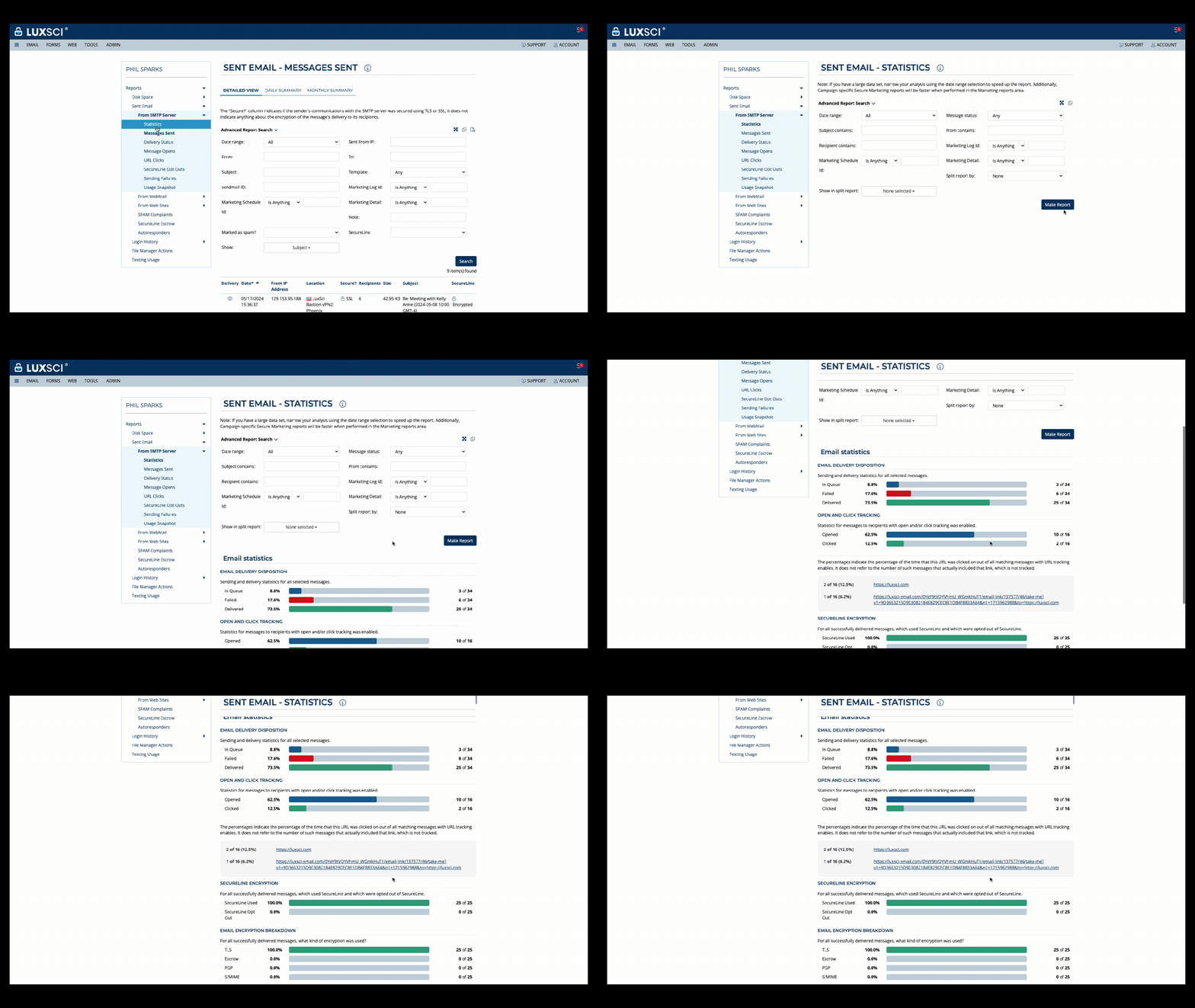
LuxSci secure communications solutions have always featured rich reporting on email deliverability, including volumes and percentages for emails:

  • in queue
  • opened
  • clicked
  • failed
  • secured

With our latest release, we made these powerful statistics easier to consume and analyze with an improved user interface for more efficiency and greater ease-of-use. Users can simply select the type of report they’d like and customize it using a range of filtering selections. This is great for diving deeper into your email performance to make adjustments on-the-fly, and to spot trends or opportunities for better engagement that you may have missed before.

New UI – Email Deliverability Statistics

LuxSci Secure Email Reporting Statistics

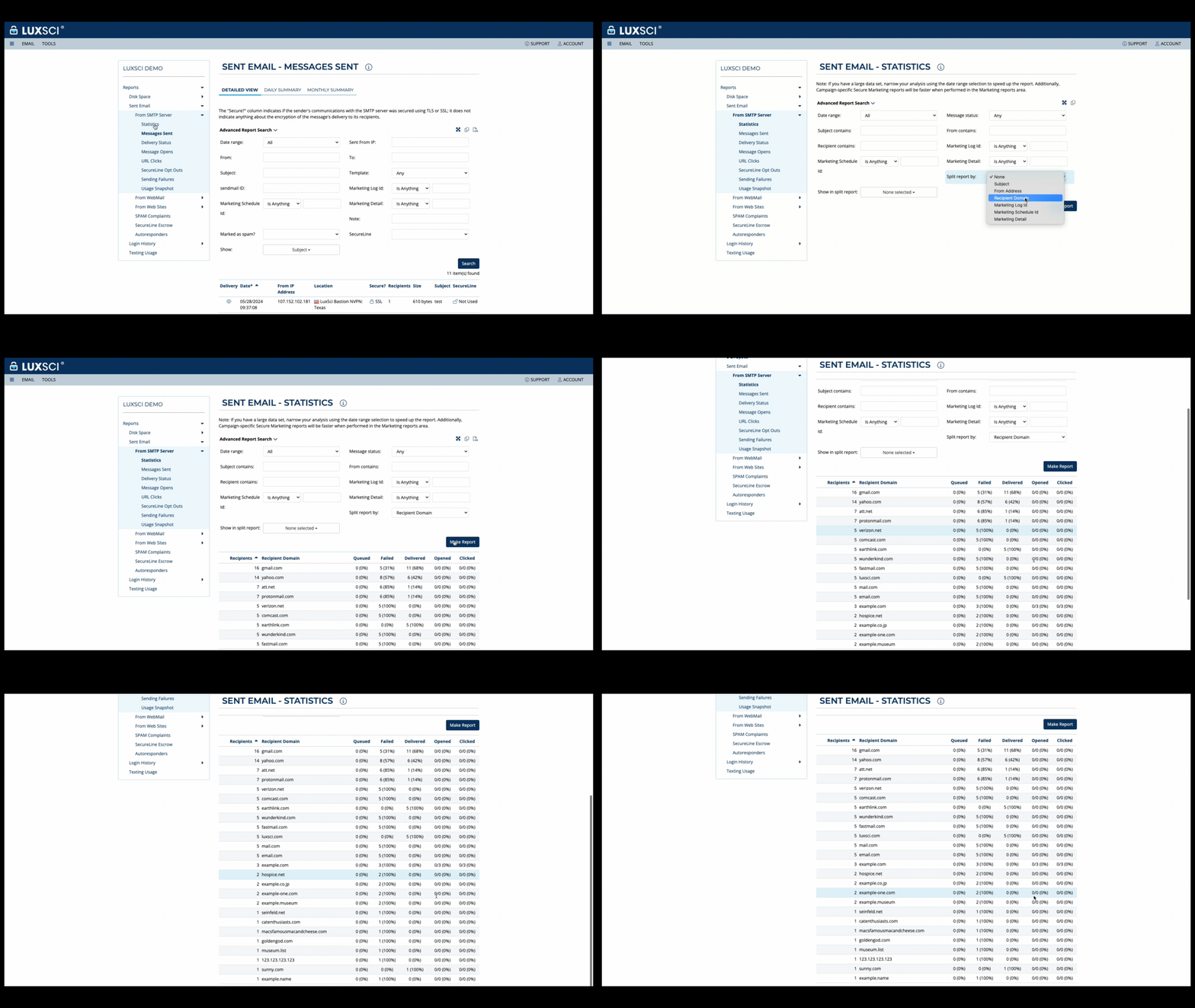
Get more granular, ID trends in real time with Split Reporting

As part of this release, we are pleased to introduce our Split Reporting feature, which empowers users to drill down on email deliverability statistics across a range of parameters, including:

  • subject
  • from address
  • recipient domains
  • marketing ID or campaign
  • custom field

For example, users can analyze email deliverability statistics by subject to determine which ones are performing best, by use case to track results by campaign, or to track performance by recipient email domains. With split reporting, users also can analyze email volumes across queued, delivered, opened, failed and clicked parameters, and determine click-through rates (CTR) to measure effectiveness and ROI of campaigns.

New Feature Example – Split Reporting by Recipient Domain

LuxSci Secure Email Split Reporting

If you’d like to learn more, reach out and connect with us today!


Picture of LuxSci

LuxSci

Get in touch

Find The Best Solution For Your Organization

Talk To An Expert & Get A Quote


A member of our staff will reach out to you

Get Your Free E-Book!

LuxSci High Email Deliverability Best Practices Paper

What you’ll learn:

Related Posts

Zero Trust Email Security in Healthcare

Zero Trust Email Security in Healthcare: A Requirement for Sending PHI?

As healthcare organizations embrace digital patient engagement and AI-assisted care delivery, one reality is becoming impossible to ignore: traditional perimeter-based security is no longer enough. Email, still the backbone of patient and operational communications, has become one of the most exploited attack surfaces.

As a result, Zero Trust email security in healthcare is moving from buzzword to necessity.

At LuxSci, we see this shift firsthand. Healthcare providers, payers, and suppliers are no longer asking if they should modernize their security posture, but how to do it without disrupting care delivery or patient engagement.

Our advice: Start with a Zero Trust-aligned dedicated infrastructure that puts you in total control of email security.

Let’s go deeper!

What Is Zero Trust Email Security in Healthcare?

At its core, Zero Trust email security in healthcare applies the principle of “never trust, always verify” to every email interaction involving protected health information (PHI).

This means:

  • Continuous authentication of users and systems
  • Device and environment validation before granting access
  • Dynamic, policy-based encryption for every message
  • No implicit trust, even within internal networks

Unlike legacy approaches that assume safety inside the network perimeter, Zero Trust treats every email, user, and endpoint as a potential risk.

Why Email Is a Critical Gap in Zero Trust Strategies

While many healthcare organizations have begun adopting Zero Trust frameworks for network access and identity, email often remains overlooked.

This is a major problem.

Email is where:

  • PHI is most frequently shared
  • Human error is most likely to occur
  • Phishing and impersonation attacks are most effective

Without a Zero Trust email security approach, organizations leave a critical gap in their defense strategy, one that attackers can actively exploit.

Healthcare Challenge: Personalized Communication and PHI Risk

Modern healthcare ecosystems are highly distributed:

  • Care teams span multiple locations
  • Third-party vendors access sensitive systems
  • Patients expect digital, personalized communication

This creates a complex web of PHI exchange—much of it through email.

At the same time, compliance requirements like HIPAA demand that PHI email security is addressed at all times.

The result is a growing tension between:

  • Security and compliance
  • Usability, engagement, and better outcomes

From Static Encryption to Intelligent, Adaptive Protection

Traditional email encryption methods often rely on:

  • Manual triggers
  • Static rules
  • User judgment

This introduces risk. A modern zero trust email security in healthcare model replaces this with:

  • Automated encryption policies based on content and context
  • Flexible encryption methods tailored to recipient capabilities – TLS, Portal Fallback, PGP, S/MIME
  • Seamless user experiences that human error – automated email encryption, including content

At LuxSci, our approach to secure healthcare communications is built around this philosophy. By automating encryption and providing each customer with a zero trust-aligned dedicated infrastructure, organizations can protect PHI without relying on end-user decisions or the actions of other vendors on the same cloud, significantly reducing risk while improving performance, including email deliverability.

Aligning Zero Trust with HIPAA and Emerging Frameworks

Zero Trust is not a replacement for compliance, it’s an enabler. A well-implemented Zero Trust approach helps organizations:

  • Meet HIPAA requirements for PHI protection
  • Reduce the likelihood of breaches
  • Strengthen audit readiness and risk management

More importantly, it positions healthcare organizations to align with emerging cybersecurity frameworks that increasingly emphasize identity, data-centric security, and continuous verification.

PHI Protection Starts with Email

Zero Trust is no longer a conceptual framework, it’s becoming the operational standard for healthcare IT, infrastructure, and data security teams.

But success depends on execution. Email remains the most widely used, and vulnerable, communication channels in healthcare. Without addressing it directly, Zero Trust strategies will fall short.

Here are 3 tips to stay on track:

  • Treat every email as a potential risk
  • Automate encryption at scale – secure every email
  • Enable personalized patient engagement with secure PHI in email

At LuxSci, we believe that HIPAA compliant email is the foundation for the future of secure healthcare communications, protecting PHI while enabling better patient engagement and better outcomes.

Reach out today if you want to learn more from our LuxSci experts.

What Sets B2B Marketing In The Healthcare Industry Apart?

B2B marketing in the healthcare industry runs through a buying environment shaped by review, caution, and internal scrutiny. A vendor may catch interest quickly, yet a deal still has to survive procurement, legal input, operational questions, and, in some cases, clinical oversight. That changes the tone and structure of effective outreach. Buyers want clear information, credible framing, and content that holds up when shared across teams. Strong campaigns account for those conditions from the first touch, giving decision makers useful material at the right point in the conversation.

How B2B marketing in the healthcare industry differs from other sectors

Healthcare buying carries a heavier internal burden than many commercial categories. A decision can affect patient related workflows, staff time, data handling, vendor risk, and budget planning all at once. That wider impact shapes how people read. A finance lead may scan for commercial logic and resource use. An operations leader may think immediately about rollout pressure and process disruption. An IT contact may focus on access, integration, and control. Messaging has to stand up to each of those viewpoints. That is why strong healthcare outreach tends to move with more restraint, more clarity, and more attention to proof than campaigns built for faster sales environments.

Trust within B2B marketing in the healthcare industry

Trust grows through judgment on the page. Buyers notice inflated language very quickly, especially when it appears in sectors where risk and accountability are part of everyday work. A polished headline can attract attention, though the body copy still has to carry weight. Clear examples help. Plain explanations help. So does a tone that sounds measured enough for someone to forward internally without hesitation. A payer team may want to see how a service affects review speed or administrative flow. A provider group may care about intake, coordination, or staff workload. A supplier may look for signs that communication across partners will become smoother and easier to manage. Credibility builds when the writing shows a close read of the reader’s world.

Buying committees do not think alike

Most healthcare deals are shaped by several people with different pressures attached to their roles. Procurement may be looking for vendor reliability and a smoother approval process. Compliance may read for privacy exposure and documentation. Operations may focus on practical fit with current workflows. Finance may want a clearer commercial case before the conversation goes any further. Those concerns do not compete with one another so much as stack on top of one another, which is why broad messaging tends to flatten out. Better campaigns anticipate that mix. One sequence can speak to efficiency and team workload. Another can support legal and compliance review. A third can frame the economic rationale in language senior stakeholders will recognise immediately.

Content that helps a deal move

Healthcare content earns its place when it gives buyers something they can use, discuss, and circulate. A short article on referral bottlenecks can help an operations lead frame the problem more clearly. A concise guide to secure communication can help internal teams ask better questions during review. A comparison page on implementation models can help a buyer weigh practical tradeoffs before a call is even booked. Useful content creates momentum because it fits the way decisions are made. It enters the conversation early, gives people sharper language for internal discussion, and keeps the subject alive between meetings. That is where strong work starts to separate itself from content written simply to fill a calendar.

Measuring progress with better signals

Healthcare teams get a clearer picture when they look past surface numbers and pay attention to the signs attached to real interest. Repeat visits from the same account can matter more than a large burst of low value traffic. A reply from an operations contact may tell you more than a high open rate. Visits to implementation, privacy, or procurement pages can indicate that the discussion is moving into a more serious stage.

Patterns like these help commercial teams judge where attention is gathering and where timing is starting to matter. Good B2B marketing in the healthcare industry supports that process by creating sharper entry points for sales, stronger context for follow up, and a more informed path from early curiosity to active evaluation.

Why Does B2B Healthcare Email Marketing Matter To Healthcare Buyers?

B2B healthcare email marketing is the practice of using email to reach healthcare business audiences with timely, relevant communication that supports trust, evaluation, and purchase decisions. In healthcare, that means more than sending promotional copy. Buyers want proof that a vendor understands procurement realities, privacy expectations, clinical workflows, and the pace of internal review. When the message is well judged, email helps move a conversation forward without forcing it. It can introduce a problem, frame the business case, and give decision makers something useful to circulate inside the company while they weigh next steps.

What makes B2B healthcare email marketing work in real buying cycles?

The difference between ignored email and useful email is context. Healthcare deals rarely move on impulse, and very few readers want a sales pitch in their inbox after one click or one download. Good B2B healthcare email marketing takes its cues from where the buyer is in the process. A first touch might define a problem in plain terms. A later message may explain implementation questions, privacy considerations, or internal adoption issues. That sequencing matters because healthcare buyers read with caution. They are not just asking whether a product looks good. They are asking whether it can survive legal review, procurement review, and scrutiny from the teams who will live with it day after day.

How does compliance shape B2B healthcare email marketing?

Healthcare email lives under closer scrutiny than email in many other industries. If a campaign touches protected health information, HIPAA enters the conversation immediately, especially the Privacy Rule and Security Rule. Even when outreach is aimed at business contacts, teams still need a disciplined view of what data is stored, who can access it, and how consent, opt out, and message content are handled.

The CAN SPAM Act also matters because sender identity, subject line accuracy, and unsubscribe function are not small details. Strong B2B healthcare email marketing treats compliance as part of message design from the start. That leads to cleaner copy, better internal approval, and fewer edits after legal teams step in.

Which audiences respond best to B2B healthcare email marketing?

Healthcare buying groups are rarely made up of one decision maker. A payer executive may care about administrative efficiency and audit readiness. A provider operations leader may be focused on referral flow, patient intake, or staff time. A supplier may look at partner communication, order handling, or data movement between systems. B2B healthcare email marketing works better when each audience receives language that matches its concerns instead of one generic message sent to everyone. That does not require jargon. It requires precision in the everyday sense of the word. Readers need to feel that the sender understands the pressures attached to their role, not just the industry label attached to their company.

What kind of content earns trust instead of quick deletion?

Healthcare buyers respond well to emails that help them think clearly. A short note that explains why referral leakage happens will land better than a vague message about transformation. A concise example showing how a health plan cut review delays can do more than a page of inflated claims. This is where B2B healthcare email marketing becomes persuasive without sounding pushy. The best messages teach, but they also move. They give the reader one useful idea, one practical example, and one reason to keep the conversation alive. That balance matters because healthcare readers are trained to be skeptical, and skepticism is not a barrier when the content respects it.

How can teams judge whether the program is doing its job?

Open rate alone does not say much in a long healthcare sales cycle. A better read comes from the quality of replies, the number of relevant page visits after a send, the movement of target accounts through the pipeline, and the way contacts share content internally.

B2B healthcare email marketing earns its place when it helps sales teams enter conversations with better timing and better context. If email is drawing the right people back to security pages, implementation pages, or procurement material, that is a useful signal. The real win is steady progress with buyers who need time, evidence, and confidence before they move.

HIPAA Compliant Email

New HIPAA Security Rule Makes Email Encryption Mandatory—Act Now!

The 2026 Deadline Is Closer Than You Think

The upcoming HIPAA Security Rule overhaul is expected to finalize by mid-2026, and it’s shaping up to be one of the most significant updates in years. Healthcare organizations that fail to prepare, especially when it comes to email security, will face immediate compliance gaps the moment enforcement begins.

Mid-2026 may sound distant, but for healthcare IT and compliance leaders, it’s right around the corner. Regulatory change at this scale doesn’t happen overnight, it requires planning, vendor evaluation, implementation, and internal alignment.

This isn’t a gradual shift. It’s a hard requirement.

Encryption Is About to Become Mandatory

For years, HIPAA has treated encryption as “addressable,” giving organizations flexibility in how they protect sensitive data. That flexibility is disappearing.

Under the updated rule, encryption, particularly for email containing protected health information (PHI), is expected to become a required safeguard.

That means:

  • Encryption must be automatic and standard for email, not optional
  • Policies must be enforced consistently
  • Email security can’t depend on human behavior

If your current system relies on users to manually trigger encryption, it’s already out of step with where compliance is heading. If you’re not encrypting your emails at all, then now is the time to re-evaluate and rest your technology and policies.

Email Is the Weakest Link in Healthcare Security

Email remains the most widely used communication tool in healthcare—and the most common source of data exposure. Every day, sensitive information flows through inboxes, including patient records, lab results, billing details, plan renewals and appointment reminders. Yet many organizations still depend on:

  • Basic TLS encryption that only works under certain conditions
  • Manual processes that leave room for human error
  • Limited visibility into email activity and risk

It only takes one mistake, such as a missed encryption trigger or a misaddressed email, to create a reportable breach. Regulators are well aware of this. That’s why email is a primary focus of the upcoming HIPAA Security Rule changes.

The Cost of Waiting Is Higher Than You Think

Delaying action may feel easier in the short term, but it significantly increases risk. Once the new rule is finalized, organizations without compliant systems may face:

  • Immediate audit failures
  • Regulatory penalties
  • Expensive, rushed remediation efforts
  • Or worst of all, an email security breach

Beyond financial consequences, there’s also reputational harm. Patients expect their data to be protected. A single incident can immediately erode trust and damage your brand beyond repair.

Waiting until the end of 2026 also means that you’ll be competing with every other organization trying to fix the same problem at the same time, driving up costs and limiting vendor availability.

Most Email Solutions Won’t Meet the New Standard

Here’s the uncomfortable reality: many existing email platforms won’t be enough, especially those that are not HIPAA compliant. Common gaps include:

  • Encryption that isn’t automatic or policy-driven
  • Lack of Data Loss Prevention (DLP)
  • Insufficient audit logging for compliance reporting
  • Lack of Zero Trust security principles

On top of that, vendors without alignment to HITRUST certification and Zero-Trust architectures may struggle to demonstrate the level of assurance regulators will expect moving forward.

If your current solution wasn’t designed specifically for healthcare and HIPAA compliance, it’s likely not ready for what’s coming.

LuxSci Secure Email: Built for What’s Next

This is where a purpose-built solution makes all the difference. LuxSci HIPAA compliant email is designed specifically for healthcare organizations navigating the latest compliance requirements, not just today, but in the future regulatory landscape.

LuxSci delivers:

  • Automatic, policy-based encryption that removes user guesswork
  • Advanced DLP controls to prevent PHI exposure before it happens
  • Comprehensive audit logs to support audits and investigations
  • Zero Trust architecture that verifies every user and action

Additionally, LuxSci is HITRUST-certified, helping organizations demonstrate a mature and defensible security posture as regulations tighten. Email data protection isn’t about patching gaps, it’s about eliminating them.

Act Now or Pay Later

If there’s one takeaway, it’s this: the time to act is now. Start by asking a few direct questions:

  • Is our email encryption automatic and enforced?
  • Do we have full visibility into email activity and risk?
  • Is our vendor equipped for evolving HIPAA requirements?

If the answer to any of these is unclear, now’s the time to take action. Organizations that move early will have time to implement the right solution, train their teams, and validate compliance. Those that wait will be forced into reactive decisions under pressure.

Conclusion: The Time to Act is Now!

The HIPAA Security Rule overhaul is coming fast, and it’s raising expectations across the board. Encryption will no longer be addressable, but rather mandatory. As a result, email security can no longer be overlooked, and compliance will no longer tolerate gaps.

LuxSci HIPAA compliant email provides a clear, future-ready path for your organization, combining automated encryption, DLP, auditability, and Zero Trust security in one solution.

The real question isn’t whether change is coming. It’s whether your organization will be ready when it does.

Reach out today. We can look at your existing set up, help you identify the gaps, and show you how LuxSci can help!

FAQs

1. When will the updated HIPAA Security Rule take effect?
The changes to the HIPAA Security Rule are expected to be finalized and announced around mid-2026, with enforcement likely soon after, by the end of the year.

2. Will email encryption truly be mandatory?
Yes, current direction strongly indicates encryption will become a required safeguard, which could start later this year or in early 2027.

3. Is TLS encryption enough for compliance?
No. TLS alone does not provide sufficient, guaranteed protection for PHI.

4. Why is HITRUST important in this context?
HITRUST certification demonstrates a vendor’s strong alignment with healthcare security standards and will likely carry more weight with regulators.

5. How does LuxSci help organizations prepare?
HITRUST-certified LuxSci offers secure email with automated encryption, DLP, audit logs, and Zero Trust architecture, helping organizations meet evolving compliance demands.

You Might Also Like

Google Drive HIPAA Compliant

Is Google Drive HIPAA Compliant?

Google Drive can be HIPAA compliant when used with Google Workspace (formerly G Suite) under a Business Associate Agreement (BAA) and with proper configuration. Standard consumer Google Drive accounts do not meet HIPAA requirements. Healthcare organizations must implement specific security settings, access controls, and usage policies to maintain Google Drive HIPAA compliant status. These measures help ensure protected health information remains secure while benefiting from cloud storage capabilities.

Google’s Business Associate Agreement

Healthcare organizations must obtain a Business Associate Agreement from Google before storing any protected health information in Google Drive. This agreement establishes Google as a business associate under HIPAA regulations and outlines their responsibilities for protecting health data. Google offers this BAA as part of Google Workspace (formerly G Suite) business plans, but not for personal Google accounts. The agreement specifically covers Google Drive among other Google services. Organizations should review the BAA carefully to understand which Google services are covered and what responsibilities remain with the healthcare organization. This legal foundation is essential for any Google Drive HIPAA compliant implementation.

Required Security Configurations

Making Google Drive HIPAA compliant requires enabling several security features available in Google Workspace. Two-factor authentication adds an additional verification layer beyond passwords. Advanced protection program features defend against phishing and account takeover attempts. Drive access controls restrict file sharing to authorized users within the organization. Data loss prevention rules can identify documents containing patient information and apply appropriate protection policies. Audit logging must be enabled to track file access and modifications. Organizations need to configure these settings through the Google Workspace admin console rather than relying on default configurations.

File Sharing and Access Controls

Proper management of file sharing is a large aspect of Google Drive HIPAA compliant usage. Healthcare organizations should establish policies restricting how files containing protected health information can be shared. External sharing controls can prevent staff from accidentally exposing patient data outside the organization. Domain-restricted sharing limits file access to users within the organization’s Google Workspace account. Link-based sharing should be disabled for sensitive documents or carefully restricted with additional authentication requirements. Role-based access permissions ensure users can only view files necessary for their job functions. These access controls prevent both accidental exposure and unauthorized access to patient information.

Encryption and Data Protection

Google Drive HIPAA compliant implementation relies on proper encryption to protect healthcare information. Google provides encryption for data in transit between users’ devices and Google servers using TLS. Data at rest in Google Drive receives encryption with AES-256 bit keys. Organizations should use Google Workspace Client-side encryption for particularly sensitive files to maintain control of encryption keys. Staff should avoid downloading protected health information to local devices unless absolutely necessary and with appropriate security measures. Encryption serves as a fundamental protection layer that helps maintain confidentiality even if other security measures fail.

Audit and Monitoring Capabilities

HIPAA regulations require tracking who accesses protected health information. Google Workspace offers audit logging features that support HIPAA compliance. These logs record user activities including file access, sharing changes, and document modifications. Organizations should configure appropriate retention periods for these logs to support compliance verification. Security monitoring tools can analyze these logs to identify unusual access patterns or potential policy violations. Regular review of these logs helps identify potential security issues before they lead to breaches. These monitoring capabilities also provide documentation during compliance audits.

Staff Training Requirements

Technical controls alone cannot ensure compliance without proper staff education. Organizations using Google Drive HIPAA compliant configurations must train staff on appropriate usage policies. Training should cover what types of information can be stored in Google Drive, appropriate sharing practices, and security feature usage. Staff need to understand the risks of downloading sensitive information to personal devices. Regular refresher training helps maintain awareness as features and threats evolve. Documentation of this training provides evidence of compliance efforts during regulatory reviews. Even with robust technical controls, human behavior remains a critical factor in maintaining HIPAA compliance.

LuxSci Data-Driven Healthcare

Data-Driven Healthcare: Leveraging PHI for Personalized Patient Engagement

As the healthcare industry moves toward delivering more efficient, value-driven care, the effective use of patient data, including Protected Health Information (PHI), to personalize communications is an essential component of data-driven care: strategies for improving engagement, fostering trust, and promoting healthier patient outcomes. 

However, using PHI in email and communications to facilitate data-driven care requires careful attention to implementing the appropriate security measures required to safeguard sensitive patient data and satisfy HIPAA compliance requirements. 

In this article, we detail how healthcare providers, payers, and suppliers can securely use PHI to tailor email messages and improve patient relationships using a data-driven approach, delivering greater efficiency and a greater experience for all.

What is data-driven care?

Data-driven care involves the use of patient data, analytics, and, in recent years, AI-driven insights to improve decision-making, personalize treatments, and improve health outcomes for patients.

In the past patient care was driven by clinical experience, generalized treatment protocols, and, the comparatively limited data kept on paper records. Naturally, despite healthcare professionals doing their best, this approach had several limitations. Clinical experience can easily be defied by unique health circumstances. Patients may not respond to general treatment plans, and paper records are prone to loss, damage, and human error, as well as being often slow and/or complicated to transfer.

Fortunately, the digitization of patient data (transforming it from PHI to ePHI (electronic protected health information) marked the advent of data-driven care. With patient data stored in Electronic Health Record (EHR) systems, customer data platforms (CDP), and revenue cycle management platforms (RCM), it became easier for healthcare organizations to store, update and, most importantly, back up and share patient data. 

Additionally, advanced analytics has made it easier for healthcare companies to offer more effective proactive outreach and engagement, based on pertinent data points, as opposed to merely reacting to symptoms that a patient may display over time.  

Better still, technological advancements have shown that we’re just scratching the service when it comes to the advancement and potential of data-driven care. For example, AI models are becoming increasingly effective at designing personalized treatment plans for patients: using the ePHI collected by their healthcare providers. 

As these digital solutions grow in sophistication and dependability, they’ll be able to consistently assist healthcare professionals in treating, engaging and marketing to patients effectively. Should these technologies reach their potential, patients will better respond to their personalized treatment plans, and healthcare providers will be able to treat more patients in less time – and a greater number of people will enjoy positive health outcomes and a better quality of life.  

What Are the Benefits of Data-Driven Care?

  1. Better Decision-Making: the more information a healthcare professional any segment of the industry has at their disposal, the better their ability to make decisions about potential treatment options, education and communications, and ongoing care.
  2. Personalized Treatment Plans: using patient history, genetics, and lifestyle data, applications can tailor treatments to an individual’s state of health.
  3. Early Disease Detection: predictive analytics help identify health risks before symptoms appear, increasing the chances of a condition being caught early and becoming more detrimental to the patient’s health
  4. Operational Efficiency: better decision-making saves time, preserves scarce resources, and helps ensure healthcare practitioners are employed to their full capabilities.
  5. Better Patient Engagement: data-driven insights promote proactive patient communication, such as appointment reminders, annual check-up or test reminders, and preventative care advice. 

How Does Data-Driven Care Relate to HIPAA Compliance?

Data-driven care depends on collecting, storing, and sharing sensitive patient data, which must comply with HIPAA’s Privacy and Security Rules, both of which are designed to ensure that the proper safeguards are put in place to secure ePHI. With this in mind, key compliance concerns surrounding data-driven care include:

  • Data Security: ensuring end-to-send PHI encryption in transit and at rest.
  • Access Controls: limiting PHI access to authorized personnel only, i.e., those who have reason to access it as part of their jobs. 
  • Third-Party Risk Management: ensuring you have Business Associate Agreements (BAAs) in place with any third parties with access to the PHI under your care, e.g., email platforms, equipment suppliers, online pharmacists, etc.
  • Audit Trails & Compliance Reporting: tracking who accesses patient data and how it’s used. Additionally, retaining copies of these logs for extended periods as per differing compliance regulations (e.g., retaining them for six years as per HIPAA regulations).

What Types of PHI Can Be Used in Email Communications?

When it comes to using PHI for personalized emails, healthcare organizations need to be clear about what information can be included. PHI can encompass a wide range of data, including:

  • Personal Identifiers: these identifiers include a patient’s name, address, contact details, Social Security number, and other personal information. On their own, they may not necessarily count as PHI, but when medical-related data, it must be secured as per HIPAA regulations. 
  • Medical History: conditions, diagnoses, treatment plans, lab results, and medications.
  • Clinical Data: this includes test results, imaging reports, medical procedures, surgical history, and appointment information.
  • Treatment Information: recommendations for medications, treatments, and care plans, which can be personalized based on the patient’s health needs and the PHI held by their healthcare providers.
  • Insurance and Billing Information: Information related to insurance coverage, claims, and billing.

These valuable data insights of PHI can be included in email communications to craft relevant, tailored content that resonates with the patient or customer, but only of you’re email is HIPAA compliant.

For example, a healthcare provider might send an email about a new medication to a patient who has been recently diagnosed with a specific condition. Similarly, an insurance provider could send a tailored wellness program and preventative care tips based on the patient’s health data.

Benefits of Using PHI for Personalized Patient Engagement

When used effectively, and, above all, securely, personalized communication based on the intelligent use of PHI can lead to numerous benefits for healthcare providers, payers, and suppliers, which include, but aren’t limited to:

  • Improved Engagement: patients and customers are more likely to open and engage with email communications that are relevant to their health needs and concerns. Personalized email messaging that uses PHI, including treatment suggestions, appointment reminders, or wellness tips, increases the likelihood of the recipient engaging with the message. 
  • Timely and Relevant Information: Sending timely messages, like reminders for health screenings, prescription refills, or post-operative care, keeps patients engaged with their care plan, ensures better adherence to prescribed medical advice, and takes a more active role in their overall healthcare journey. This is particularly important for chronic disease management, where proactive communication can help prevent complications and reduce hospital readmissions.
  • Better Relationships with Payers and Suppliers: healthcare payers and suppliers can also leverage PHI for personalized communications. For example, insurers can send targeted messages about new health plan options, plan renewals, claims processes, or wellness programs tailored to the patient’s health needs. Suppliers, meanwhile, can use data to communicate directly with patients about new product offerings, adherence tools, or therapies based on their present state of health. This personalized engagement can enhance customer satisfaction and loyalty.
  • Stronger Brand Loyalty: all combined, consistently engaging with patients and customers about topics related to their health needs and concerns – subjects, in some cases, they may not be discussing with anyone else – helps them develop trust in their healthcare providers. This, subsequently, makes them more receptive to future email communications, resulting in better adherence to treatment plans, better healthcare outcomes, and higher levels of satisfaction with their healthcare provision.

Ensuring HIPAA-Compliant Data-Driven Care 

Before any PHI is included in email communications, healthcare organizations must follow proper security protocols to ensure HIPAA compliance. Here are some of the most fundamental ways to ensure HIPAA compliance when implementing data-driven care practices. 

1. Patient Consent

First and foremost, healthcare organizations must obtain explicit consent from patients before sending their PHI via email. HIPAA compliant email marketing requires that all recipients opt-in before receiving emails. Patients should be informed about the types of communications they will receive and should have the option to opt in or opt out of receiving different types of communications containing PHI.

2. Encryption

Encrypting email communications is essential to protecting PHI. Email encryption ensures that the message is unreadable to a malicious actor if it’s intercepted during transmission. Any email that contains PHI must be encrypted end-to-end, i.e., in transit and at rest, which includes both the message content and any attachments. It’s also important that the email service being used is fully HIPAA-compliant, meaning it must have the technical safeguards required under its stringent regulations.

3. Secure Email Solutions

HIPAA compliant email platforms, such as LuxSci, offer built-in, automated encryption, authentication, and access controls to safeguard patient data. These solutions ensure that PHI is only accessible to authorized individuals and that the integrity and privacy of the data are maintained.

4. Access Control and Authentication

To protect PHI, email systems must be configured with strict access control measures. This includes setting up multi-factor authentication (MFA) for accessing email accounts or documents that contain sensitive data. MFA adds an additional layer of security, ensuring that even if a password is compromised, the account cannot be accessed without additional verification methods, e.g., a security access token, or biometric scan.

5. Data Minimization

When sending PHI via email, it’s important to limit the amount of information shared to what is necessary for the communication. For instance, while treatment instructions may be relevant, healthcare organizations must avoid sharing overly detailed medical histories or unnecessary personal identifiers when it’s outside the scope of the communication, or the topic being discussed. 

By the same token, data minimization must also apply to access control privileges, ensuring that those who handle PHI only have access to the patient data they require for their job role. 

How LuxSci Can Help with Data-Driven Care

At LuxSci, we specialize in providing secure, HIPAA compliant solutions that enable healthcare organizations to execute effective, personalized data-driven care communication campaigns.  With over 25 years of experience, helping 2000 healthcare organizations securely deliver more than 20 billion emails, LuxSci thoroughly understands the intricacies of HIPAA compliance and has crafted powerful tools designed for the particular security and regulatory needs of the healthcare industry. 

To learn more about how LuxSci can help your organization leverage PHI for personalized, secure email communications, contact us today. We’re here to help you create more meaningful patient and customer relationships using today’s latest healthcare strategies, including data-driven care.

HIPAA compliant email services

How To Implement HIPAA Compliant Email Marketing?

HIPAA compliant email marketing requires healthcare organizations to obtain written patient authorization before using protected health information in promotional communications, implement end-to-end encryption for all marketing messages, execute business associate agreements with email service providers, and maintain detailed audit trails of all promotional activities. Healthcare providers, payers and suppliers must distinguish between permissible treatment communications and restricted marketing activities, ensuring that any promotional campaigns involving patient data receive explicit consent through properly executed authorization forms while utilizing secure email platforms that meet HIPAA requirements.

Healthcare organizations may feel pressure to attract new patients through digital marketing channels while navigating privacy regulations. Email marketing campaigns that appear straightforward in other industries are legally complicated when patient information enters the equation, demanding careful planning and compliance oversight.

Patient Authorization for HIPAA Compliant Email Marketing

Written patient consent precedes any use of protected health information in promotional email campaigns, including patient testimonials, demographic targeting, or treatment outcome sharing. Authorization forms require sixteen specific elements including detailed descriptions of information usage, recipient identification, expiration dates, and clear explanations of revocation rights. Healthcare organizations cannot condition treatment or payment on patients providing marketing authorization. HIPAA compliant email marketing authorization forms use plain language that patients understand without legal expertise. Organizations cannot combine marketing authorization with treatment consent documents or bundle multiple promotional purposes into single authorization requests. Each marketing campaign requiring PHI usage needs separate, specific authorization that clearly explains how patient information will be used.

Patients retain the right to revoke marketing authorization at any time, forcing organizations to immediately remove those individuals from all promotional campaigns. Revocation requests receive prompt attention, with most organizations processing these within 48 hours of receipt. Organizations maintain systems to quickly identify and remove revoked patients from active marketing lists across all platforms and campaigns.

Email Platform Selection Ensures HIPAA Compliant Email Marketing

Email service providers handling patient information for marketing purposes sign business associate agreements that outline HIPAA compliance responsibilities, data protection requirements, and breach notification procedures. These agreements cannot be generic vendor contracts but specifically cover healthcare privacy obligations and liability allocations for potential violations. Marketing platforms provide end-to-end encryption for all messages, secure data storage with access controls, and comprehensive audit logging capabilities. Email systems encrypt data both in transit and at rest, utilize strong authentication protocols, and maintain detailed records of message creation, transmission, delivery, and recipient interactions.= Cloud-based email marketing platforms present compliance challenges because patient data may be stored on servers in multiple geographic locations. Organizations ensure their chosen platforms maintain appropriate data residency controls and can demonstrate compliance with HIPAA safeguards through independent security assessments and certifications.

Platform configuration requires careful attention to default settings that may not meet HIPAA requirements. Marketing teams disable automatic data sharing features, configure appropriate access controls based on staff roles, and establish secure backup and disaster recovery procedures that protect patient information throughout the email marketing infrastructure.

Content Creation Within Privacy Protection Guidelines

Marketing email content avoids using patient information without proper authorization, even for seemingly innocuous purposes like demographic statistics or general treatment outcome claims. Any reference to patient experiences, treatment results, or practice statistics derived from patient data requires explicit authorization from affected individuals or proper de-identification according to HIPAA standards. HIPAA compliant email marketing content creation involves careful review processes to ensure no protected health information appears in marketing messages without appropriate consent. Stock photography replaces actual patient images, and testimonials include proper authorization documentation. Even appointment scheduling or service reminder emails can become marketing communications if they promote extra services or third-party products. De-identification offers an alternative to patient authorization but requires removing all identifying elements that could reveal patient identity when combined with other available information. Safe harbor de-identification requires removing eighteen specific identifier categories, while expert determination methods need statistical analysis to ensure re-identification risks stay appropriately low.

Content review workflows include legal oversight for any marketing emails that reference patient data, treatment outcomes, or practice statistics. Organizations benefit from establishing clear guidelines about what constitutes marketing versus treatment communications to prevent inadvertent violations when staff create promotional content.

Segmentation and Targeting

Patient list segmentation for marketing purposes requires careful evaluation of whether targeting criteria constitute protected health information usage. Segmenting patients based on age, gender, or geographic location may be permissible, while targeting based on medical conditions, treatment history, or appointment patterns requires specific authorization for marketing purposes. Email marketing platforms provide sophisticated targeting capabilities that can inadvertently use protected health information without proper authorization. Healthcare organizations configure these systems to prevent automatic segmentation based on medical data while still enabling effective marketing communication with appropriate patient segments. External marketing vendors and consultants need clear guidelines about permissible data usage when creating targeted email campaigns. Business associate agreements specifically prohibit vendors from using patient information for purposes beyond the agreed-upon marketing activities, and organizations monitor vendor compliance through audits and oversight procedures.

Marketing automation workflows present particular challenges because they may trigger different messages based on patient behavior or characteristics that constitute protected health information. Organizations carefully design these automated systems to ensure all triggered communications comply with authorization requirements and privacy protection standards.

Security Measures and System Protection

HIPAA compliant email marketing systems implement appropriate safeguards including access controls, audit logs, integrity protection, and transmission security measures. User authentication requires strong passwords, multi-factor authentication for administrative access, and access reviews to ensure only authorized personnel can access patient information used for marketing purposes. Email transmission security requires encryption protocols that protect messages during delivery to patient email accounts. Transport Layer Security protocols need proper configuration, and organizations verify that recipient email systems can receive encrypted messages appropriately. Some patients may need alternative secure communication methods if their email providers cannot handle encrypted messages. Backup and disaster recovery procedures for marketing email systems maintain the same privacy protections as primary systems. Marketing data backups containing patient information require encryption, access controls, and secure disposal procedures when retention periods expire. Organizations test recovery procedures to ensure patient data stays protected during system restoration activities.

Network security measures isolate marketing email systems from other practice management systems when possible, reducing potential exposure if security breaches occur. Firewalls, intrusion detection systems, and security monitoring help protect patient information used in marketing campaigns from unauthorized access or cyberattacks.

Performance Monitoring and Compliance Auditing

HIPAA compliant email marketing requires monitoring of campaign performance, patient engagement metrics, and compliance adherence across all promotional activities. Organizations track authorization status for all marketing recipients, monitor revocation requests, and maintain detailed records of patient consent for regulatory auditing purposes. Email marketing analytics avoid collecting protected health information without authorization. Standard metrics like open rates, click-through rates, and unsubscribe rates don’t require extra authorization, but behavioral tracking that reveals health-related interests or conditions may trigger privacy protection requirements. Compliance audits examine marketing authorization documentation, vendor compliance with business associate agreements, and safeguard implementation across all email marketing systems. These audits help identify potential violations before they result in regulatory enforcement actions or patient complaints.

Staff training on HIPAA compliant email marketing occurs annually and whenever marketing procedures change significantly. Training covers authorization requirements, content creation guidelines, and system usage to ensure all team members understand their compliance responsibilities when handling patient information for marketing purposes.

Enforcement Trends and Violation Prevention

Recent Office for Civil Rights enforcement actions have targeted healthcare organizations for using patient information in email marketing without proper authorization, sharing marketing data with vendors without business associate agreements, and failing to honor patient requests to opt out of marketing communications. These cases show increasing regulatory scrutiny of healthcare marketing practices. Common violations include using patient email accounts obtained for treatment purposes in marketing campaigns without separate authorization, incorporating patient testimonials or photos in promotional emails without consent, and failing to properly segment marketing lists to exclude patients who have revoked authorization. Organizations establish clear procedures to prevent these compliance failures.

Settlement agreements require organizations to implement HIPAA compliant email marketing programs, conduct staff training, and submit to monitoring for extended periods. Compliance programs that consider these enforcement priorities can minimize violation risks and avoid costly regulatory investigations that disrupt practice operations and damage professional reputations.

Why Does B2B Healthcare Email Marketing Matter To Healthcare Buyers?